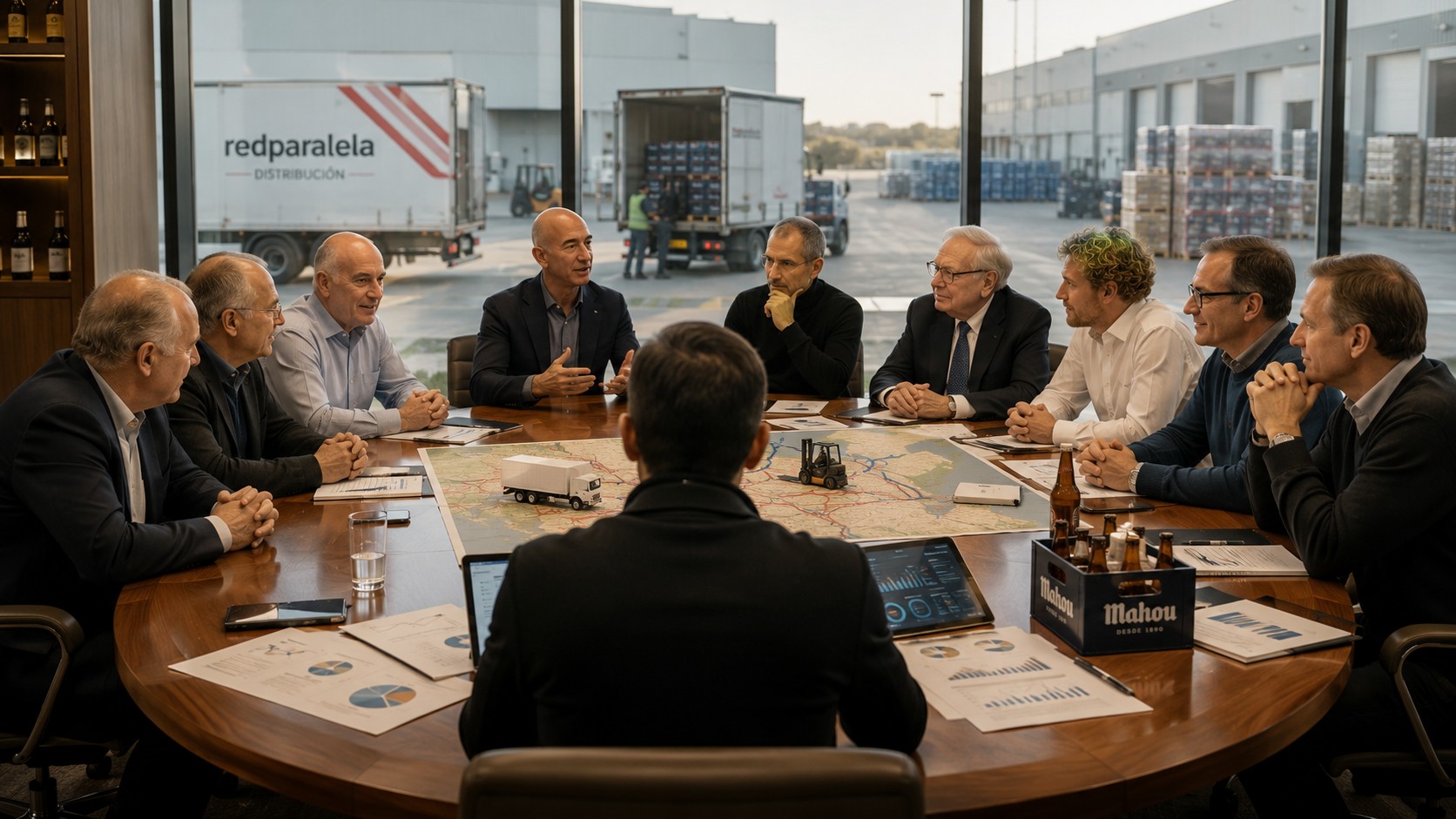
Ten Lessons from Great Business Leaders to Inspire You as a Distributor

diez consejos de grandes empresarios

Lessons from “the Greats” Adapted to Daily Decision-Making in Your Distribution Business.

Running a distribution company for the Horeca sector is not for the faint of heart. Between supply chain management, supplier negotiations, and the pressure of on-time delivery for the evening service, your daily decisions define the success of your business.

To help you sharpen your leadership instinct, we have compiled 10 essential lessons from great business leaders, adapted to the real challenges of your day-to-day operations.

1. Amancio Ortega (Inditex): Speed and flexibility beat prediction

The founder of Zara revolutionized the world with one obsession: don’t try to guess what the customer will want in six months; give them what they are asking for today. His model is built on ultra-fast logistics that react in real time.

Application in distributors: Instead of trapping yourself in rigid purchasing forecasts that later flood your warehouse with dead stock, design an agile system. Listen to the demand peaks of your hospitality clients week by week and adapt quickly. Flexibility is your greatest competitive advantage.

2. Juan Roig (Mercadona): The customer is “the boss” (but the supplier is your ally)

Roig bases his success on the Total Quality Model. For him, satisfying the customer (“the boss”) is the ultimate goal, but this can only be achieved by maintaining an honest, transparent, and long-term relationship with suppliers.

Application in distributors: Your customer wants the best service, but to deliver it, you need your suppliers not to fail you. Don’t squeeze your supplier over a penny if it damages trust. Build solid alliances so that when market stock runs short, your distribution business is the first to receive merchandise.

3. Ingvar Kamprad (IKEA): The real enemy is waste

The founder of IKEA was famous for his austerity and his obsession with cost optimization. His major revolution was understanding that empty space in transport costs money (hence, flat-packed furniture).

Application in distributors: Space and fuel are your most critical costs. Review how your trucks travel: are they half-empty? Do routes duplicate unnecessary kilometers? Do you have shrinkage due to poor warehouse placement? Eliminating “air” and waste saves your margins.

4. Jeff Bezos (Amazon): Categorize your decisions to gain speed

The founder of Amazon divides decisions into two types: “one-way door” decisions (irreversible and slow) and “two-way door” decisions (changeable and fast).

Application in distributors: Don’t spend weeks deciding whether to try a new routing software for your drivers. If it doesn’t work, you can turn back (two-way door). Save your energy and time for decisions that truly have no turning back, like buying a new warehouse or changing a strategic partner.

5. Richard Branson (Virgin): Take care of your team first

“If you take care of your employees, they will take care of your clients.” The British entrepreneur shattered the myth that the customer always comes first, putting the focus squarely on the human team.

Application in distributors: Your sales reps and delivery drivers are the face of your company to hotels and restaurants. If your logistics team works motivated, feels valued, and has the right tools, customer service will improve automatically and organically.

6. Steve Jobs (Apple): The power of saying “No”

Jobs used to say that true focus doesn’t mean saying yes to good ideas, but having the courage to say no to a hundred fantastic projects so you can concentrate on the one that truly matters.

Application in distributors: It’s tempting to expand your catalog with thousands of obscure SKUs just because an occasional customer asks for them. However, hyper-specialization and efficiency are usually more profitable. Learn to say “no” to low-turnover products that only serve to clutter your storage space.

7. Peter Drucker: What cannot be measured cannot be improved

The Austrian thinker, considered the father of modern management, based the survival of any company on the metric control of objectives.

Application in distributors: In the distribution sector, every penny counts. Measure the cost per kilometer, the error rate in order preparation (picking), and unloading times. A business owner’s intuition matters, but real data is what saves the numbers at the end of the month.

8. Bill Gates (Microsoft): Your most unhappy customers are your greatest source of learning

For Gates, listening to complaints is not a personal attack, but a free audit of what is failing within your internal machinery.

Application in distributors: When a trusted hospitality client complains about a stockout or a delay in the morning service, don’t get defensive. Analyze exactly where the breakdown occurred in the preparation or delivery chain and use it to bulletproof the process against your competitors.

9. Warren Buffett: Invest only in what you understand

One of the most successful investors in history never puts a single dollar into a business or technology whose internal mechanisms he cannot fully understand.

Application in distributors: Before diving into a cutting-edge digital tool or an expensive consultancy promising to automate your entire business with artificial intelligence, make sure you understand exactly how it fits into your day-to-day operations and what the actual, measurable benefit will be.

10. Simon Sinek: Start with “Why”

People don’t just buy what you sell; they buy the purpose behind it. Inspiring leaders are capable of conveying the real value of their work.

Application in distributors: Your company is not just “a truck transporting food or beverage boxes.” You are the invisible engine that allows local hospitality businesses to open every day with the peace of mind that everything is ready. Incorporate that pride throughout your entire organization.

Conclusion

The day-to-day operations of a distributor demand speed, but great leaders know when to pause for a second to think with a strategic perspective.

At Red Paralela, we closely know the management, logistics, and decision-making challenges you face, and we work to be the ally that smooths your path. If you want to know how we help companies like yours improve their market competitiveness, do not hesitate to contact us.
3 NLP Techniques to Defuse (and Save) an Angry Customer

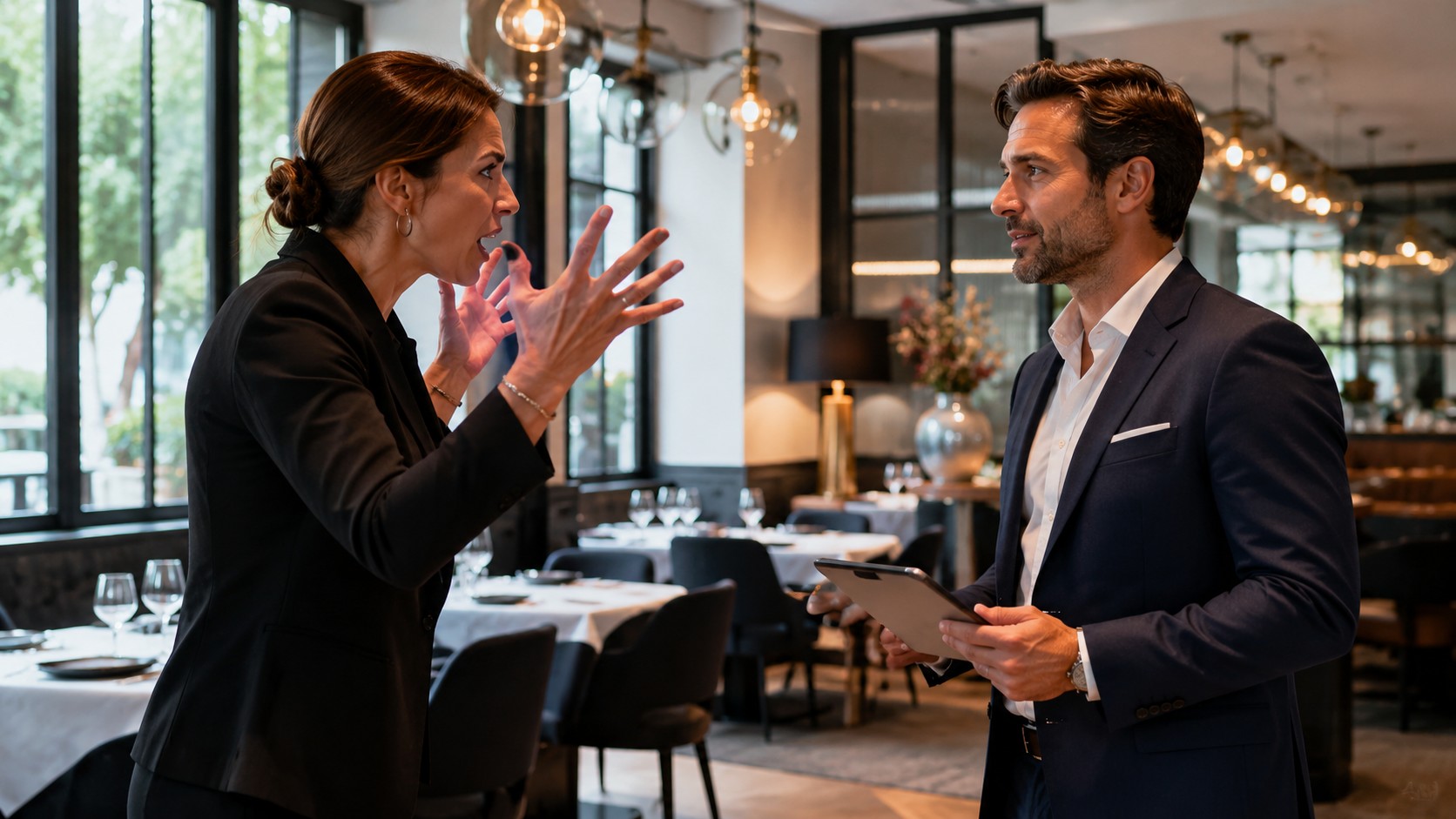
clienta de un restaurante enfadada con un comercial

An angry customer is not a problem; it is an opportunity disguised as a storm.

The most common mistake in customer service is trying to respond with logic to someone operating from pure emotion. That is where standard scripts fail and where nlp (neuro-linguistic programming) becomes your best ally.

Today, we will show you how to use the psychology of communication to calm the waters, win their trust, and resolve the situation naturally and effectively.

What is NLP and why do you need it urgently?

In short, neuro-linguistic programming (NLP) is the study of how we process information and how we communicate. It is like having the instruction manual for the human mind.

Why is it vital when facing a complaint?

When a customer gets angry, their brain enters “attack” mode. Logic disappears. If you respond with boilerplate phrases or evasive answers, you will only add fuel to the fire. NLP allows you to connect with their subconscious, lower their defenses, and guide them from anger toward a solution.

The 3 NLP tools that change the game

1. Rapport (pacing and leading)

Rapport is the technique of creating harmony. It is not about blindly agreeing with them, but about matching their rhythm so they feel you are “on the same team” and, from there, redirecting them.

  • When should you apply it? From second one of the contact. It is your entry shield.

  • How does it work in the main channel (WhatsApp)? If they text you short, fast, and direct messages, do not reply with a huge, formal paragraph. Match their speed (but without their hostility) and then lower the intensity.

Example 1 (On the phone):

  • Customer (speaking fast and loud): “I’ve been waiting for my order all morning and nobody is here yet! This is shameful!”

  • You (with high energy and pace, but calm): “I completely understand your frustration, it makes total sense since you’ve been waiting. Let me check right now what happened.” (From there, you gradually lower your pace and tone of voice so that they unconsciously mirror you).

Example 2 (Via WhatsApp – Fast conversation):

  • Customer (11:15): “Hi. Still no order. You said first thing in the morning.”

  • Customer (11:16): “Is anyone there?”

  • You (fast, direct, and proactive): “Hi, Juan. I understand the inconvenience, the delivery should be there by now. Give me a minute, I’ll call the driver right away and let you know.” (You avoid long texts, get straight to the point like him, but defuse the tension).

2. Representational systems (VAK)

We all filter reality through our senses, and we usually have a preferred channel: visual (they see the world), auditory (they hear it), or kinesthetic (they feel it). If you use their same “sensorial” words, communication flows effortlessly.

  • When should you apply it? While they are explaining the problem. Listen to (or read) the verbs they use.

Example 1 (Visual customer – Focuses on what they see or what isn’t clear):

  • Customer: “The thing is, I don’t see clearly when this is going to arrive, it looks like you are flying blind.”

  • You (natural and visual): “You’re right, let’s take a look together. Let me check the tracking screen and I will show you exactly where the truck is.”

Example 2 (Kinesthetic customer – Talks about feelings or “carrying” a burden):

  • Customer: “I feel stranded, this delay is really messing up my workday.”

  • You (natural and kinesthetic): “I completely understand, it’s a huge blow to your day’s organization. Let’s get straight to work right now to take that weight off your shoulders.”

3. Reframing

This consists of changing the framework of the situation. You don’t deny the problem, but you focus on it from another perspective to move the customer away from the complaint loop and toward the solution.

  • When should you apply it? During the resolution phase. Ideal for the two most typical issues: delivery drivers and calls on hold.

Example 1 (Complaint: “You don’t pick up the phone”):

  • Customer: “It’s impossible to talk to you! I’ve had to call four times just to get through.”

  • You (reframing): “You are absolutely right and I apologize. Our lines are completely packed right now precisely because we are prioritizing getting all urgent orders out for delivery on time. But I am with you now, tell me, how can I help you?” (You transform “they are ignoring me” into “they are working at 100% capacity to make sure orders go out”).

Example 2 (Complaint: The delivery driver):

  • Customer: “The driver was in a massive rush and just threw the boxes down carelessly.”

  • You (reframing): “I am very sorry about that treatment. Agencies sometimes work with hyper-tight schedules to ensure everything gets delivered today, but that doesn’t justify poor manners. I will file an immediate internal note so they handle your deliveries with more care.” (You transform “poor manners” into “an effort to deliver on time”, without invalidating their complaint).

How to internalize these techniques so they come naturally?

Knowing the theory is great, but when a customer puts pressure on you, adrenaline can make you freeze. To automate them, try this:

  1. Create your “reframing dictionary”: Gather the 3 or 4 most common complaints (delivery delays, stock issues, etc.) and write down the “reframed” response with your team. This way, you’ll have it handy.

  2. The WhatsApp channel game: When reading customer messages, try to guess in two seconds if they are more visual or kinesthetic, and force yourself to reply using a word from their channel.

  3. 5-minute roleplay: Every now and then, simulate a difficult call between teammates. It will sound forced at first, but within ten days, it will come naturally.

The result? Less stress for the support team, customers who feel truly heard, and a drastic increase in loyalty.

Automating order management for HORECA distributors

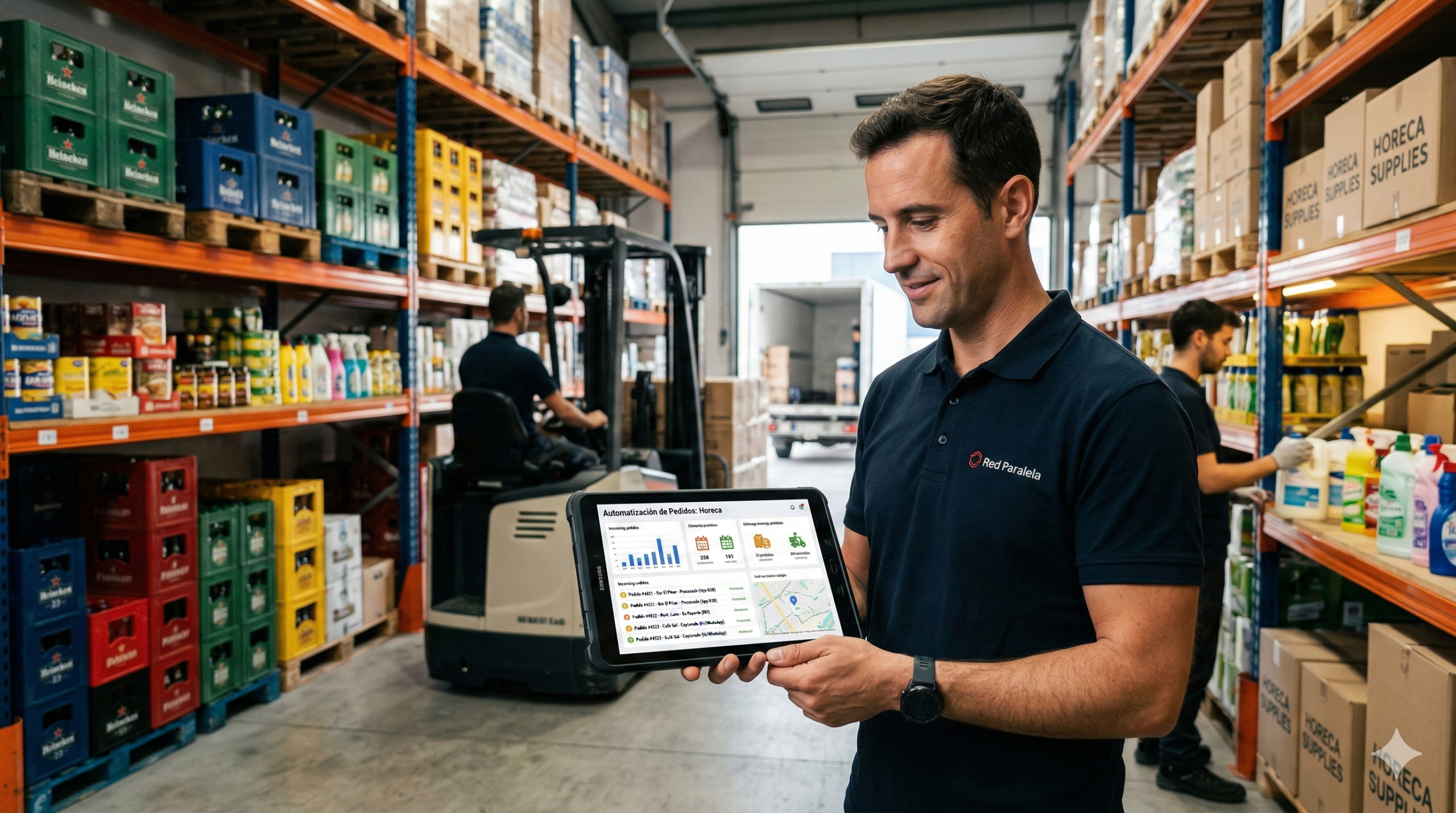
automatización de pedidos del distribuidor horeca

Automate or Die: The Future of Order Reception in the Horeca Channel

The Horeca distribution sector is living a paradox: while gastronomy innovates at a breakneck pace, many distributors are still managing their orders as they did twenty years ago.

If your operations still depend on a sales rep listening to WhatsApp voice notes at midnight or an administrator transcribing paper notes into the ERP, you have a leak problem.

  • Leaks of time,
  • of money and,
  • most seriously, of customers.

In a market with tight margins, efficiency is no longer an extra; it is your life insurance.

The Era of Zero Error: Technologies that Dictate Who Stays Behind

Automation is not about “buying software,” it’s about eliminating the bottlenecks that kill your profitability. These are the tools that are separating the leaders from those about to disappear:

1. B2B Portals: Your Store Open While You Sleep

Waiting for a sales rep to visit the premises is a thing of the past. A dedicated B2B e-commerce portal allows hospitality professionals to place their orders at their moment of greatest need (when closing the books or taking inventory).

  • The impact: You reduce the cost per order to almost zero and prevent the customer from calling the competition if your sales rep doesn’t arrive on time.

2. AI and OCR: Digitalizing Customer Chaos

You cannot force all your customers to be tech-savvy, but you can be. Artificial Intelligence with OCR solutions allow you to receive a photo of a crumpled delivery note or a voice message and automatically convert them into a structured order in your system.

  • The advantage: You maintain customer convenience while eliminating human error in data entry.

3. EDI (Electronic Data Interchange): The Language of the Giants

If you aspire to serve large restaurant chains or organized groups, EDI is your “identity document.” It remains the gold standard for systems to talk to each other without human intervention, ensuring that the order, delivery note, and invoice match to the penny.

4. Self-Sales and Pre-Sales Apps (SFA)

Giving your sales reps total mobility. The order is closed at the customer’s table and printed in the warehouse in real time. If your sales rep is still taking notes in a notebook to record them when they get back to the office, you are losing critical logistics hours.

Why Resistance to Change is Your Company’s Biggest Cost

Many distributors fear that technology will “cool down” the relationship with the customer. The reality is quite the opposite:

      • Fewer incidents = Happier customers: A misdelivered order due to a transcription error damages the relationship more than any machine ever could.
      • Sales reps, not data entry clerks: Your sales team should be advising, introducing new references, and improving margins, not typing data into a screen.
      • Precision logistics: Receiving automated orders allows for delivery route optimization even before the warehouse opens.

Conclusion: The Clock is Ticking

Technology has stopped being an economic barrier and has become a mental one. Distributors who remain anchored in “the way we’ve always done it” will see their operating costs devour their profits, while digitalized competitors gain market share with leaner and faster structures.

The “order-taking” salesperson is dead

el comercial toma-pedidos ha muerto

The “order-taker” salesperson is dead: here’s how your marketing and sales must adapt to survive

Let’s be clear: the “order-taker” salesperson is dead. And many companies still haven’t realized it.

The “coffee, drink, and cigar” distribution model is over.

For decades, sales in HORECA ran on inertia: the route salesperson would drop by, say hello, write down what was missing on the shelf, and leave. It worked because margins were wide and costs were low.

Today, that model is financial suicide.

As we’ve analyzed at Red Paralela, today’s cost structure (fuel, staff, vehicles) no longer allows 15 different companies to visit the same bar just to ask, “What can I get you?”. If your sales strategy still depends on a physical visit to collect a routine replenishment order, you’re losing money every time you start the van.

Here are the 4 keys to adapting your sales system before the market forces you off the road.

1. Technology for ordering, people for value

The salesperson isn’t going to disappear, but their role must change radically. Technology must remove bureaucracy: replenishment orders should be automatic or digital (web, app, automated WhatsApp).

If the owner can order on their own, why visit them?

• Before: to fill out an order sheet.
• Now: to advise, introduce a profitable new product, or solve a problem.

The distributor that survives won’t be the one who visits more, but the one who visits better. Less frequency, more value.

2. Sniper marketing, not shotgun marketing

Most distributors have a database, but they use it as a paperweight. They send the same wine offer to a cocktail bar and to a lunch-menu restaurant. That’s not marketing, that’s noise. And noise doesn’t sell—it only eats your margin.

To sell today, you need to segment:

• Who has a terrace? (Summer offer)
• Who does late-afternoon drinking? (Spirits offer)
• Who has stopped buying a certain product family? (Recovery campaign)

A clean, segmented database is worth more than ten sales reps driving around with no direction.

3. Real omnichannel: the route salesperson isn’t alone

The route salesperson is still the anchor of trust, but they can’t be the only channel. Today’s HORECA customer wants immediacy. Your sales system must combine:

In-person visits: to close agreements and build loyalty.
WhatsApp / Email: for flash offers and reminders.
Telesales / Web: for boring replenishment that adds no in-person value.

If Amazon entered HORECA aggressively tomorrow (and it’s already watching closely), it would win on convenience. Your only defense is to offer that same digital convenience—plus the face-to-face service of your team.

4. Goodbye intuition, hello data

“I think this route is profitable.” That sentence has shut down more companies than any crisis.

You can’t manage sales by gut feeling. You need to measure:

• Net margin per customer (not gross). Some customers buy a lot but make you lose money with their logistics demands.
• Cost per stop.
• Drop size (average order size).

The problem isn’t selling too little. The problem is selling badly.

At Red Paralela, we’re clear: what isn’t measured with data is paid for with margin.

The uncomfortable conclusion

The market is going to reorder itself. In five years, there won’t be room for anyone who only moves boxes from one place to another. The survivors will be those who deliver service, agility, and profitability.

The market won’t wait for you to adapt. The road is narrowing, and not everyone will fit.

Your job is no longer just to sell soft drinks or beer. Your job is to help your customer make money while protecting your own margin.

If you need to improve your competitiveness to adapt to this new scenario—whether by buying better or freeing up excess stock that helps you hit rebates—at Red Paralela we know how to play this game.

The future of distribution (5-year outlook)

El futuro de la distribución a 5 años

A hypothesis on the future of distribution (5-year outlook)

Here it is. Let’s see what you think:

Distribution is not going to disappear.
But it will stop working the way it has until now.

For decades, the model has been more or less the same: many suppliers, many routes, many visits, and enormous operational inertia. It worked because margins allowed it, and because the cost of not changing was low.

That is over.

Over the next five years, distribution will be forced to reconfigure itself under four very specific pressures: costs, logistics, and technology.

And that leads us to an uncomfortable but inevitable question:

Does it make sense for 15 different companies to supply and visit the same establishment?

1. The cost problem (that can no longer be absorbed)

Fuel, staff, vehicles, warehouses, insurance, financing, bureaucracy, and crushing taxes…
The cost structure of a distributor is becoming heavier and less flexible every year.

The current model multiplies expenses:

      • Overlapping routes.
      • Small and frequent deliveries.
      • Sales reps visiting the same venue week after week for very similar orders.

For years, this was offset by volume.
Today, that balance no longer works.

Five years from now, margins will not support 10, 12, or 15 different suppliers visiting the same customer.

2. Logistics: too much complexity for too little value

From a logistics perspective, the system is inefficient by design.

A single restaurant receives:

      • One truck for beer.
      • Another for wine and spirits.
      • Another for fruit and vegetables.
      • Another for frozen products.
      • And several more, depending on agreements and brands.

Each with its own schedule, incidents, and hidden cost for the customer.

The question is not whether this is convenient for the distributor.
The real question is whether it delivers real value to the hospitality operator.

Increasingly, the answer is no. That is why we will see:

      • Delivery consolidation.
      • Shared logistics platforms.
      • Operators that do not sell brands, but service and capillarity.
      • Fewer trucks.
      • Better loaded.
      • Better coordinated.

3. Technology: the sales rep stops being an order taker

Technology will eliminate one of the main justifications of the current model: constant visits.

Automatic orders based on consumption history, calendar-based forecasting, smart integrations, well-designed digital catalogues.
All of this drastically reduces the need for physical presence.

Sales reps will not disappear, but their role will change:

      • Less order taking.
      • More advisory work.
      • More judgment.
      • Less frequency, more value.

If orders can be placed automatically, why so many visits?

In the end, attending sales reps is also a cost for the hospitality operator. There is no better proof than showing that visits are no longer about taking orders.

4. The hypothesis

My hypothesis is simple:

In five years, the market will not be able to sustain 15 different companies supplying the same establishment on a recurring basis.

Not for theoretical efficiency reasons.
For pure economic survival.

The system will reorganize around:

      • Fewer players per customer.
      • More logistical collaboration.
      • Real specialization.
      • And a clear separation between those who provide product and those who provide service.

5. This is not concentration by choice, it is adaptation

This is not about big versus small.
It is about viable models versus exhausted ones.

Some will disappear.
Others will integrate.
Others will radically change their role.

The status quo is not an option.

6. Who will make it — and who won’t

In this scenario, it will not be “the best” or “the most innovative” who survive.
It will be those who fit into a viable model.

Put clearly:

The distributor who needs to visit in order to sell will not make it.
The one who is called when needed will.

The one who competes on catalogue will not make it.
The one who solves a specific category better than anyone else will.

The one who duplicates existing routes will not make it.
The one who reduces deliveries, incidents, and operational friction will.

The one who calls digitalizing orders “innovation” will not make it.
The one who uses technology to eliminate useless work — their own and their customer’s — will.

The one who shifts complexity onto the hospitality operator will not make it.
The one who removes it will.

Everything else — frequency, proximity, “personal treatment” — will stop being an advantage when costs no longer allow it.

7. The conclusion (no detours)

Let’s go back to the initial question.

Does it make sense for 15 different companies to supply and visit the same establishment?

The answer is not ideological.
It is economic.

In five years, this model will no longer be dominant because it will not be profitable.
Not for the distributor.
Not for the customer.
Not for the system.

Distribution will not transform because of strategic vision,
but out of pure necessity.

And when that happens, there will be no time to adapt.
Only time to see whether you were already on the right side.

The intergenerational shift in HoReCa distribution: when growth is no longer about accumulation

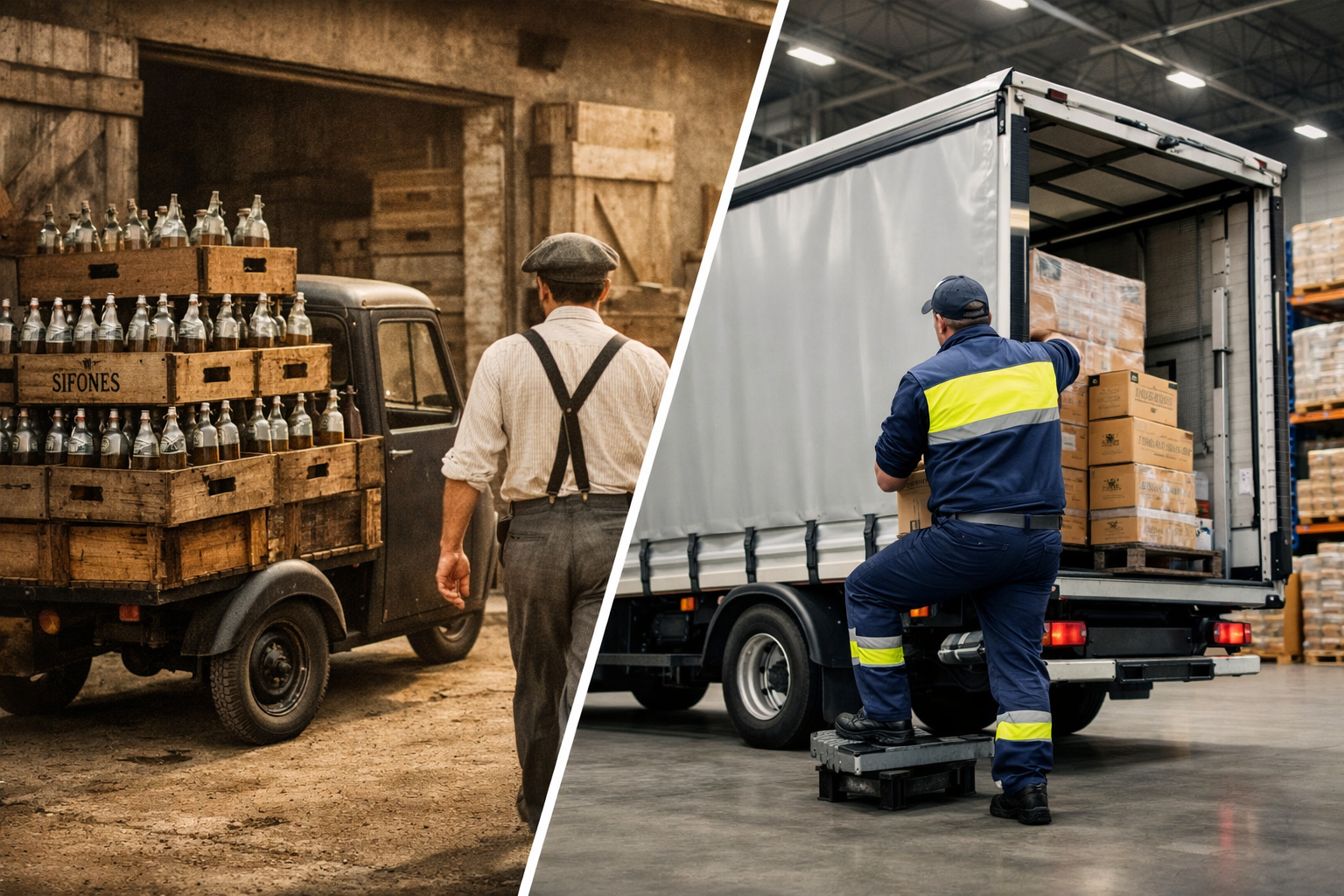
De la distribución artesanal al modelo logístico actual: una evolución que invita a reflexionar.

Where We Come From — and Why the Model Is Starting to Weigh Us Down.

Many beverage and soft drink distribution companies did not start out as distributors. They began as small local producers of soda water, siphon bottles, or soft drinks. Family businesses, closely tied to their territory, that grew by solving a simple problem: supplying drinks to the bars in their area.

Carbòniques Montaner is a clear example of that journey. It went from manufacturing siphon bottles in the 1930s to distributing water, then beer, and later soft drinks. The next step was a logical one: together with other distributors in the region, it created a buying group to better manage that growth, add more product lines, and gain autonomy and independence from manufacturers who put pressure on our company, fully aware of the leverage they held over it. Over time, it continued expanding the catalogue until it was distributing around 1,000 SKUs.

That model worked. And it worked well for many years. Until, gradually, we became Red Paralela, leaving behind the capillary, local delivery model that had accompanied us for so many decades.

Technology followed that evolution too: from the fax machine to the first IT systems, and from there to what Red Paralela is today—an extranet designed to organise and manage distributors’ parallel operations.

Three generations along this path.

Today, many distributors still build their business around one or two official brands that are the true backbone of their revenue. In many cases, more than 50% of the business depends on them. Around that core, there is a very broad range of brands and product families that “tag along”, but are not strategic.

And that “tag-along” range comes at a cost:

      • A growing labour cost: more sick leave and lower productivity than ever.
      • An ever-increasing financial cost.
        A logistics cost that is hard to justify.
      • And a management cost that never stops rising.
      • While the core brand sustains the business, everything else starts to weigh it down. More SKUs, more stock, more breakages, more errors, and more resources spent on products that do not create real value

On top of that, the current context is especially challenging. Labour costs rising out of control. A suffocating regulatory environment. New laws, procedures, and obligations piling up—and instead of helping, they make day-to-day operations harder and reduce the ability to be efficient.

      • More rules every day.
      • Less margin every day.

And that is where uncomfortable questions begin to appear:

      • Does it make sense to maintain structures designed for massive catalogues when the real business rests on three or four key manufacturers?
      • Wouldn’t it be more sensible to simplify, focus efforts, and be extremely efficient by representing only those manufacturers that truly support the distributor (now and in the future) and that the distributor can genuinely defend?
      • Could it be time to stop and rethink the model before the structural weight makes it unviable?

Rethinking the model is not always comfortable, but it is almost always necessary.

How to apply a price increase when your competitors don’t

How to apply a price increase when your competitors don’t

Cómo subir precios cuando tu competencia no lo hace

Your cost has already gone up and another distributor is still selling cheaper: 5 real tactics to win.

In horeca sales this happens often: the manufacturer has already increased prices, you are now buying at the new cost, but your competitors are still clearing old stock and can sell cheaper. The customer is very clear: “When you match the price, I’ll buy from you.”

    • If you try to match it, you destroy your margin.
    • If you stand still, you lose sales — or even customers, if the product is critical.

The solution is easy to understand and hard to execute: offer something the bar or restaurant owner values directly, here and now, even if the price per case is slightly higher.

These tactics work because they change the comparison: you stop competing only on “euros per case” and start competing on total value.

1. Deferred rebate

Instead of lowering the price on every invoice, you return part of the value later, in exchange for a specific customer behavior.

What usually works:

    • monthly or quarterly rebate if an agreed volume is reached in that product family
    • rebate if the increased-price reference is combined with other products the customer does not usually buy from you, and where you have no relevant price disadvantage versus competitors
    • credit balance for the next order (very effective to secure repeat business)

Why it works
The operator does not reject paying more if they feel that, at the end of the period, they come out ahead. Mentally, it is not perceived as an “expensive price” but as a “price that comes back.” You protect the updated price, avoid discount wars, and reward commitment. You also avoid a very common effect: losing several references because of just one.

2. Activations the operator can monetize

When you cannot win on price, win on sales. But it must be concrete — not vague promises of “support.”

Actions that are understood and actually used:

    • simple point-of-sale material linked to purchase (chalkboards, posters, bar displays)
    • a closed promotion proposal for the venue. For example, when beer is the reference that has increased in price, you can activate a weekend pack including beer, olives, and chips at a special weekend price, plus table material that encourages customers to order the promotion — so the operator not only sells the now more expensive beer, but also increases the average ticket through the accompaniment
    • short, practical staff training to drive one specific reference (30–45 minutes)

Why it works
Operators do not buy “service,” they buy results. If they see a product rotates better with you because you help them attract customers, they stop comparing only price. Price stops being a cost and becomes an investment. You are helping them sell more, not just supplying product.

3. Cross-selling with references your competitor cannot match

If you are agile, respond with a cross-offer using products your competitor does not have in their portfolio. The key is that they must be easy to sell and have enough margin to absorb part of the price gap.

How to apply it simply:

    • “If you take X cases of this reference, I improve conditions on these others you already consume”
    • “If we do this mixed order, the advantage is visible in the total”
    • “I’ll prepare a standard weekly order based on what rotates most in your venue”

Why it usually works
The customer compares the full order, not just the problematic reference. If the total makes sense, the focus shifts. Even if you earn less on one line, you do not lose the sale or the customer. You keep the relationship, rotation, and control of the full order.

4. Clear financing or flexible payment terms

Here we are talking about something the customer understands in ten seconds: cash flow. In horeca, many decisions are made based on liquidity, not theoretical price.

Useful examples:

    • extending payment terms for selected customers
    • splitting a large order into two due dates
    • allowing smaller replenishments for a few weeks to avoid tying up cash

Why it works
Operators value paying better far more than paying less. Less cash tension means less friction in buying. This competes directly with “it’s cheaper elsewhere” because it reduces the immediate financial strain, which is what hurts most day to day.

5. The parallel market as a price option

When your supplier only sells at the new price, but there is still old stock available in the market, the parallel market can be a temporary solution to avoid losing competitiveness.

Why it works
You gain time while the market aligns, prevent the customer from getting used to buying from another distributor, and maintain the commercial relationship. That said, it must be used carefully: as a temporary solution, ensuring traceability, and as a transition tool — not as a permanent model that could damage your relationship with the official supplier.

A useful note: when this can be anticipated, you can win earlier

This scenario is easier to manage when you see it coming. If you know a reference is about to increase and there will be weeks of misalignment, you can prepare agreements or purchasing plans before the customer compares prices when it is already too late.

In summary

When another distributor is still selling at old prices, you will not win by copying their game. You win by changing the comparison:

    • deferred rebates
    • activations that help sell in the venue
    • mixed orders with real rotation
    • financing

It is not about selling more expensively.
It is about selling with an advantage that today’s cheaper option is not offering.

The natural next step would be to turn this into a direct sales script for reps, sentence by sentence, to use at the bar without detours. But I’ll leave that in your hands.

Overstock

Como solucionar el sobre stock

How to clear overstock without devaluing the brand in your own area

Many distributors and sales reps face the same problem: they need to move product, but they can’t afford visible discounts that might damage the brand or create tension with nearby points of sale.

The concern is valid: a badly placed discount can hurt product perception, trigger unwanted comparisons, and—at worst—undermine relationships within the distribution network.

The key is to find a discreet, controlled and profitable channel.

Move overstock without public discounts

With Red Paralela, you can release product without exposing reduced prices in your direct market. This helps you recover liquidity, free up space and protect the brand image in your own area.

This approach is especially useful when you face:

  • Accumulation of slow-moving SKUs
  • Packaging or seasonal changes
  • A need to generate cash quickly without impacting your territory

In summary

Clearing overstock doesn’t have to mean discounting or damaging the brand. You just need a parallel channel—discreet, safe and profitable.

How to safeguard your margin before the year begins

Un comercial de una distribuidora entrando a un restaurante para negociar las plantillas con el cliente.

🔒How to safeguard your margin before the year begins

Many distributors start January negotiating under pressure. And that almost always means losing margin, accepting poorly considered conditions, or beginning 2026 with less control than you’d like.
Protecting your margin starts with a simple action: closing your negotiation templates before the year ends.

Why it pays to do it now

When you work with closed templates:

  • You enter January with clear, agreed-upon conditions.

  • You avoid improvised negotiations that end in unnecessary concessions.

  • You gain margin visibility for the first quarter.

  • You strengthen your position with clients who tend to apply strong pressure at the start of the year.

  • You reduce the risk of accepting conditions that will hurt you throughout 2026.

In short, it’s about avoiding improvisation in the most delicate month of the year.
As we often say at Red Paralela in our sessions with distributors:
“Starting January with everything agreed is the difference between defending margin or giving it away.”

Practical steps for a distributor

  1. List your key clients (the ones that really move margin).

  2. Define what you want to achieve: final margin, rebates, services, exclusivities.

  3. Prepare clear, closed templates that are easy to validate.

  4. Schedule meetings before Christmas. The sooner, the better.

This preparation saves you trouble and protects your margins for months.

A friendly piece of advice from Red Paralela

Red Paralela doesn’t negotiate on your behalf or participate in your agreements, but we work closely with many distributors and we see the same pattern every year:
those who plan ahead negotiate better.

That’s why we insist on this message: closing templates before January is a small action with a huge impact on your 2026 margin.

If you want more practical advice to improve your distribution,
stay connected with Red Paralela.

Hit your rebates without stressing your sales network

The end of the year is approaching and you’re still short of the volume you need to reach your annual rebate. Your HORECA clients are already stocked, your sales network is stable, and pushing discounts now would only hurt you: lost margin, damaged image, and a market that takes months to fix afterward.

The truth is: you can close the year well without breaking anything. And you have two clean paths to do it.

1. Add value without touching your prices
You don’t need to force product out the door. Build smart proposals: assortments aligned with real consumption, rotation-friendly packs, or punctual incentives that don’t distort your pricing. You maintain your positioning and protect your sales network.

2. And when real volume doesn’t get you there… Red Paralela steps in
This is how many distributors close their rebate quietly, cleanly, and with zero consequences.

  • You need extra volume to reach your rebate.
  • Another distributor has already achieved theirs and doesn’t want to increase their figure any further (because the supplier will use that figure to set next year’s rebate).
  • Red Paralela acts as the intermediary:
    • they buy the stock from the distributor who hasn’t reached the rebate yet,
    • they resell it to the distributor who already has,
    • and they ensure neither party is exposed or even knows who is on the other side.

Nobody knows who sells. Nobody knows who buys.
Not the supplier, not the sales team, not the competition.
No explanations. No uncomfortable calls. No one pulling your ears.

You hit your rebate.
The other distributor earns extra margin without risk.
And your market stays untouched.

Fast, clean, and invisible.