

- Shipped
- Reading
- 7 min
What will HORECA distribution look like in 20 years?
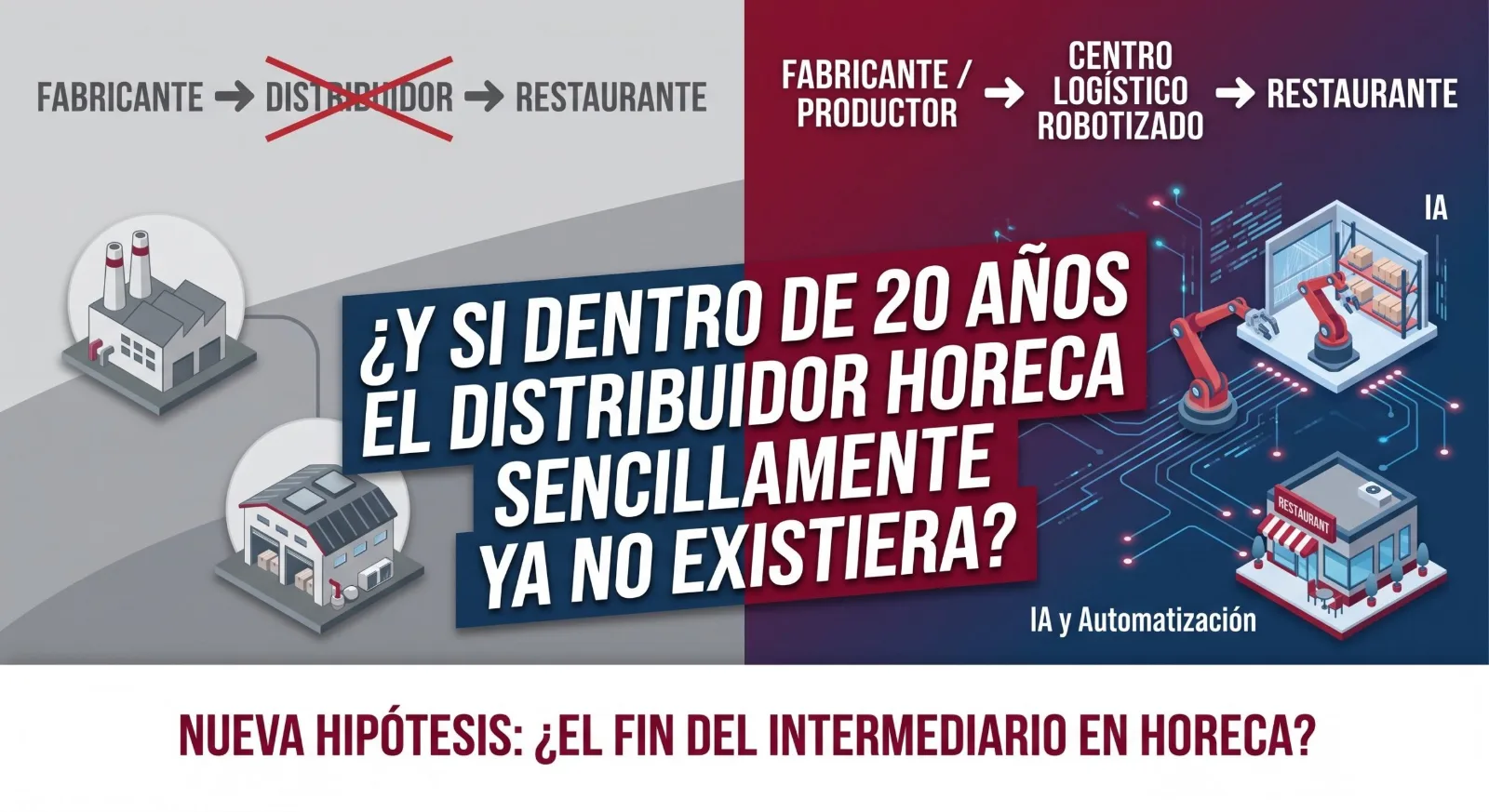
A hypothesis: perhaps the distributor will no longer be needed.
We have been directly involved in distribution for almost 40 years.
We have seen products, brands, buying habits, management systems and the way we deal with hospitality businesses all change.
Today Red Paralela is no longer a conventional HORECA distributor. But precisely for that reason we can look at the sector from a different position and ask ourselves a question:
What will HORECA distribution look like in 20 years?
What follows is not a prediction.
It is only a hypothesis.
But it is a hypothesis that, given how fast artificial intelligence, automation and the ability to connect information in real time are advancing, we believe is worth imagining.
And if we take that evolution to its logical conclusion, a fairly radical scenario emerges:
What if, in 20 years' time, the distributor as we know it today had practically disappeared?
Nobody would place the order any more
Today a restaurant needs to place orders.
Someone checks the storeroom, works out what is needed, talks to a sales rep, logs on to a platform, sends a message or makes a call.
Then the distributor picks the order, plans a route and delivers it.
It is a process we have built up over decades.
But let's imagine another scenario.
The restaurant's management system is connected directly to its day-to-day activity.
It knows what it sells.
It knows what is left.
It knows the bookings.
It detects consumption patterns.
It can forecast what it will need over the coming days.
And, thanks to artificial intelligence, it can anticipate needs that today still require a person to step in.
When the system detects that it needs a certain product, it doesn't generate an alert for someone to place an order. It places the order itself.
The owner sets the rules. The system does the rest.
This doesn't mean the restaurant loses control. Quite the opposite.
The owner could decide exactly how they want their supply to work:
- ✓ For this product, I always want this brand.
- ✓ For this other one, I'll accept any equivalent product.
- ✓ In this case I want to work with a specific manufacturer.
- ✓ Here I want the best price.
- ✓ For this product I don't want substitutions.
- ✓ And for the non-critical ones, you can automatically choose the best available option.
The owner sets the rules.
The system takes care of carrying them out.
And this is where everything changes. Because that system would no longer need to be connected to a distributor. It could be connected directly to manufacturers and producers.
The manufacturer would no longer need to go through the distributor
Imagine a manufacturer knows, thanks to these platforms, that over the coming days certain products will see specific demand in a particular area.
It could ship goods directly to large logistics hubs.
Not necessarily because someone has placed a specific order.
But because the information available makes it possible to anticipate demand.
Those hubs could receive goods from thousands of different manufacturers and producers.
Store them. Sort them. Keep them chilled when necessary. Prepare them. And group them to make deliveries as efficiently as possible.
The goods would be much closer to demand even before the outlet had formally made the purchase. And when the restaurant's system needed that product, it could locate it automatically and trigger the whole process.
Manufacturer / producer ➔ Logistics hub ➔ Restaurant(No distributor needed in between)
The logistics hub becomes a key piece
This would probably be impossible without an enormous transformation in logistics.
We could imagine large, highly automated platforms capable of handling goods from thousands of suppliers and manufacturers.
Almost fully robotised warehouses.
Systems able to know in real time what is in stock, who it belongs to, where it is and what demand exists for each product.
And, above all, able to group products from many different manufacturers into a single delivery.
That would be one of the great advantages of the model.
Today a distributor needs to buy, store and manage a huge number of lines in order to offer its customers a wide enough range.
In this scenario, that function disappears.
The restaurant can access a huge catalogue without any single company having to own all that stock.
And invoicing could also drop out of the manual process
If the system knows what has been ordered, what has been delivered, at what price and under what conditions, invoicing can be built into the same process.
The product leaves the logistics hub.
It reaches the restaurant.
The system records the delivery.
The invoice is generated.
It is posted to the accounts.
Payment is made.
All connected.
No calls. No emails. No manual data entry. No need for several companies to exchange information over and over again.
The operation could be automated from start to finish.
So what happens to the distributor?
This is the most important part of our hypothesis.
If this system really worked well, the traditional distributor could cease to be necessary for a large share of the products it sells today.
Not because anyone decided to eliminate it.
Simply because its role as an intermediary would no longer add enough value.
If a manufacturer can reach the restaurant owner directly.
If the product can be stored in a large logistics hub.
If that hub can prepare and group goods from thousands of suppliers.
If artificial intelligence can anticipate demand.
If the system can generate orders automatically.
And if invoicing is connected too…
What need would there be for a distributor to buy, store and resell that product?
This is probably the most uncomfortable question in the whole article.
But perhaps not all distributors will disappear
Even in this scenario, it is hard to imagine that absolutely every product could work the same way.
Specialist distributors could survive.
Companies working with very specific brands.
Limited-production products.
Products that need special storage or handling.
Products requiring a high level of technical knowledge.
Small brands without the capacity to get into the big networks.
Unique products whose sales depend heavily on advice, recommendation or personal relationships.
In those cases, the distributor could still make sense.
But it would be a very different distributor.
It wouldn't compete on having the biggest warehouse or the most lorries.
It would compete on its knowledge, its brands, its specialisation and its ability to provide something the big platform cannot automate.
What if this really were the future?
We repeat: this is only a hypothesis.
We don't know if it will happen. We don't know when. We don't know what barriers will arise. We don't even know whether technology will ever be integrated so completely.
But many of the pieces of this scenario already exist separately:
- Artificial intelligence can analyse and anticipate demand.
- Systems can communicate with each other.
- Logistics is moving towards ever greater automation.
- Warehouses are becoming smarter and smarter.
- Manufacturers have more and more information about consumption.
- And outlets generate huge amounts of data about what they sell and what they need.
The interesting question is what will happen when all those pieces are connected.
Perhaps the big change isn't technological
Perhaps it is a business change.
For decades we have built distribution around one central figure: the distributor.
The distributor buys. Stores. Finances. Holds stock. Sells. Picks. Transports. Invoices.
But if technology makes it possible to connect demand directly with supply and to use large shared logistics infrastructures, some of those functions might no longer need an intermediary company.
And then the model could shift from:
Manufacturer ➔ Distributor ➔ Restaurant
to something much more like:
Manufacturer / producer ➔ Logistics hub ➔ Restaurant
With a huge technology layer connecting it all.
And perhaps the real protagonist would no longer be the distributor.
It would be information about demand.
A hypothesis worth starting to think about today
We don't know whether in 20 years we will see exactly this scenario. Probably not.
The future always ends up being different from how we imagine it.
But we believe it is worth raising because it forces us to ask a question that could matter long before 2046:
If one day technology manages to connect manufacturers and producers directly with HORECA outlets, anticipate their needs, manage stock, organise logistics and automate invoicing… what role will be left for the distributor?
Perhaps it will disappear.
Perhaps it will transform.
Perhaps it will survive only where the product, the brand or the know-how still need a person in the middle.
We don't know.
But if this hypothesis makes any sense, the future of HORECA distribution won't be about doing better what we do today.
It will be about asking ourselves which part of what we do today will still be needed tomorrow.
And perhaps that is a question we shouldn't wait twenty years to answer.