PPE in Beverage Distribution

epis almacén de bebidas

PPE in Beverage Distribution: Between the “Absurd”, the Mandatory, and Shielding Your Company Legally

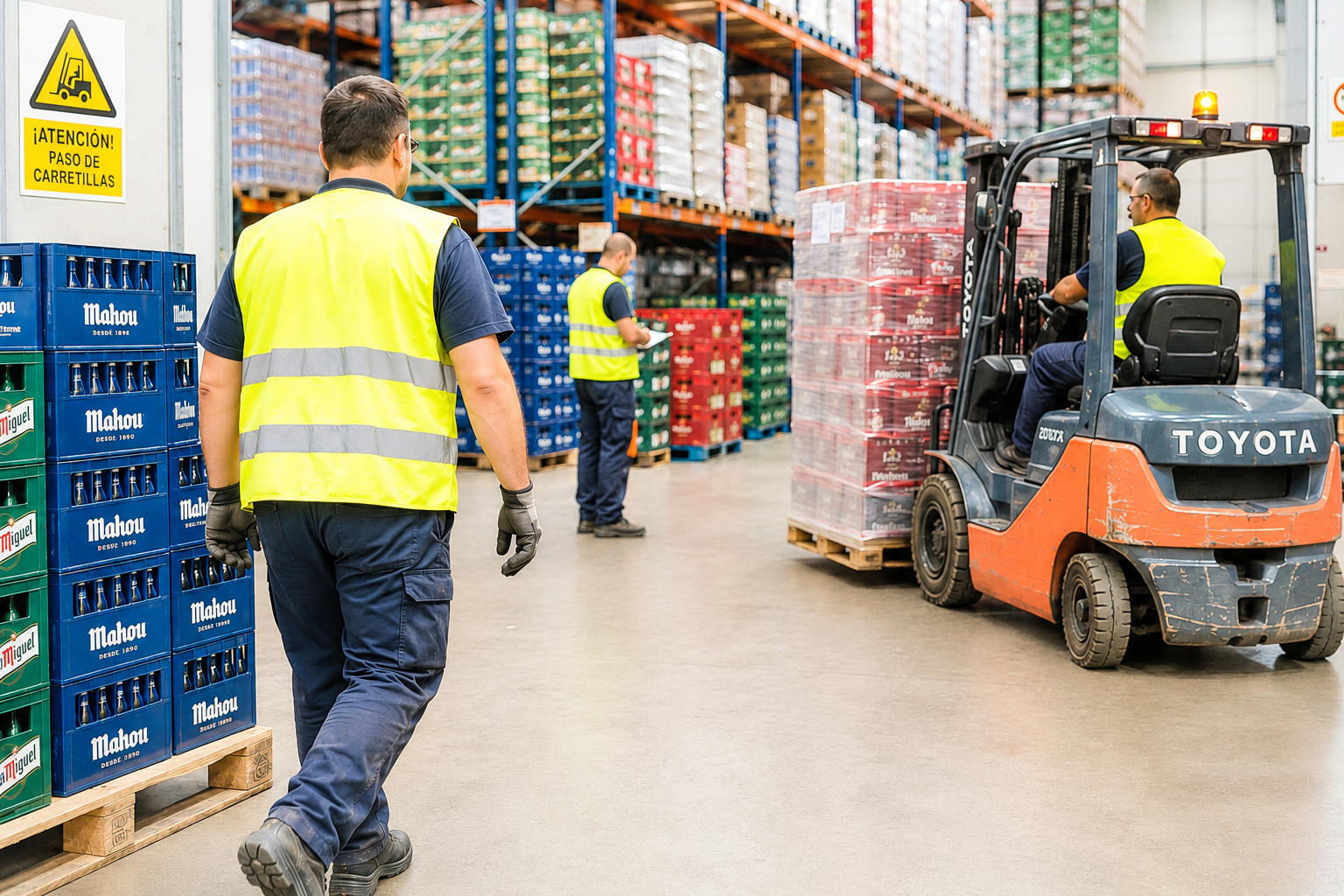
The day-to-day operations in a beverage distribution warehouse are a high-intensity ecosystem: forklifts speeding through aisles, beer pallets weighing hundreds of kilos moving high above, thousands of clinking glass bottles, and, occasionally, the inevitable wet floor from a breakage.

In this environment, Personal Protective Equipment (PPE) is the thin line separating a productive day from a tragedy. However, any warehouse manager has heard something like: “Boss, these boots are just too heavy for summer” or “The reflective vest makes me absurdly hot, besides, we all know each other here.”

Today we analyze that dangerous boundary between what workers consider “uncomfortable” and what the law mandates as strictly mandatory, and how you must act to prevent an employee’s recklessness from ruining your company legally.

1. Is it Really Necessary? Between Comfort and Real Risk

What might seem like an exaggerated rule to a worker is pure survival logic for physics and the Occupational Risk Prevention Act (LPRL). In the beverage distribution sector, the risks are highly specific and severe:

    • Safety Footwear: A 50 kg beer keg slipping during loading or unloading can crush an unprotected foot.

    • High-Visibility Vest: In a warehouse with constant machinery movement, failing to be seen by a forklift operator in a blind spot poses a critical risk of being run over.

    • Protective Gloves and Safety Glasses: A glass bottle bursting under pressure or handling broken boxes causes hundreds of severe cuts and serious eye injuries every year.

The use of PPE is not a goodwill suggestion; it is a legal mandate that leaves no room for negotiation.

2. The Rebellious Worker and the Collective Agreement Labyrinth

When a worker repeatedly refuses to use PPE, looking the other way is never an option. As an employer, you have a duty to protect them, but also the power to sanction them. Now, how is this punished legally?

In Spain, there is no single “Beverage Collective Agreement.” Depending on your province and how your business is classified, your warehouse might be regulated by the Wholesale Food Trade, Logistics, or even Hospitality collective bargaining agreements.

Despite this geographic mix, all collective agreements align on the fundamentals. The regulations are categorical: a repeated refusal to use PPE or creating a serious risk to oneself or coworkers is almost always classified as Very Serious Misconduct.

If you detect this attitude, you must apply a relentless and gradual disciplinary protocol:

    1. Verbal Warning: First notice and educational awareness.

    2. Written Warning: If they repeat it, a formal letter is delivered detailing the day, time, and missing PPE. The employee must sign the acknowledgment of receipt.

    3. Suspension from Work and Pay: Activating whatever your collective agreement dictates for very serious misconduct, which typically ranges between 16 and 60 days of penalty.

    4. Justified Disciplinary Dismissal: If the rebellion is chronic, the Workers’ Statute protects the dismissal without the right to a single euro of severance pay.

Golden Rule for Protection: Do not issue generic or undocumented warnings. Review the collective agreement code on your company’s payrolls, look up the exact article for Very Serious Misconduct, and copy its wording verbatim into the sanction letter. If you use the wrong agreement, a judge will void the measure due to a procedural defect.

3. The Nightmare: What Happens if There Is an Accident Due to Not Using PPE?

There is a widespread myth that “if workers get injured through their own fault by not wearing their boots, the company washes its hands of it.” This is a grave mistake. If the Labor Inspectorate arrives after a serious accident and finds that the employee was not wearing the mandatory equipment, the company faces a nightmarish scenario:

    • Financial Penalties: Administrative fines that can reach astronomical figures depending on the severity of the case.

    • The Dreaded Benefit Surcharge: The company can be ordered to pay out of pocket a surcharge of between 30% and 50% on all financial benefits the worker receives (sick leave, disability, etc.) for life. No insurance covers this.

    • Criminal Liability: The company’s administrator or the warehouse manager could face prison sentences if it is proven that there was “passive tolerance” or a lack of supervision.

For the company to be cleared of blame before a judge, it is not enough to show that the worker “didn’t want” to wear the PPE; you must prove that the company did everything legally and humanamente possible to force them to use it.

4. How to Legally Shield Your Company (Action Plan)

To prevent a third party’s recklessness from becoming your ruin, you must build a shield of indisputable documentary evidence:

Key Action How to Implement It Effectively?
Delivery Record Every time you hand over PPE, the worker must sign a document stating the date, model, and their explicit commitment to its use and care.
Documented Training Giving out the equipment is not enough. You must conduct specific talks on beverage warehouse risks and record the attendance signature of the entire workforce.
Active Supervision Perform regular visual inspections. If you see someone non-compliant, order them to gear up immediately and keep an internal record of the warning.
Disciplinary Regime If a worker persists in their stance, issue written sanctions. The lack of prior penalties is employment lawyers’ favorite argument to blame the company for tolerating the risk.

Maintaining safety in a beverage distribution warehouse requires firmness. PPE might feel uncomfortable in the summer heat, but the cost of not using it is infinitely higher for the worker’s health and completely unsustainable for your business’s viability. Leading by example, raising awareness, and, when necessary, disciplining with the collective agreement in hand, is the only valid strategy.

The Salesperson’s DNA: 20 Questions to Hire a Sales Rep

“`html

entrevistando a una comercial

The Salesperson’s DNA: 20 Key Questions to Hire the Perfect Sales Rep for Your Distribution Business

In the distribution sector, inventory turnover and business profitability depend on a critical factor: the sales force. There is an old debate in the commercial world: are good salespeople born or made? At Red Paralela, we have a clear stance. The technical knowledge of a product or a route can be taught in a few weeks; however, the psychological profile of a natural-born salesperson is innate.

Resilience, empathy, a hunger for success, and frustration tolerance are not learned in a corporate manual. That is why, if you need to add sales talent to your distribution company, you shouldn’t look for someone who knows your current catalog best, but rather for someone who has the right mental framework to open markets and close deals.

“Don’t hire a sales rep for what they know about your product; hire them for how they react when a client says no.”

If you are looking to boost your sales network, these are the 20 psychological and behavioral questions you should ask during interviews to find out if you are facing the ideal candidate.

Block 1: Resilience and rejection management

The day-to-day of distribution is full of “noes” and closed doors. You need to know how the candidate processes frustration.

    • 1. How do you handle a flat ‘no’ after months of negotiating with a major account or point of sale? (Look for emotional maturity and the ability to move on quickly).

    • 2. Tell me about the most difficult sale you’ve lost in your career and what you learned from it. (Evaluates their capacity for self-criticism).

    • 3. What do you do when you go through a sales dry spell to keep your motivation high? (Measures their discipline and whether they only rely on peak seasons).

    • 4. How do you react to a client who is openly hostile or angry? (Evaluates impulse control and assertiveness).

    • 5. What motivates you to keep making cold calls or doing door-to-door visits on a Monday morning? (Probes into their internal drive: money, self-improvement, recognition?).

Block 2: Empathy and client psychology

Selling in distribution isn’t about delivering a monologue; it’s about listening and understanding the pain points of the client’s business.

    • 6. If you had to explain our distribution model to a 10-year-old, how would you do it? (Measures their ability to simplify complex pitches and arguments).

    • 7. How do you identify the real needs of a client who doesn’t even know what they want? (Evaluates their ability to ask strategic diagnostic questions).

    • 8. In a first meeting with a potential client, what percentage of the time do you speak versus letting the other person speak? (The ideal answer should favor active listening, at least 60/40).

    • 9. Tell me about a time when you had to win the trust of a client who was suspicious of suppliers. (Looks for long-term relationship-building techniques).

    • 10. How do you handle price objections without immediately resorting to offering a discount or lowering the margin? (Measures if they know how to defend the value of the service).

Block 3: Methodology, organization, and proactivity

Talent without order in distribution is not sustainable. A good sales rep must be methodical with their routes and portfolio.

    • 11. How do you qualify a potential client to know if it’s worth investing time in visiting them? (Prevents them from wasting time on unprofitable accounts).

    • 12. Describe your process for preparing a meeting with a major account or a key buyer. (Evaluates whether they improvise or thoroughly research the market beforehand).

    • 13. What technological tools or CRM do you consider essential for managing your client portfolio? (A modern salesperson must rely on data and follow-ups).

    • 14. How do you prioritize your schedule when you have pending routes, incidents, and new contacts to make? (Measures time management under pressure).

    • 15. If you join our team, what would you do during your first 30 days to start generating opportunities? (Looks for proactivity, initiative, and autonomy).

Block 4: Ambition and results orientation

The distribution sector needs profiles that want to compete, exceed quotas, and seek constant growth in their assigned territory.

  • 16. What percentage of your monthly targets do you consider a personal ‘success’? (If they settle for 100%, they lack ambition. The best always aim for 120%).

  • 17. Do you prefer a high base salary with low commissions, or an adjusted base with unlimited commissions? (A salesperson confident in their ability will always choose the second option).

  • 18. What has been the biggest sales achievement of your career to date and how did you attain it? (Look for passion and pride when recalling success).

  • 19. When do you decide it’s time to walk away from a potential client and stop insisting? (Measures efficiency; knowing when to retreat to avoid wasting time is also a virtue).

  • 20. Why should we choose you over candidates who do have direct experience in our distribution niche? (The litmus test: if they can’t sell themselves on this question, they will hardly sell your products).

Conclusion: The catalog can be learned, the profile must be detected

As a distributor, when you use this battery of questions in your hiring processes, don’t just focus on the content of the answers. Pay special attention to the candidate’s tone, body language, and energy.

A sales rep with the right psychological profile will answer tough questions honestly, won’t try to sugarcoat past failures, and will demonstrate, from the very first minute, that they are in control of the conversation. After all, the job interview is their first big sale; if they can convince you, they will be able to convince your clients.

“`

How much does it cost to digitalize your delivery trucks?

iot para flotas de reparto

 3 IoT solutions with names, prices, and links

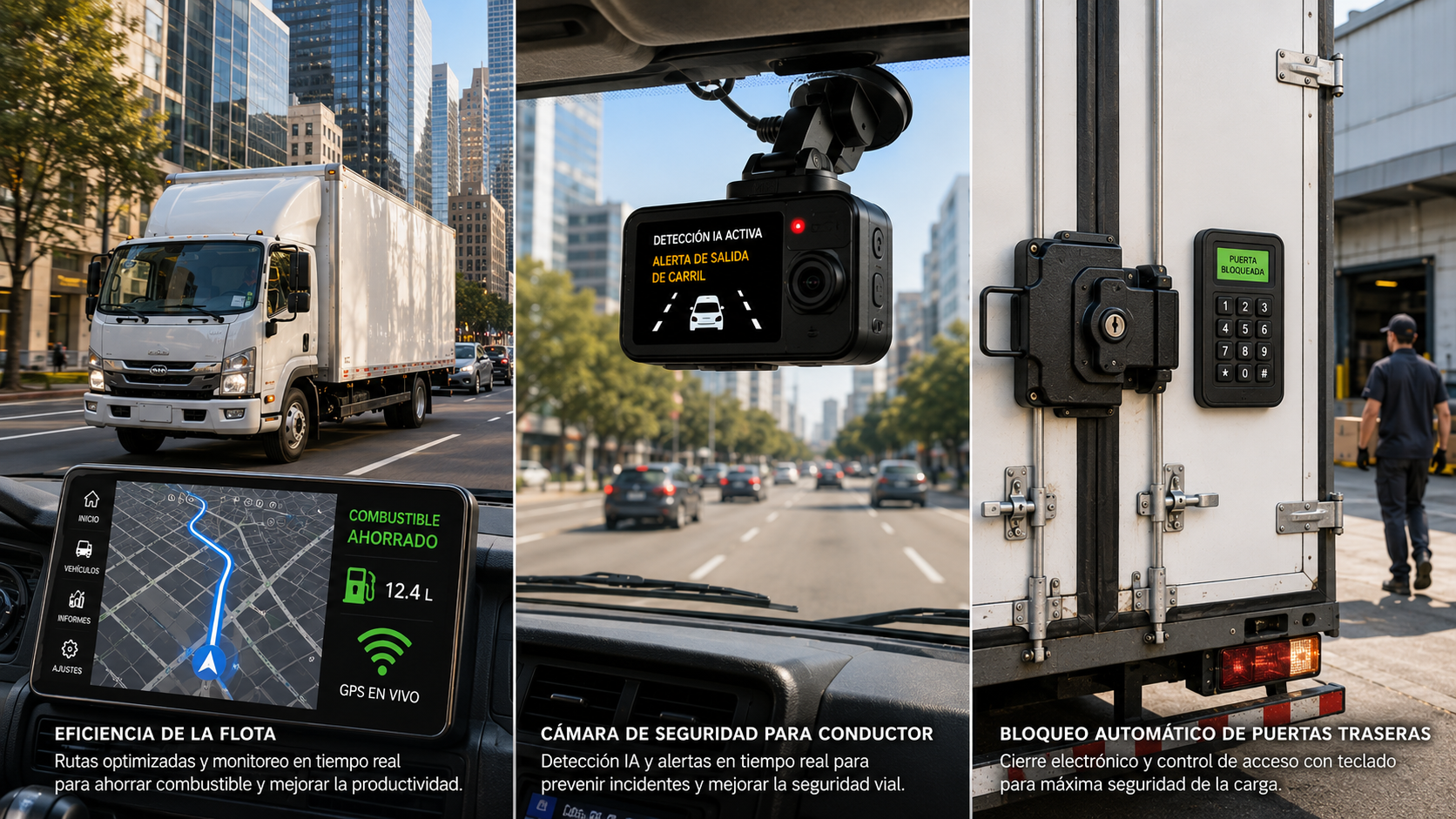
In urban and regional distribution, profit margins are won or lost on every corner. Talking about “telemetry” or “internet of things (IoT)” sounds great on paper, but if you manage delivery trucks, you need pragmatism: what device to buy, what brand sells it, and how much the bill will cost you.

Today we set theory aside. We analyze three real commercial solutions you can install in your rigid trucks or vans to optimize delivery routes, reduce fuel consumption in the city, and prevent theft during unloading.

1. Route control and fuel savings in the city: Webfleet (by Bridgestone)

In local delivery, traffic jams and closed streets skyrocket fuel consumption. This is the leading platform in Spain to monitor what happens with your trucks street by street.

  • The hardware: The LINK 740 series device is installed hidden, connected directly to the vehicle’s OBD port or CAN bus.
  • What it does in practice: It gives you the exact GPS location second by second, plans optimal delivery routes with urban traffic in real time, and analyzes the driver’s driving style (such as leaving the engine running while unloading, which wastes money, or unnecessary acceleration between traffic lights).
  • Approximate cost: The physical device costs around 100 € – 150 € (one-time or financed payment) and the monthly software subscription ranges between 15 € and 30 € per truck.
  • Where to buy: You can request a direct quote on the official website of Webfleet España.

2. Safety with cameras and AI against bumps and fines: Samsara

Urban delivery is prone to minor accidents, scrapes in loading zones, and false third-party claims. Smart camera technology is the most mature solution to protect both the driver and the truck.

  • The hardware: A front-facing and cabin dashboard camera (Samsara CM31 or similar) connected to the dash.
  • What it does in practice: It is not a standard camera. Its artificial intelligence detects if the driver gets distracted at the wheel (preventing rear-end collisions) and, most importantly, if the truck is hit while parked during unloading, it instantly records the footage to the cloud so you have irrefutable proof for the insurance company.
  • Approximate cost: It operates under a subscription model that unifies hardware and software, with costs usually starting from 25 € – 40 € monthly per vehicle depending on your fleet volume.
  • Where to buy: You can request a demo and a quote on the page of Samsara España.

3. Automatic electromechanical locks (anti-theft on the go): SBS Locks (distributed by Cargotrack)

In urban delivery, the biggest danger is “opportunistic theft”: having your rear tailgate or side door opened while you are inside a business delivering an order 50 meters away from the truck, having had to park far away due to lack of space.

  • The hardware: Surface-mounted or integrated security locks on the cargo doors (such as the SBS lock range).
  • How does it connect to IoT? Although the base system is local electromechanical, it can be integrated with the fleet’s GPS trackers. This allows the lock to send real-time data to the central management station every time the door opens or closes, logging the event on the map.
  • What it does in practice: It features an automatic slam-lock system. As soon as the courier unloads the goods and closes the door, it locks mechanically instantly. To reopen it, the driver uses a coded remote or a digital keypad (avoiding reliance on whether the GPS has coverage between tall buildings), but control managers receive an instant alert if the door remains open longer than it should.
  • Approximate cost: The physical device ranges between 180 € and 350 € per door (one-time payment). If you want to connect it to the telemetry platform to monitor openings in real time, a small monthly fee of about 5 €/month is added.
  • Where to buy: You can check the specific security catalog and request a quote on the website of Cargotrack España – Cierres SBS.

Investment summary for a delivery fleet

Let’s do some quick numbers for a distribution company with a modest fleet of 5 urban delivery trucks:

Concept Initial investment (devices) Total monthly fleet cost (5 trucks)
Route control and efficiency (Webfleet) ~600 € ~100 € / month
Safety with AI cameras (Samsara) Integrated into leasing/renting ~150 € – 200 € / month
Automatic anti-theft locks (Cargotrack) ~1,200 € (one-time payment) 0 € / month (it is pure technology)

The real balance: A single theft avoided in an industrial estate thanks to the automatic lock, an insurance dispute won due to an urban bump, or an 8% reduction in fuel consumption thanks to better routes, completely pay off the cost of this technology within the first few months of use.

In this article, we have gathered three specific examples of companies providing these services, although fortunately the technology market is wide and more alternatives exist. Our intention has been to show real, mature cases with baseline figures on the table to help evaluate the feasibility of making the digital leap in freight distribution.

The Ultimate Checklist for Distributors Before Signing

comercial vendiendo vino a un distribuidor

Interested in this new product? The ultimate checklist for distributors before signing

Every week, dozens of manufacturers knock on the door of any wholesale distributor with the “holy grail” of products: the most innovative, the highest margin, the one that will sell itself. But in this business, enthusiasm doesn’t pay the bills. Introducing a new reference costs time, warehouse space, and the effort of your sales network.

To separate the wheat from the chaff and avoid wasting resources for nothing, a distributor cannot decide based on intuition alone. A cold, analytical filter is required.

If you are being offered a new product, before saying “yes”, the manufacturer must satisfactorily answer these 7 critical questions divided into three essential blocks:

Block 1: Shielding the Territory (Legal)

1. Is there a real, contractually guaranteed territorial exclusivity?

Being told “you are our guy in the province” verbally is worthless. Exclusivity is not a whim; it is the only way to guarantee that the prospecting and positioning efforts your team puts in aren’t exploited by the competitor next door three months later by dropping the price by two cents.

2. The danger of the “groundwork effect”: Who will sell to key accounts?

You do the heavy lifting: you open up the market client by client, make the brand visible, and suddenly, a major hotel chain or a national restaurant group takes an interest in the product.

  • The key question: If a corporate account or central purchasing body takes an interest in the product within my territory, will you respect my exclusivity or will you sell to them directly from the factory? If the manufacturer bypasses the distributor for the juicy accounts, they are taking advantage of your hard work.

Block 2: Viabilidad and “Proof of Performance” (Commercial)

3. What is the real market penetration potential in my area?

Not all markets consume the same way. A product that is a massive hit in a coastal or tourist area can be an absolute failure in an inland region with different consumption habits. The manufacturer must prove they have studied your local market and are not flying blind.

4. Can you show me a sales track record from a similar region?

Paper and catalogs can handle anything. A serious manufacturer must provide sell-out data (actual sales to the end customer) from other areas with demographic and commercial characteristics similar to yours. If the product already works in similar markets, the risk decreases significantly.

5. What is the level of commercial support and advertising investment?

A distributor is not a marketing agency; it is a logistical and commercial partner. If the manufacturer expects you to finance building their brand awareness, that’s a bad sign.

  • What you should demand: Will there be digital advertising campaigns targeted at the area? Will they provide us with POS (Point of Sale) materials, free samples for salespeople to showcase, or specific training for the sales team?

Block 3: Risk Mitigation (Financial)

6. What is your return policy if the product doesn’t work out?

Assuming 100% of the inventory risk for an unknown product is reckless. If, after 3 or 6 months of commercial effort, the product does not rotate due to factors beyond the distributor’s control (for example, the end consumer doesn’t accept it), a safety net must exist.

  • The ideal agreement: Agree on a buy-back or return clause for obsolete or slow-moving stock during the first year to share the launch risk.

7. Does the contract penalize manufacturer non-compliance?

A serious contract must be a two-way shield. It must specify what happens if the manufacturer faces stockouts that leave you stranded with your customers, or what compensation you are entitled to if they break the agreement unilaterally after you have consolidated their brand in the market.

📌 The quick checklist before signing:

  • [ ] Exclusivity: Is the territory defined with pinpoint accuracy in the contract?

  • [ ] Key Accounts: Is direct factory sales explicitly excluded within my territory?

  • [ ] Track Record: Has the manufacturer proven with data that the product is already moving in similar areas?

  • [ ] Marketing: Is there an allocated budget for samples, advertising, and sales support?

  • [ ] Security: Is there a return or credit policy for slow-moving stock?

  • [ ] Guarantees: Are the required purchasing targets realistic and progressive?

Conclusion: Combining intuition with cold analysis

Accepting a new product is an investment in the future. The manufacturer provides the merchandise, but the distributor contributes their most valuable asset: the trust of their customer portfolio, their sales force, and their logistical footprint.

Don’t give away your infrastructure to run a free launch campaign for a third party. If the manufacturer truly believes in their product, has a solid marketing plan, and respects your business, they will have no problem signing an agreement that protects, supports, and shares the risk with both parties. Otherwise, it’s better to pass on the “opportunity.”

The tricky fleet dilemma

camion de reparto vs furgoneta

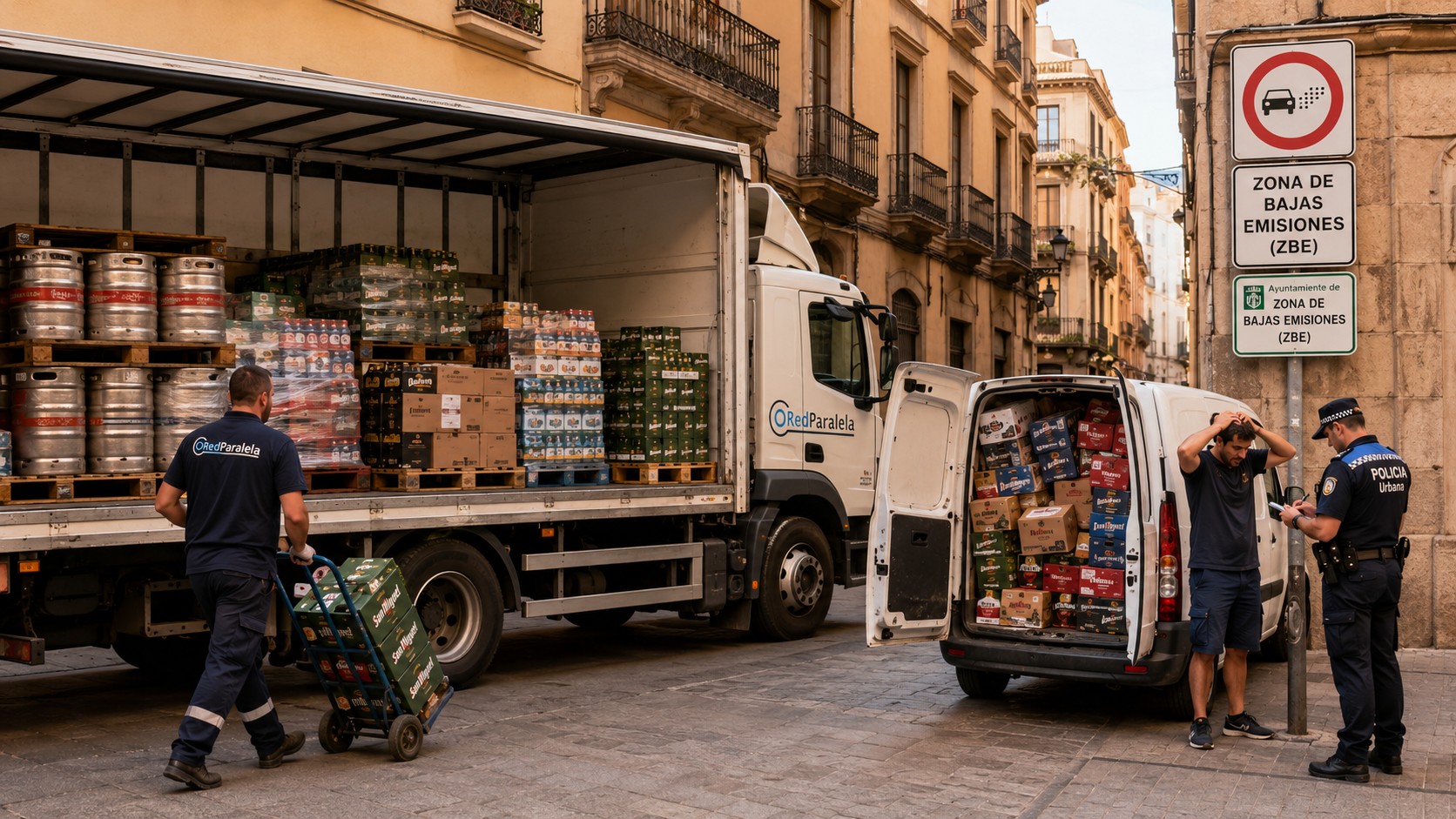
How to Choose the Right Beverage Delivery Truck in the Era of LEZs?

Delivering beverages in urban centers has always been a top-tier logistical challenge. Moving tons of liquid and glass through narrow streets, dodging traffic, and searching for free loading and unloading zones requires almost superpowers.

However, the rules of the game have completely changed. With Low Emission Zones (LEZs) fully active, beverage distributors find themselves trapped in a true strategic dead-end. It is what we call “the tricky fleet dilemma”: whichever option you choose to renew your vehicles, it seems you always fall into an economic or operational trap.

How to get out of this labyrinth without harming your business’s profitability? Let’s lay the cards on the table.

The 3 Traps of Modern Urban Delivery

When a distributor considers how to adapt their fleet to continue entering city centers to serve the HORECA channel, they usually evaluate three paths. The problem is that all three come with “fine print”:

🛑 Trap No. 1: “The Van Refuge” (For fear of the truck license)

  • The temptation: Since professional drivers are scarce in the market, the logical temptation is to buy large 3,500 kg vans. After all, anyone with a car driving license (B) can drive them, and you can forget about the tachograph.

  • The real trap: The weight of the goods. An empty van already weighs around 2,300 kg, leaving you with barely 1,200 kg of payload. In our sector, that amounts to little more than a pallet and a half of stock. To deliver the same amount that a single truck carries, you have to put three vans on the street. What you save on the driver’s license, you pay threefold in salaries, insurance, fuel, and, very likely, overweight fines.

🛑 Trap No. 2: “The Pure Electric Mirage” (Green posturing)

  • The temptation: Buying a 100% electric heavy truck with a 0 Label to have full and guaranteed access to any LEZ for the next fifteen years.

  • The real trap: The company’s cash flow. The purchase price of an electric truck today remains astronomical for a distributor SME. Unless you are a large multinational with financial muscle and your own ultra-fast charging infrastructure in your warehouse, this investment can decapitalize your business before you have amortized the first kilometer.

🛑 Trap No. 3: “Diesel Inaction” (Waiting for the storm to pass)

  • The temptation: Do nothing. Maintain current Euro VI diesel trucks (C Label) and rely on the temporary exemptions that city councils grant to commercial freight transport.

  • The real trap: Exemptions have an expiration date. The day time or access restrictions tighten in your city, you will be locked out. If your truck cannot enter to unload at the exact time the hospitality business needs the stock, that client will call another distributor who can. Inaction is a direct commercial risk.

The “Anti-Trap” Solution: The 7,200 to 7,500 kg Truck with ECO Technology

To break this vicious cycle, urban beverage logistics has found its ideal sweet spot in a very specific category: the truck between 7,200 kg and 7,500 kg of Maximum Authorised Mass (MAM) with an ECO powertrain (hybrids or powered by Compressed Natural Gas/CNG).

Why is this the smartest investment from a purely economic standpoint?

  • Real payload capacity: Compared to the one thousand kilos of a van, a 7,200 kg truck (like the Iveco Daily chassis) or a 7,500 kg one (like the Fuso Canter) offers a net payload of between 3,500 and 4,000 kg. It allows you to move between 4 and 5 heavy pallets completely legally in a single trip. Route optimization in its purest form.

  • Maneuverability without penalties: These are compact, narrow, or cab-over trucks designed specifically for city stop-and-go driving. They turn in tight spaces and do not gridlock traffic.

  • The ECO Label shield: Hybrid or gas versions bypass LEZ restrictions without the need for the prohibitive upfront cost of a pure electric vehicle. Their acquisition cost (CAPEX) is perfectly manageable for an SME, and the cost per kilometer (OPEX) in urban cycles is highly competitive.

Professionalizing the Fleet Is Not an Expense, It Is an Investment in the Future

It is true that making the leap to a 7.5-ton truck legally requires your delivery drivers to hold a C1 or C driving license and the CAP (Certificate of Professional Competence), in addition to managing driving times with a tachograph.

But if we look at the numbers coldly, professionalization is the only profitable path. A qualified driver at the wheel of an efficient vehicle with the proper payload capacity performs three times better than three overloaded vans dodging traffic police controls.

In modern beverage distribution, efficiency is no longer measured just by how many crates you can move, but by how much it costs you to get each kilo of product into the city center. The 7,500 kg ECO truck is not a future option; it is the necessary tool to protect your business margins today.

The secret of the top-selling HORECA distributors is internal communication

atencionalcliente_exxi@energiaxxi.com

The Secret of the Top-Selling HORECA Distributors: What Do Your Bars and Restaurants Really Think of You?

In the HORECA sector, the pace is frantic. The daily routine of a food, beverage, or supply distributor relies on speed and repetition: pre-sales visits, phone calls to secure recurring orders before routes go out, delivery notes, trucks, and boxes moving in and out of the warehouse constantly.

At this speed, it is alarmingly easy to fall into the routine of “What can I get you this week?”. We take the order, deliver it, collect the payment, and move on to the next client. Hardley anyone stops to gather feedback and ask: how are we really doing?

Leveraging daily momentum to gather fresh insights provides a brutal competitive advantage. In a market where margins are tight to the penny and competitors lurk around every corner, the one who listens to the business owner best, keeps the account.

The Danger of “Silence” in Hospitality

In the hospitality industry, there is a golden rule that every distribution manager should remember: an unsatisfied customer rarely complains, they simply switch suppliers. If a bar faces recurring stockouts, if the delivery driver arrives late three times in a row during peak hours, or if product quality drops, the business owner (who is already overwhelmed managing the kitchen, staff, and tables) often won’t call the office to file an official complaint. Instead, next week they will simply order from the competitor who walks through their door with a smile.

Gathering continuous customer feedback is your protective shield. It allows you to spot the fire before it completely burns down the commercial relationship.

The Harsh Reality of the Streets: The “WhatsApp Effect” and Lost Information

When it comes to gathering feedback, many think of complex systems or sending digital email surveys. Let’s be realistic: that does not work in HORECA. A busy hospitality client is not going to open an email to fill out a satisfaction test.

Valuable information happens face-to-face. And this is where the closest link to the customer comes in: the delivery driver.

The delivery driver goes right into the kitchen, enters the storage room, and shares maximum trust with the client. They hear firsthand remarks like: “Hey, last week this cheese format didn’t work for me” or “Tell your rep I urgently need some samples of the new beer.”

Since the delivery driver is dealing with double-parked trucks, tight schedules, and heavy boxes, they do the best they can: they pull out their phone, record a quick 15-second WhatsApp voice note, and send it to the local pre-sales rep.

They do their part. But here begins the great black hole for distributors:

The pre-sales rep receives the audio while driving to another client or in the middle of a visit. They listen to it, think “I’ll write it down later”… and that message gets buried under 40 other chats throughout the day. In reality, the sooner it’s logged, the better for everyone, because we never know if the client might call the main office in the meantime.

WhatsApp is a fast internal channel, but if the information isn’t registered in a centralized system, it gets blown away by the wind. And the client is left waiting for an answer or a solution that never arrives.

The Keepers of Information: Pre-Sales and Telesales

For this flow to work, we must understand that the delivery driver is only the “receiver” of the alert on the street. The ones responsible for bringing that information into the company’s control loop are the pre-sales rep and the telesales team.

  • The pre-sales rep as a filter: At the end of their daily visits, one of the rep’s tasks must be to review those WhatsApp messages from their area’s drivers and log them cleanly onto the client’s file (whether in the CRM or the company’s ERP) before they fade from memory. A traffic-light alert system can be a massive help for the sales manager to spot what important events took place and see if they have been resolved. For this reason, logging these notes is fundamental to customer service excellence. This way, anyone who opens the client’s file can see the latest status and act accordingly.

  • Telesales as the closer: When the phone support team calls to lock in the recurring order, they will have the note right on their screen. That is where the magic happens and the account gets secured: “Hi Manuel, the driver mentioned you had an issue with the cheese format on Tuesday. I have it noted right here and we have corrected it for the delivery coming your way tomorrow.”

The business owner will feel they are dealing with a professional company that coordinates internally and truly cares, rather than disconnected departments that don’t talk to each other.

The Role of the Sales Manager: Stop Leading from the Office

None of the above will happen if sales management doesn’t take charge. The sales manager cannot just look at revenue charts at the end of the month; they have to be the human bridge between the warehouse and the street.

When information gets lost, it’s often because leadership hasn’t built the habit or motivated the team. The Sales Manager must lead this shift in two directions:

  1. Raise awareness and value the driver: You need to head down to the loading dock and talk to the delivery team. Explain why their role is so vital: “Team, your eyes at the venue save our accounts. If you see a client is upset or that a competitor is bringing in a new product, let the rep know. Your WhatsApp is vital.” When drivers see their insights matter and are taken seriously, their involvement multiplies.

  2. Audit and demand accountability from reps: The sales manager must banish the phrase “I forgot what the driver told me.” Their job is to audit that sales reps process street data and leave it registered so the rest of the company can act on it.

Conclusion: The Coordinated Distributor Faces Less Competition.

In the HORECA sector, catalog pricing matters, of course. But service, reliability, and empathy matter much more. When you stop being a mere “order taker” and ensure your delivery driver, pre-sales rep, and telesales team speak the same language and share local insights, you stop competing over pennies. You become the owner’s trusted partner. And a trusted partner who makes life easier is a partner you never replace.

Incentives and Responsibility: A System for Real Profitability

Oficinistas y mozos de almacén saltando de alegría en un almacén tras haber alcanzado sus objetivos.

The Delicate Balance of Incentives: Where Entitlement Ends and Responsibility Begins

In contemporary business culture, the pendulum seems to have swung heavily toward the side of rights and entitlements. While this is an undeniable social advancement, for a manager, it poses a critical challenge: how to recover a culture of responsibility without falling into authoritarian models?

The answer lies not in “what,” but in “how much” and “when.” The most honest way to reintroduce individual responsibility is through an incentive system that is fair, transparent, and, above all, real.

1. The Whole Ship or None: Why Incentivize Everyone?

A common mistake is segmenting incentives only for “key employees” or sales departments. However, a company’s efficiency is a transmission chain.

Consider the freight metaphor: if everyone rows and the ship reaches port early, everyone should share in the fuel savings or the freight profit. If we only reward the captain, the rest of the crew will have no reason to care about speed or the condition of the cargo. Collective responsibility is born when collective success has a direct impact on each person’s pocket.

2. KPIs Felt in the Day-to-Day

For an incentive to inspire, it cannot be an abstract formula calculated behind closed doors. It must be based on tangible values that the worker can influence through their daily behavior:

  • Quantifiable Productivity: In departments with measurable tasks, the incentive should reward agility without errors.

  • Monthly Net Commercial Margin: This is the true thermometer. When the team understands that protecting the margin (avoiding unnecessary discounts or billing errors) increases their variable pay, they become guardians of the business.

  • The Cost of Error: Real responsibility means that mistakes (shrinkage, breakages, or unpaid invoices) affect the result. An incentive is a reward for profit; if an unpaid invoice eats that profit, it is logical for the incentive to be affected. It is not a punishment; it is the reality of the market.

3. Rewarding Production, Not Just Presence

There is a fundamental concept that often gets blurred: no one can be paid for results they have not produced. A balanced incentive system must be linked to actual attendance. Sick leave or vacations, although consolidated labor rights, imply that the worker has not been present to generate that extra margin or monthly productivity. Therefore, it is natural for those periods to be deducted from the variable portion. An incentive is not an acquired right; it is a reward for the value contributed during effective working time.

4. The Golden Rule: The Cumulative System

Perhaps the most important point for a company’s survival is understanding that months are not isolated compartments. A bold incentive system must be cumulative.

If a month is exceptional but the year-to-date total shows a loss, distributing incentives would decapitalize the company and jeopardize everyone’s future. The incentive must guarantee that the company reaches the end of the year with profits. Only when the cumulative result is positive does the distribution make sense. This turns every employee into a strategic partner who watches over long-term financial health, not just the fleeting success of a single day.

Epilogue: Red Paralela’s DNA

This management model is not just a business school theory; it is our roadmap. At Red Paralela, we apply this cumulative and transversal system because we believe it is the only way to build a healthy company where rights are sustained on the foundation of shared responsibility. Because when everyone wins, the company grows; and when the company grows responsibly, we all win.

The end of delivery as we know it

Un almacén logístico con todo tipo de mercancías y dos operarios trabajando

Towards the “Single Operator”? A Hypothesis on the End of Goods Distribution as We Know It

If you step out onto any busy street in a major city at ten in the morning, you’ll witness a scene that would be almost comical if it weren’t so inefficient: five vans from five different companies, double-parked, delivering five orders to the same building.

In other sectors, the trend has been clear: consolidate or perish. Yet last-mile logistics has remained a stronghold of individualism… until now. The question we raise today at Red Paralela is not whether the model will change, but how much time the current model has left before it collapses.

The Wall Ahead: The Triple Threat

Traditional delivery is colliding with three realities that can no longer be avoided:

  1. Runaway cost escalation: Fuel, fleet maintenance and, above all, labour costs are making the margin per delivery increasingly negligible.

  2. Legislative pressure and Low Emission Zones (LEZ): Municipal regulations are no longer suggestions; they are physical barriers. Entering city centres is (and will be) an expensive and restricted privilege.

  3. Customer expectations: We want everything “yesterday”, but we don’t want to see vans blocking our streets or breathe their fumes.

Logistics Integration: Utopia or Necessity?

The idea we put forward is ambitious: a unified distribution network. Imagine that, instead of each distributor maintaining its own infrastructure as today, there are shared facilities where goods are consolidated before entering the urban environment.

What would we gain from this “shared logistics” model?

  • Real load optimisation: vans and trucks with fewer, fuller loads.

  • Drastic reduction in emissions: fewer vehicles on the road means cleaner cities and companies that finally meet their sustainability targets without going bankrupt.

  • Savings on operating costs: by sharing infrastructure and transport, fixed costs are spread. There is strength in unity, but in logistics, there is also profitability.

From Competition to “Coopetition”

We know what you’re thinking: “How am I supposed to hand my goods over to a competitor or an integrated third party?”. This is where the shift in mindset comes in.

In a globalised world, competitive advantage should no longer be about who has the fastest van, but about who manages information and customer service better. Logistics must move from being a war of physical assets to a pursuit of excellence in data management.

The future of distribution does not lie in having more vehicles on the street, but in having fewer, better utilised and fully integrated into a common ecosystem.

Are We Ready?

At Red Paralela we believe that integration is not merely a possibility — it is the only viable path forward. The current model is exhausting its last reserves of efficiency. The transition towards shared urban hubs and integrated fleets will be painful for those who resist, but a golden opportunity for those who choose to lead it.

What do you think? Do you see a future where you and your competitors share the same delivery vehicle to protect your margins?


AI in HORECA Distribution: Transforming Customer Service

Atención al cliente con inteligencia artificial en distribución horeca

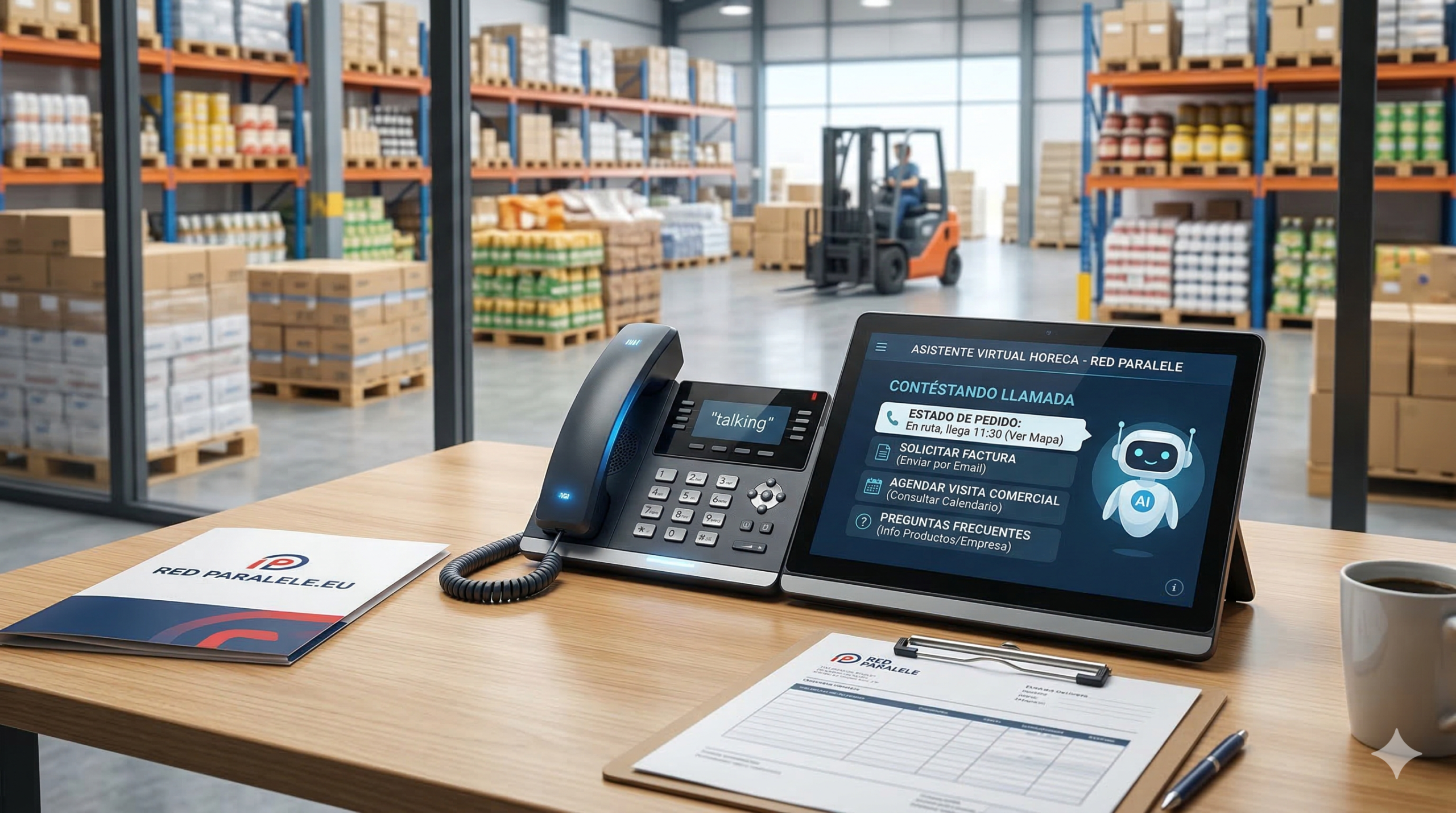
AI in HORECA distribution: Why a wholesaler’s phone can no longer afford to “communicate”

In the fast-paced day-to-day of the HORECA channel, time is the most expensive ingredient. For a wholesale distributor, managing calls during “peak hours” is often a bottleneck: last-minute orders, queries about lost invoices, or the eternal question “where is my truck?”.

Digitalization has advanced significantly with e-commerce platforms, but the landline phone remains the trusted channel for many customers. The good news is that, thanks to Artificial Intelligence, this traditional channel has become a high-efficiency tool.

The Voice Agent: Your new “employee” that never rests

Unlike old “press 1 for sales” switchboards, today’s AI voice agents hold natural conversations. They understand context, don’t get tired and, most importantly, are integrated with company data.

What can this technology actually do for a HORECA wholesaler?

1. Intelligent Reception and Routing

The agent answers the call on the first ring. It identifies whether the customer needs to speak with accounting, their assigned sales representative, or the warehouse.

  • The benefit: No more hold music and endless call transfers. The customer reaches the right person immediately.

2. On-the-fly Document Management

It’s common for a restaurant owner to call asking for an invoice for their accountant or a quote for a special event.

  • The solution: The AI accesses the ERP, locates the document and sends it via email or WhatsApp in seconds, while continuing the conversation with the customer. No human intervention.

3. Real-time Order Status

“What time will my order arrive today?” This is the most frequently asked question.

  • The solution: Being connected to logistics, the AI informs about the expected delivery window or any incidents on the route, reducing stress for both the customer and the customer service team.

4. Answering Questions and FAQs

From checking allergens of a specific product to knowing the minimum order for a particular area, the AI acts as a living company manual, accurately answering any technical question about the catalog.

5. Automated Sales Scheduling

If a customer identifies a need that requires personal attention, the AI doesn’t just take note: it can check the sales representative’s schedule for that area and book a visit directly. This ensures no business opportunity is lost due to administrative oversight.

Reflection: Implementing AI is not about replacing human interaction, but freeing it from repetitive tasks so it can focus on what truly adds value: personal relationships and strategic advice.

Towards smarter distribution

At Red Paralela, we believe that operational efficiency is the key for the HORECA sector to keep growing. This forward-looking vision and continuous technological evolution are made possible thanks to our innovation ecosystem, where we rely on the technical support of grau.ad (a group company), who help us integrate these cutting-edge solutions into the day-to-day of distribution.

The future of wholesale distribution is not just about moving boxes; it’s about moving information quickly, accurately and humanly. Is your phone ready for the next level?


Beverage Distribution in Spain: How to Survive the Administrative Stranglehold in 2026

Un camión de reparto en la plaza de una ciudad aplastado por un mazo gigantesco

Administrative suffocation in wholesale beverage distribution: Comply with laws or sell product?

The wholesale beverage distribution sector in Spain is going through a critical phase. What was traditionally a business based on logistical efficiency and commercial relationships is becoming a race through bureaucratic obstacles. The convergence of new environmental regulations, digitized fiscal controls and market regulations is forcing qualified staff to spend more time filling out forms than optimizing routes or visiting clients.

In this article we analyze the regulations that, although with commendable objectives, are reducing the competitiveness of our companies by imposing tasks that add no real value for the customer.

1. The environmental maze: From RD 1055/2022 to the new European Regulation (PPWR)

Packaging management has become a massive statistical task for distributors. Royal Decree 1055/2022 already requires a detailed breakdown of weights and materials for every product reference placed on the market. But the challenge does not end there.

Starting on August 12, 2026, the new European Packaging Regulation (PPWR) will come into effect. This regulation introduces even stricter obligations:

      • Space minimization: Empty space inside grouping and transport boxes may not exceed 50%.

      • Supplier auditing: Wholesalers must request and archive certificates of conformity from each manufacturer to ensure packaging complies with the new recyclability standards.

      • ERP data registration: Management systems must be adapted to record the exact composition and recyclability class of each package.

Obligation Administrative Task Impact on Staff
Producer Registration Annual reporting of units, weights and materials. Very High (Months of data collection).
PPWR Certification Audit and archiving of supplier certificates. High (Technical and documentation workload).
Empty Space Control Physical and documentary verification of packaging. Medium (New warehouse protocols).

2. The Plastic Tax: A persistent “operational chaos”

Since its implementation, the tax of €0.45/kg on non-reusable plastic has been described by associations such as ANAIP as a source of legal uncertainty. The problem is not only the cost, but also traceability:

      • Impossible certifications: Getting international suppliers to provide the Spanish standard UNE-EN 15343:2008 is a titanic task that often ends with the company assuming the full tax cost due to lack of documentation.

      • Refund management: The procedure before the AEAT to recover the tax on exports is so complex that many SMEs give up, losing commercial margin.

3. Food Chain Law and the RECA Register

The reform of Law 12/2013 sought to balance the chain, but it has introduced contractual rigidity that clashes with the day-to-day dynamism of the sector.

      • RECA registration: Requires each contract and its modifications to be registered in the AICA digital registry before delivery takes place.

      • Destruction of agility: In a sector where offers change daily and volumes fluctuate, this constant “data entry” prevents quick deals and forces sales staff to act as data administrators.

4. Total fiscal surveillance: SILICIE, EMCS and VeriFactu

For those distributing alcohol, the digital tax burden is permanent. In addition to the already known SILICIE system (immediate reporting of special tax accounting books) and the EMCS system for the circulation of goods , new requirements are now being added:

      • VeriFactu (January/July 2026): All companies and self-employed professionals must implement systems for the immediate transmission of invoicing records to the AEAT.

      • Fiscal Stamps: Starting January 1, 2026, the commercialization of spirits with old fiscal stamps will be prohibited, requiring rigorous physical and documentary stock control to avoid serious penalties.

System Function Administrative Burden
SILICIE Real-time electronic accounting of alcohol. Very High (Reporting for every movement).
VeriFactu Immediate transmission of invoices to the tax authority. High (Investment in software and processes).
EMCS Control of the movement of excise goods. High (ARC code management).

5. The challenge of Urban Logistics (DUM-H)

Not all bureaucracy is in offices. Municipal regulations on Urban Goods Distribution (DUM-H) are suffocating delivery drivers:

      • Low Emission Zones (LEZ): Require specific authorizations for each vehicle in each municipality, with platforms that do not communicate with each other.

      • Insufficient loading times: The standard 30 minutes are unfeasible for reverse beverage logistics (collection of empty containers and kegs), generating an avalanche of fines that administrative staff must contest daily.

Conclusion: Toward a digitalization that frees rather than chains

The sum of these tasks —environmental, fiscal, contractual and logistical— consumes more than 1,500 hours per year in bureaucratic procedures for companies in our sector. That is time not spent finding new clients or improving our catalog.

What is the solution?

      1. Automation: Integrating the ERP with public systems (RECA, SILICIE, VeriFactu) is now a survival requirement, not an option.

      2. Administrative unification: Authorities must urgently apply the “only once” principle so companies do not have to report the same data to different ministries.

At RED PARALELA, we believe the value of a wholesaler lies in its service capacity and its knowledge of the market, not in its ability to fill out forms. We also believe it is time to rationalize the legislative ecosystem so those who truly move the economy can focus on their work.