

- Shipped
- Reading
- 5 min
PPE in beverage distribution
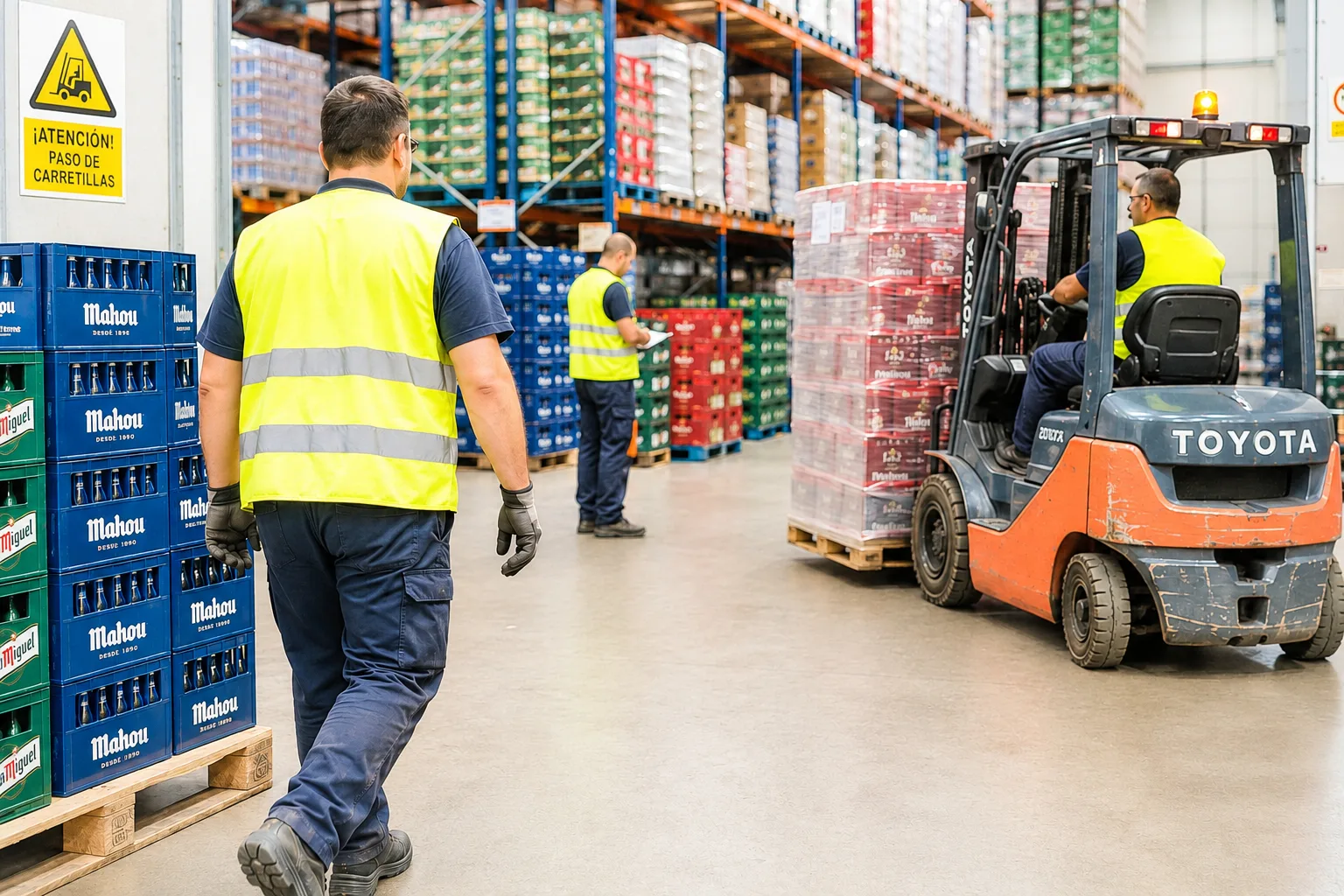
Day-to-day life in a beverage distribution warehouse is a high-intensity ecosystem: forklifts racing down the aisles, beer pallets weighing hundreds of kilos moving overhead, thousands of glass bottles clinking and, every now and then, the inevitable wet floor from a breakage.
In this environment, Personal Protective Equipment (PPE), known in Spain as EPIs, is the thin line between a productive shift and a tragedy. Yet every warehouse manager has heard something like: "Boss, these boots are too heavy for summer" or "This hi-vis vest makes me ridiculously hot, and we all know each other here anyway".
Today we look at that dangerous border between what a worker considers "uncomfortable" and what the law sets as strictly mandatory, and at how you should act so that one employee's recklessness does not become your company's legal ruin.
1. Is it really necessary? Between comfort and real risk
What may look like an exaggerated rule to an operator is, for physics and for the Ley de Prevención de Riesgos Laborales (LPRL, Spain's Occupational Risk Prevention Act), pure survival logic. In beverage distribution the risks are very specific and severe:
- Safety footwear: A 50 kg beer keg slipping during loading or unloading can crush an unprotected foot.
- High-visibility vest: In a warehouse with machinery constantly on the move, not being seen by a forklift driver in a blind spot is a critical risk of being run over.
- Gloves and safety glasses: A pressurised glass bottle bursting or handling broken cases causes hundreds of deep cuts and serious eye injuries every year.
Using PPE is not a goodwill suggestion; it is a legal requirement that is not open to negotiation.
2. The rebellious worker and the maze of collective agreements
When an operator repeatedly refuses to wear PPE, looking the other way is never an option. As an employer you have a duty to protect them, but you also have the power to sanction them. So how do you penalise this legally?
In Spain there is no single "Beverage Agreement". Depending on your province and how your company is classified, your warehouse may be governed by the collective agreement for Wholesale Food Trade, for Logistics or even for Hospitality.
Despite this regional patchwork, all the agreements line up on the essentials. The rules are clear-cut: repeatedly refusing to wear PPE, or creating a serious risk to oneself or to colleagues, is almost always classed as a Very Serious Offence.
If you detect this attitude, you must apply a firm, gradual disciplinary protocol:
- Verbal warning: First notice and awareness-raising.
- Written warning: If it happens again, hand over a letter stating the day, the time and the PPE that was not worn. The worker must sign an acknowledgement of receipt.
- Suspension without pay: Applying what your agreement sets for very serious offences, which usually ranges from 16 to 60 days.
- Fair disciplinary dismissal: If the defiance is chronic, the Estatuto de los Trabajadores (Spain's Workers' Statute) supports dismissal without a single euro of severance pay.
Golden rule to protect yourself: Do not issue warnings "blindly". Check the collective agreement code shown on your company's payslips, find the exact article on Very Serious Offences and copy its wording literally into the sanction letter. If you cite the wrong agreement, a judge will overturn the measure on a procedural defect.
3. The nightmare: what happens if they have an accident because they were not wearing PPE?
There is a widespread myth that "if workers get injured through their own fault for not putting their boots on, the company is off the hook". This is a very serious mistake. If the Inspección de Trabajo (Spain's Labour Inspectorate) turns up after a serious accident and finds the employee was not wearing the mandatory equipment, the company faces a Kafkaesque scenario:
- Financial penalties: Administrative fines that can reach astronomical figures depending on the severity of the case.
- The dreaded benefits surcharge (Recargo de Prestaciones): The company can be ordered to pay out of its own pocket a surcharge of 30% to 50% on all the financial benefits the worker receives (sick leave, disability, etc.) for life. No insurance covers this.
- Criminal liability: The company director or the warehouse manager may face prison sentences if "passive tolerance" or a lack of supervision is proven.
For the company to be cleared of blame before a judge, it is not enough to show that the worker "didn't want" to wear the PPE; you must prove that the company did everything legally and humanly possible to make them wear it.
4. How to protect your company legally (Action Plan)
To stop someone else's recklessness from becoming your ruin, you must build a shield of indisputable documentary evidence:
| Key Action | How to implement it effectively |
| Issue Record | Every time you hand out PPE, the worker must sign a document with the date, the model and their explicit commitment to use and look after it. |
| Documented Training | Handing over the equipment is not enough. You must hold specific talks on the risks of a beverage warehouse and keep the signed attendance of the whole workforce. |
| Active Supervision | Carry out regular visual inspections. If you see someone not complying, order them to put on the equipment immediately and keep an internal record of the warning. |
| Disciplinary Procedure | If an operator persists, issue a written sanction. The absence of previous sanctions is employment lawyers' favourite argument for blaming the company for tolerating the risk. |
Keeping a beverage distribution warehouse safe requires firmness. PPE may be uncomfortable in the summer heat, but the cost of not wearing it is infinitely higher for the worker's health and completely unaffordable for the viability of your business. Leading by example, raising awareness and, when necessary, sanctioning with the collective agreement in hand is the only valid strategy.