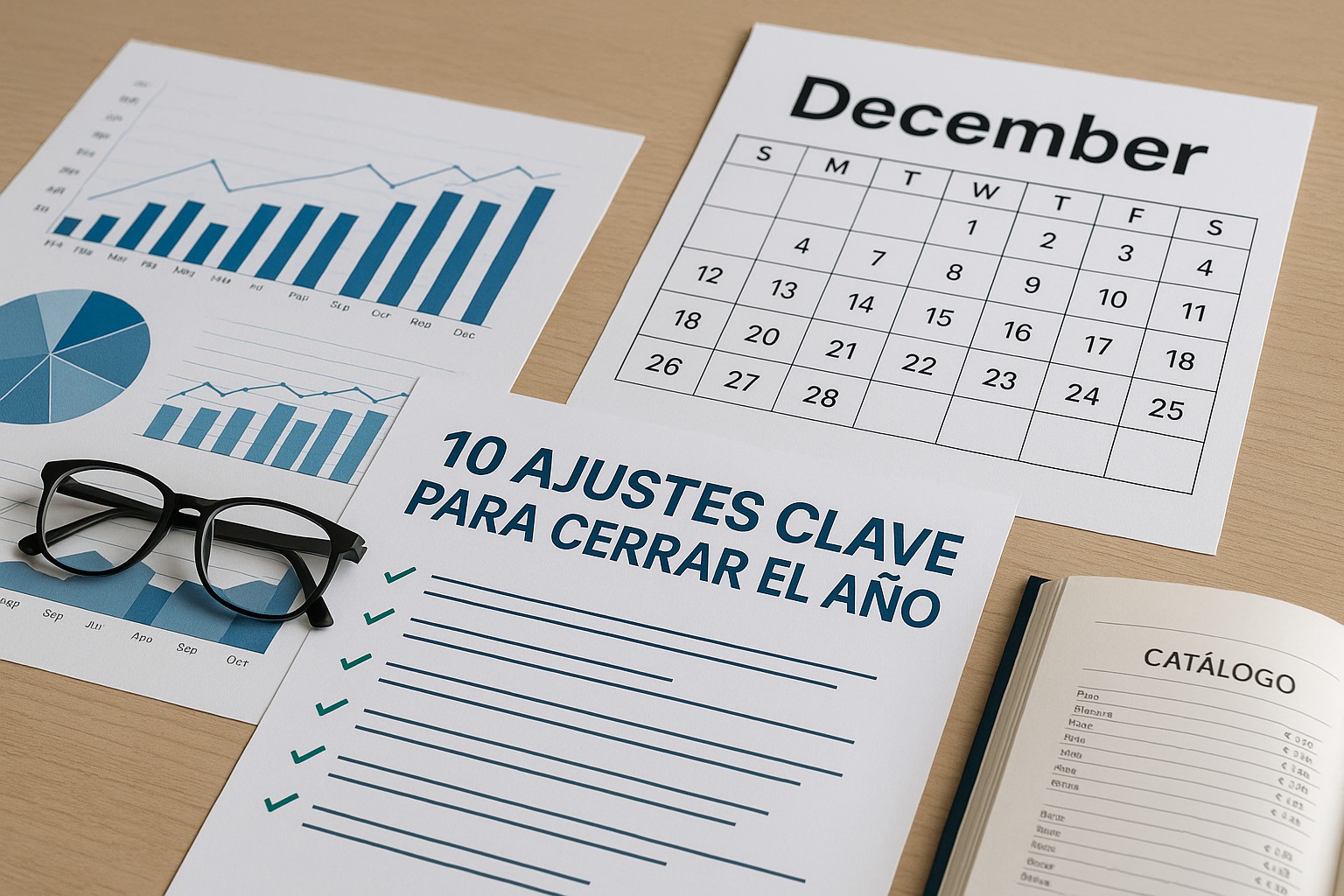
10 Key Adjustments to Close the Year with Liquidity, Achieve Bonuses, and Secure Better Purchases for 2026

The end of the year is approaching, and for distributors selling to the HORECA channel, this is the perfect time to fine-tune operations, optimize performance, and prepare the ground to start 2026 strong.

We’re not talking about aggressive discounts or clearing stock at any cost. We’re talking about strategy, foresight, and concrete actions that can improve your liquidity, help you achieve your year-end bonuses, and strengthen your purchasing power for the year ahead.

1. Prioritize products with expected price increases
Do you have items that are likely to increase in price in 2026? Move them before the year closes. This boosts stock rotation, generates liquidity, and lets your customers benefit from buying ahead of price hikes.

2. Reduce stock strategically (without eroding margins)
Avoid internal promotions that hurt your market positioning. Use B2B channels like Red Paralela to sell part of your inventory without visible discounts or brand devaluation.

3. Clean up pending collections
Liquidity isn’t just about selling—it’s also about collecting on time. Review outstanding invoices and negotiate early. Better now than in January, when cash flow tightens for everyone.

4. Prepare your 2026 price lists and catalogs
Take the time to review margins, include new products, and finalize your commercial materials. This will give you agility and a competitive advantage at the start of the year.

5. Close negotiation frameworks with key customers
Don’t wait until the last minute. Agreeing on framework conditions now (volumes, prices, exclusivities) provides predictability for both sides and positions you more strongly against competitors.

6. Remove dead or slow-moving items
Do a quick analysis: which products have been sitting too long in your warehouse? Free up space and capital to focus on the items that truly drive your business.

7. Review conditions with your suppliers
If you’re ending the year with good liquidity, use it to your advantage—negotiate better payment terms, bonuses, or exclusivity agreements for 2026.

8. Spot buying opportunities with a long-term view
Many distributors liquidate stock in December. If you buy smart now, you can start 2026 with branded products at 2025 prices, improving your margins from day one.

9. Sell stock to reach your year-end bonuses
Are you just a few thousand euros short of your annual bonus target? Selling that stock through Red Paralela can give you the final push without stressing your usual sales channels or cutting prices publicly.

10. Buy on Red Paralela with a strategic mindset
Red Paralela is also a channel for opportunity purchases: access branded lots with genuine discounts and full security. What’s a good purchase today will be an even better margin tomorrow.

Conclusion: Closing the year well means starting the next one stronger

These adjustments aren’t just administrative tasks—they’re strategic decisions that make the difference between a tight year-end and a commercially solid one with strong liquidity.

If you want to sell part of your stock to meet your year-end goals, or spot great buying opportunities to start 2026 with an advantage, Red Paralela is your commercial ally.

Want to close the year with liquidity and stronger purchasing power?

Do it the smart way.
🔗 Start selling or buying on Red Paralela
Or contact us—we’ll help you prepare your year-end operation.

Marketing for the Horeca Distributor: Effective Commercial Segmentation

How to Use Your Database for Targeted Campaigns That Drive Real Sales

Most Horeca distributors have a customer and prospect database, but very few use it strategically. The result: generic campaigns that don’t create impact, offers sent to the wrong people, and unnecessary commercial effort. The good news is that with basic segmentation and smart use of communication channels, you can multiply the effectiveness of your commercial actions.

1. Clean and organize your database

A messy list is impossible to take advantage of. Before thinking about campaigns, make sure your database is up to date:

  • Remove duplicates.
  • Complete essential details (venue name, type of business, contact person, email/phone).
  • Update inactive or closed customers.
    👉 A clean database is worth more than a huge one full of noise.

2. Define relevant segmentation criteria

Not all Horeca clients are the same. The most useful criteria include:

  • Type of venue: bar, restaurant, hotel, nightclub…
  • Purchase volume: large, medium, or small customers.
  • Seasonality: strong summer customers (terraces, beach bars) vs. winter customers (mountain hotels).
  • Key products: beer, soft drinks, spirits, wines…
    👉 Segmentation means adapting the message to each group.

3. The sales rep: the core of communication

In Horeca, the sales rep (commercial visit) is the main communication channel. Nobody questions its importance: they build trust, take orders, and detect daily needs. But the mistake is to depend solely on them. Today customers expect immediacy and multiple contact points. This is where segmentation becomes more valuable, because it allows the sales rep to rely on other channels to deliver sharper messages.

4. Complementary channels to the sales rep

WhatsApp / Direct Messaging

  • Ideal for confirming orders, sending urgent promotions, or keeping contact alive.
  • Very effective because bar and restaurant owners check it constantly.
  • Recommendation: don’t spam, personalize, and coordinate with the sales rep.

Segmented Email

  • Perfect for reinforcing campaigns: digital catalogs, seasonal updates, reminders.
  • Less intrusive than WhatsApp and works as supporting documentation.
  • Best used when linked to clear segments (e.g. “winter hotels”).

Occasional Phone Call

  • Useful for medium or small clients who don’t get frequent visits.
  • Activates purchases at key times (before a holiday, local events, or peak season).

Social Media

  • Not a direct sales channel, but effective for positioning.
  • Reinforces the distributor’s image, gives visibility to brands, and builds market trust.
    👉 The key is combining all channels: the sales rep at the core, WhatsApp and phone as agile support, email as reinforcement, and social media as the showcase.

5. Create campaigns tailored to each segment

Instead of sending the same offer to everyone, adjust your proposal:

  • To cocktail bars: promotions on spirits for weekends.
  • To restaurants: wine and beer packs designed to pair with menus.
  • To hotels: special conditions for events or peak season.
    👉 Real example: a summer beer promotion sent only to venues with terraces had 40% more orders than the mass mailing the previous year.

6. Use your CRM as an ally, not just a file

A CRM (or even a well-structured Excel) lets you:

  • Tag clients by segment.
  • Schedule reminders for follow-ups.
  • Measure the response to each campaign.
    👉 The point is not just to have data, but to use it to decide how and through which channel to communicate.

7. Measure results and improve each time

After every campaign:

  • Which segment responded best?
  • Which channel was most effective?
  • Which message generated more orders?
    👉 Only by measuring can you refine the next action and make it more profitable.

Conclusion

Commercial segmentation is not extra work: it’s the smartest way to sell more without spending more. The sales rep will remain the engine of your business, but if you support them with segmented digital channels, each visit and every contact will have much more impact.

Legal reasons why your goods may be seized for incorrect labeling

In Spain, health authorities have the power to seize goods and sanction the distributor when products do not comply with labeling regulations. This often creates confusion: in your wholesale warehouse inspections are rare, but once you deliver to a client (bar, restaurant, or shop) the goods are already in circulation — and that’s where problems may arise.

Who can seize and sanction?

Food control responsibilities are transferred to the autonomous communities, usually through:

  • Health or Food Safety Inspection Services (regional health departments).
  • Regional consumer or public health agencies.
  • In some cases, municipal inspectors (local public health).

The Ministry of Health coordinates criteria, but enforcement is regional.

How high are the fines?

  • Minor: €600 to €3,000.
  • Serious: €3,001 to €15,000.
  • Very serious: up to €600,000 in cases of health risk or repeat offenses.

Beyond the fine, seizure means you cannot sell the product until labeling is corrected, with the associated economic and reputational damage.

What the law says (Regulation 1169/2011)

Full text in Spanish (BOE): download here

  • Article 8 – Operator’s responsibility

“The food business operator responsible for the food information is the one under whose name or business name the food is marketed.”
👉 If you are an importer or parallel distributor, you are responsible for ensuring the label is applied and compliant.

  • Article 9 – Mandatory information

Name of the food, list of ingredients, allergens, net quantity, expiry date or minimum durability, storage and use conditions, business name and address of the responsible operator in the EU, country of origin (when required), production lot, and alcoholic strength (>1.2%).

  • Article 12 – Availability and location of information

“Mandatory food information shall be available and easily accessible for all foods.”

  • Article 13 – Presentation of information

“Mandatory food information shall appear in a prominent place, easily visible, clearly legible, and indelible. It shall not be hidden, obscured, or separated by other indications or images.”
👉 This rules out handing out loose labels: the information must already be affixed to the package at the time of circulation.

  • Article 15 – Language
    In Spain, Spanish is mandatory. In regions with a co-official language, that language may also be required.

Box, sales unit, and loose labels

  • Wholesale box/unit: if this is the unit sold to the HORECA channel and the items inside are already compliant, labeling the box is sufficient.
  • Consumer units (bottles, cans): must be re-labeled if they don’t comply (e.g., imports without Spanish).
  • Sign in the establishment: does not replace labeling on the package, it only serves as extra information.
  • Handing loose labels to the client: not legally valid. If an inspection occurs before the retailer applies them, the fine is for the wholesaler. The information must travel with the product, visible and affixed.

Our solution at Red Paralela

Many wholesalers lack the means to properly re-label imported or parallel-market products. That’s why at Red Paralela we can re-label according to the law before delivery to the client. This way you avoid:

  • Surprise seizures during inspections.
  • Unnecessary fines.
  • Risks of complaints from competitors.

In summary

  • Regional health authorities can seize and sanction.
  • The labeling must already be on the goods when they leave the wholesaler.
  • Handing out loose labels doesn’t work: Articles 12 and 13 of the Regulation make that clear.
  • Red Paralela can handle re-labeling so your goods circulate without risks.

A decision that impacts your image as a distributor

More and more bars, restaurants and hotels are valuing sustainability in the supply chain. For a HORECA wholesaler, choosing the right suppliers of water, beer and soft drinks not only affects the planet: it also strengthens the distributor’s image in front of clients. The key question is: what makes more sense, supporting the recycling of single-use packaging or betting on returnable containers? The answer depends on very specific factors that are worth knowing.

Quick recommendation

Most sustainable: steel kegs for beer and tanks for soft drinks. They last for years, can be reused dozens or even hundreds of times, and at the end of their life they can be fully recycled.
Good option: returnable glass, as long as each bottle is reused at least 20–25 times and the return logistics are efficient (taking advantage of trucks on their way back).
Reasonable alternatives: aluminum cans with a high recycled content and PET plastic bottles with rPET (recycled plastic).
Last option: single-use glass, even if recycled, because it is heavy and requires a lot of energy to be manufactured again.

How packaging sustainability is measured

To compare packaging, it’s not enough to check whether it can be recycled or not. Experts use what’s called a life cycle analysis: this means studying the entire life of the container, from production, transport and use, to its reuse, recycling or disposal. With this complete view, we can see that: returnable glass wins in sustainability when reused many times and when it doesn’t create empty trips. Single-use glass, even if recycled, always starts at a disadvantage because of its weight and the heat required to remelt it. Aluminum cans are competitive because they are widely recycled and save a large amount of energy. PET plastic with rPET (recycled) is lighter and can be a better option than single-use glass.

What happens in Spain

Coca-Cola: its returnable glass bottles are designed to be reused up to 25 times.
Estrella Damm: states that its bottles can exceed 30 reuses and that around 65% of its containers in hospitality are returnable.
Mahou San Miguel: reports that more than 80% of what it sells in hospitality is reusable.
Vichy Catalan: offers returnable packaging, although it does not publish figures on reuse.
In addition, Spain has 13 glass treatment plants distributed across the territory, which brings the recycling of single-use bottles closer to wholesalers. As for collection, beverage cans exceed 70% and PET plastic bottles are still around 40%, with expectations of improvement in the coming years thanks to the deposit-return system.

Questions you should ask your suppliers

To make decisions with criteria and communicate them to your clients, ask manufacturers for clear information on: the actual number of times their bottles are reused. The percentage of bottles returned versus those that are lost or broken. Water and energy consumption in the washing processes. Percentage of recycled glass in single-use bottles. Percentage of recycled aluminum in cans. Percentage of recycled plastic (rPET) in PET bottles. How they organize return logistics to ensure there are no empty trips.

Conclusion

In the HORECA sector, the best bet is to prioritize reuse: kegs and tanks first, followed by returnable glass bottles with sufficient life cycles and efficient return logistics. When it is not possible to guarantee these requirements, choose aluminum cans with high recycled content or PET bottles with rPET, leaving single-use glass as the last option. Most importantly: don’t buy blindly. Demand clear data from your suppliers on reuse, recycling and resource consumption. That way you will make more sustainable decisions and show your clients that your distribution company is up to what the future requires.

Final question

And now that you’ve made it this far, here comes the tough part: your competitiveness in the market. So let me ask you:

Is it sustainable for your business to apply all this?

Because you know that if your prices aren’t competitive and all this sustainability ends up ruining you because you can’t sell, then none of it will be worth it.

Impact of automation and digital transformation: how to measure efficiency and cost reduction

Automation and digital transformation are no longer futuristic concepts: they are the foundation of today’s competitiveness. For HORECA distributors and many SMEs, adopting technologies and automated processes means working with fewer frictions, reducing costs, and gaining agility.

But the big question is: how can their impact really be measured?

1. Operational efficiency: key indicators

Efficiency is not a perception; it is measured with data. Some useful KPIs are:

  • Process time → how many minutes are reduced in repetitive tasks (orders, invoicing, route management…).
  • Operational errors → incidents before and after automation.
  • Fulfillment rate → percentage of orders delivered on time and in full.
  • Productivity per employee → number of operations each person manages after digitalization.

2. Cost reduction: where to look for savings

The most direct impact is usually found in:

  • Labor costs: fewer hours dedicated to manual tasks.
  • Logistics costs: more efficient routes, lower fuel consumption.
  • Inventory costs: fewer stockouts or excess merchandise.
  • Administrative costs: electronic invoicing, automatic reconciliation.

3. Return on investment (ROI)

The initial cost of implementing technology is only part of the equation. What really matters is:

  • Payback period: time needed to recover the investment thanks to the savings generated.
  • Estimated annual savings: comparison of costs before and after.
  • Indirect benefit: customer satisfaction, loyalty, and new business opportunities.

4. Measurement tools

  • Real-time dashboards integrating sales, logistics, and finance.
  • Internal benchmarking: comparing quarters before and after each implementation.
  • Satisfaction surveys for employees and customers to measure perception of agility and quality.

In conclusion, automation is not just a trend but a real lever for savings and efficiency. The key is to accompany each initiative with clear metrics that allow its impact on the bottom line to be verified. Sometimes it is enough to start measuring to realize how much room for improvement still lies ahead.

Complying with the law isn’t optional: the difference between a trusted supplier and a risk to your business

In the world of buying and selling first-brand stock—especially between wholesalers and importers—one reality that few mention is clear: not everyone complies with food regulations. And when that happens, the risk doesn’t just fall on the importer—it also falls on the buyer.
As responsible importers, our priority is not just moving product, but ensuring that every batch leaving our warehouse complies with all the laws and regulations that protect consumer health and our clients’ reputation.

The cornerstone: RGSEAA

At the foundation is the Registro General Sanitario de Empresas Alimentarias y Alimentos (RGSEAA), regulated by Real Decreto 191/2011. Without this registration, it is not legal to operate as a food importer or wholesaler in Spain. This document proves that the company is supervised by health authorities and meets the necessary conditions to store, handle, or distribute food.
A wholesaler should always request this document from their supplier.

More than just a number on paper

Beyond RGSEAA, we fully comply with all the European and Spanish regulations that guarantee product safety, traceability, and quality:

  • Regulation (EC) 852/2004 and (EU) 2021/382 – Food hygiene and allergen control.
  • Regulation (EC) 1935/2004 and (EU) 2022/1616 – Food contact materials and packaging.
  • Regulation (EC) 2073/2005 – Microbiological criteria.
  • Regulation (EC) 1333/2008 – Approved food additives.
  • Regulation (EC) 1169/2011 – Labelling and consumer information.
  • Regulation (EU) 2023/915 – Maximum limits for contaminants.
  • Law 17/2011 – Food safety and nutrition.

(In our internal file, we also comply with the rest of the specific regulations included in the quality commitment that our clients require: Regulation (EC) 853/2004, Regulation (EC) 1935/2004, Regulation (EC) 2073/2005, Regulation (EC) 1333/2008, Regulation (EC) 450/2009, Regulation (EC) 37/2010, Law 17/2011, Regulation (EC) 10/2011, Regulation (EU) 2021/77, Regulation (EU) 2022/1616, Regulation (EU) 2023/915, Royal Decree 773/2023, Regulation (EU) 2023/648, Regulation (EU) 2018/848 and Royal Decree 833/2014.)

What happens when compliance fails

Working with an importer who doesn’t respect these laws can have serious consequences:

  • Administrative sanctions and fines.
  • Product withdrawal from the market.
  • Damage to your business’s reputation.
  • Economic losses due to retained or destroyed merchandise.

Our commitment

While the goods are in our warehouse, it’s our responsibility that they arrive in perfect condition and in compliance with all regulations. When we hand them over to the transporter, the customer receives a product with guaranteed traceability, labelling and safety.
That’s the difference between working with a reliable importer and one who just moves boxes without assuming responsibility.

In summary

At Red Paralela, we believe that complying with the law isn’t a burden—it’s a competitive advantage. Because whenever we protect the consumer, we also protect our clients’ business.

The KPIs every HORECA distributor should track (and how to improve them)

In a business like HORECA distribution, what you don’t measure, you can’t improve. And what you measure poorly can lead to the wrong decisions.

What are KPIs?
KPIs (Key Performance Indicators) are key metrics that help you understand how your business is evolving and allow you to make decisions based on facts — not just intuition.

📊 1. Stock turnover

What it measures: the speed at which you sell your inventory.
Why it matters: the faster your stock moves, the less capital is tied up, and the lower the risk of expiry or deterioration. But be careful: if you discount too aggressively, you might lose more margin than the liquidity you gain.

What matters more? It depends on the product and your financial situation. Holding onto slow-moving stock comes with hidden costs: space, expiry risk, devaluation, and lost opportunities to sell faster-moving items. In most cases, sacrificing some margin is better than letting stock become unsellable.

How to improve it:

  • Set up automated alerts to detect slow-moving items.
  • Anticipate packaging or format changes and cut purchases early to avoid getting stuck with obsolete stock.
  • Run targeted or cross-promotions to clear slow stock before it’s too late.

💶 2. Gross margin per customer

What it measures: the actual profit you make from each customer, after product and service-related costs.
Why it matters: some customers buy a lot but barely leave you any profit.

But be careful: some low-margin customers can bring volume and visibility — especially if they’re key accounts in your area. It’s worth considering their strategic value, not just their numbers. If they help you consolidate routes or attract other clients, they might still be worth it.

How to improve it:

  • Calculate margin per order, not just per product.
  • Factor in discounts, rush orders, returns, and logistics costs.
  • Adjust service conditions or delivery frequency if a customer isn’t profitable — unless their strategic value justifies it.

🚚 3. Logistics cost per delivery and per route

What it measures: the real cost of delivering an order and the overall performance of each delivery route.
Why it matters: an individual delivery may seem profitable, but the entire route could be losing money.

How to improve cost per delivery:

  • Group deliveries by zones and days.
  • Raise the minimum order size for low-margin drops.
  • Use route optimization tools to minimize distance and time.

How to improve cost per route:

  • Treat each route as a unit: total cost, total margin, and order density.
  • Identify consistently unprofitable routes.
  • Increase sales efforts in low-density areas to gain volume.
  • Adjust delivery frequencies or combine routes with insufficient volume.

📞 4. Customer satisfaction (automated and actionable)

What it measures: the customer’s experience right after delivery, focusing on key service moments.
Why it matters: if you don’t catch dissatisfaction early, you risk losing the customer without knowing why.

How to improve it:

  • Send a short survey after each delivery, with just 3 questions:
    1. How do you rate the order handling?
    2. How do you rate the delivery?
    3. Any comments or suggestions?
  • Integrate responses into your CRM for proper follow-up.
  • Act within 24 hours if a customer gives negative feedback.
  • Use positive comments to build loyalty or strengthen relationships.

📆 5. Customer order frequency

What it measures: changes in how regularly a customer places orders within a profitable ticket size.
Why it matters: tracking whether frequency is increasing or decreasing helps you anticipate churn or double down on loyalty-building efforts.

How to improve it:

  • Define a “healthy” frequency range based on customer type and order size.
  • Set alerts for significant changes in buying patterns.
  • Reach out proactively if a customer is ordering less — ideally with a special offer or better terms. If they’re ordering more, reward their loyalty with exclusive perks.

⚠️ BONUS: Don’t track everything

More data doesn’t always mean more insight. What really matters is tracking KPIs that help you make decisions. If a KPI doesn’t lead to action, drop it.

💡 What now?

Ask yourself:

  1. Am I tracking what really matters?
  2. Am I making decisions based on these KPIs?
  3. Is my follow-up automated, or am I relying on Excel and luck?

If you have any questions about what we’ve explained, email us at info@redparalela.eu — we’ll be happy to help.

Pressure is mounting on HORECA distribution: evolve or vanish

The COVID-19 pandemic marked a turning point for HORECA distribution. What seemed like a temporary disruption has triggered a deep and ongoing transformation. Inflation, geopolitical tensions, and evolving consumer habits have further accelerated the shift.

In this new environment, digitalization and sustainability are no longer optional—they are essential for survival.

Digitalization is no longer a choice

Bars, restaurants, and hotels demand agility, transparency, and seamless processes. Distributors must automate orders, improve commercial communication, optimize routes, and access real-time data.

Digitalization is not about complexity—it’s about simplifying operations and freeing up resources to focus on what really matters: selling better.

Sustainability: from added value to purchasing requirement

Sustainability is now a purchasing criterion. Clients value local products, reduced packaging, and efficient logistics. However, some regulations—such as axle load limits or blanket emissions tolls—are making transportation more expensive without reducing environmental impact.

Being forced to use more vehicles to move the same goods, or facing rising costs without accounting for operational efficiency, can have the opposite effect. Zoning policies like Low Emission Zones can work—if they come with fair access conditions and realistic timeframes.

That’s why distributor associations must step up and ensure that new transport and mobility regulations are technically sound, economically viable, and operationally coherent. The sector must be part of the solution—not a passive recipient of poorly designed policies.

A more informed and demanding customer

Today’s hospitality professionals are more informed than ever. They compare, expect immediacy, and value personalized attention. Distributors must offer more than just products—they need to provide service, advice, and real value.

Margins under pressure

With shrinking margins and rising costs, operational efficiency is a must. Tight financial control, product mix optimization, process automation, and smart route planning are no longer optional—they are vital for profitability.

Companies that base their decisions on data are the ones that endure—and grow.

So, what now?

This is not just another crisis. It is the beginning of a new phase in HORECA distribution. And those who understand this change—and act accordingly—will lead the way.

At Red Paralela, we saw this coming and continue to grow by helping distributors adapt without losing control. If you want to evolve, we can support you with our experience and solutions.

Just reply to this message and one of our team members will get in touch. In a changing environment, having the right partner makes all the difference.

Your Database Is Your Greatest Asset: How to Attract Hospitality Clients and Sell Without Relying on Social Media (With a Little Help From AI)

In a saturated market like horeca distribution, many businesses still bet everything on social media, thinking that’s enough to “do marketing.” But the truth is, it’s becoming harder and harder to get your message seen. Why? Because you don’t control the channel. Algorithms decide what gets shown—if anything at all—and often, not even paid ads guarantee visibility.

That’s why, now more than ever, building and leveraging your own database is your most powerful sales tool.

Why You Need Your Own Database

Because it belongs to you.
Because no one can limit your access.
And because it allows you to speak directly to the person making the buying decisions.

With a strong database of emails (and to some extent, WhatsApp or phone numbers), you can communicate without filters to bars, restaurants, and hotels. You can send updates, promotions, useful tips—or simply remind your clients you’re there.

And beyond that:

  • Email marketing still sees open rates above 30% when done right.

  • You can automate without sounding robotic.

  • And every response, click, or lack of interaction gives you valuable insight.

How to Collect Data Without Being Pushy

It’s not about asking for an email “just because.” It’s about offering something of value in return:

  • An exclusive discount.

  • A quick guide with menu ideas.

  • Entry into a giveaway.

  • A personalized product sample.

  • Or simply the promise to send up-to-date pricing and new offers.

During in-person visits, a tablet or mobile form feels much more professional than a paper sheet.

How to Structure Your Database to Make It Work

A messy Excel sheet isn’t a database.
A list of untagged emails isn’t either.

Organize your contacts by:

  • Type of establishment (bar, restaurant, hotel, catering…).

  • Geographic area.

  • Profile (modern, classic, premium, budget…).

  • Interests or product categories.

And of course, make sure you’ve obtained clear consent in compliance with data regulations (GDPR). It forces you to communicate clearly from the start—and that’s a good thing.

AI Takes Your Results Further

When it comes to artificial intelligence, we rely on the expert support of GRAU.AD, who help us apply these technologies in a practical, agile, and secure way.

Thanks to this collaboration, we can help you:

  • Automatically generate tailored messages for each type of client.

  • Identify behavioral patterns: who opens your emails, what catches interest, who’s gone cold.

  • Create personalized campaigns in seconds, including targeted offers.

  • Summarize meetings or calls automatically for better follow-up.

  • Automate workflows for onboarding, reactivation, and more—without losing your personal touch.

AI doesn’t replace your sales team. It amplifies it.

What Kind of Campaigns Work Best Today?

  • Time-sensitive offers (“Only this week!”).

  • Short emails with one clear message or product.

  • Suggestions based on past purchases.

  • Reactivation messages for inactive clients.

  • Launches or contests where your clients get exposure too.

And if email doesn’t get through, try WhatsApp—only if there’s already a relationship, and never spam.

Use Social Media to Feed Your Database, Not the Other Way Around

Instagram and Facebook are good for visibility, not for closing sales.

  • Post content that educates or adds value.

  • Include strong CTAs like “Download our free guide” or “Sign up for special updates.”

  • Move followers from public platforms to your private communication channel—as fast as possible.

Final Thoughts

A well-built database isn’t just a marketing tool.
It’s your lifeline in an overcrowded, algorithm-driven digital world.

And with the right technology, you can build, manage, and activate it faster and more effectively than ever.

👉 At Red Paralela, we help you build and structure that database—and get real results from it. And to take things even further, we trust GRAU.AD to help us integrate smart, efficient AI systems that actually work.

Key products and exclusivity: don’t let them tie your hands

When key products draw a fine line between strategy and conflict

In the HORECA distribution world, some products change everything. We’re talking about key products—high-turnover items, easily recognized by consumers, that can make the difference between winning or losing a client.

These products help you:

✅ Break into new accounts with an irresistible offer
✅ Protect your existing clients from competitor distributors
✅ Offer a complete service to clients who already buy almost everything from you… except that one product they find cheaper elsewhere

the problem: exclusivity that ties your hands 🚧

Many distributors sign exclusive agreements with brands that later become a trap:

  • The manufacturer itself leaks the product through unofficial channels and breaks the price

  • That same product shows up on platforms like RED PARALELA at lower prices

  • If you buy it elsewhere to protect your margin, the brand may accuse you of breaching the contract

is it legal for an exclusive deal to make you lose money? ⚖️

Spain’s Competition Authority (CNMC) and the courts have said it clearly: exclusivity is only valid if it actually benefits the market, not if it restricts it.

  • Spanish Competition Law (art. 1): bans agreements that limit or distort competition (like forcing you to buy expensive while others sell cheap)

  • EU Regulation 2022/720 (art. 4): if market share exceeds 30%, blocking sales outside your territory is no longer allowed

  • Spanish Civil Code (art. 1255): contracts are valid only if they don’t violate the law or public interest

Plain English: if a brand forces you to buy high and at the same time floods the market with lower prices, that clause is likely invalid—or at least renegotiable.

real cases where courts sided with the distributor 📜

  • STS 317/2017 (Spain’s Supreme Court): the supplier ended deliveries without fair notice; the court granted compensation and forced them to buy back unsold stock

  • STS 305/2007: the manufacturer sold through cheaper, parallel channels; the court ruled in favor of the distributor for lost profits and client base

  • CNMC resolution, 6 Feb 2020 (Case S/DC/0630/18): Adidas was forced to remove restrictions that blocked online sales outside the official store

client base compensation: money to cover the value of customers you generated for the brand.

what can you do as a distributor? 🧠

  1. Review your contracts: watch for clauses that restrict you without real benefit

  2. Document leaks: take screenshots, save unofficial offers, collect proof

  3. Track prices: alternative prices can help you show the harm

  4. Negotiate with facts: share the legal precedents and possible risks with the brand

And if you need access to key products without breaking your structure, RED PARALELA offers you a secure and confidential way to do it—backed by legal support.

conclusion: strategy, not submission 🎯

An exclusive agreement should not become a prison.
A brand that plays in multiple markets can’t demand blind loyalty.
Protect your margins, your client base, and your reputation—with the tools and legal backing already in your corner.

If this situation sounds familiar or you want to discuss your case, get in touch. We’re here to help.