

- Shipped
- Reading
- 5 min
The salesperson's DNA: 20 questions to hire a sales rep
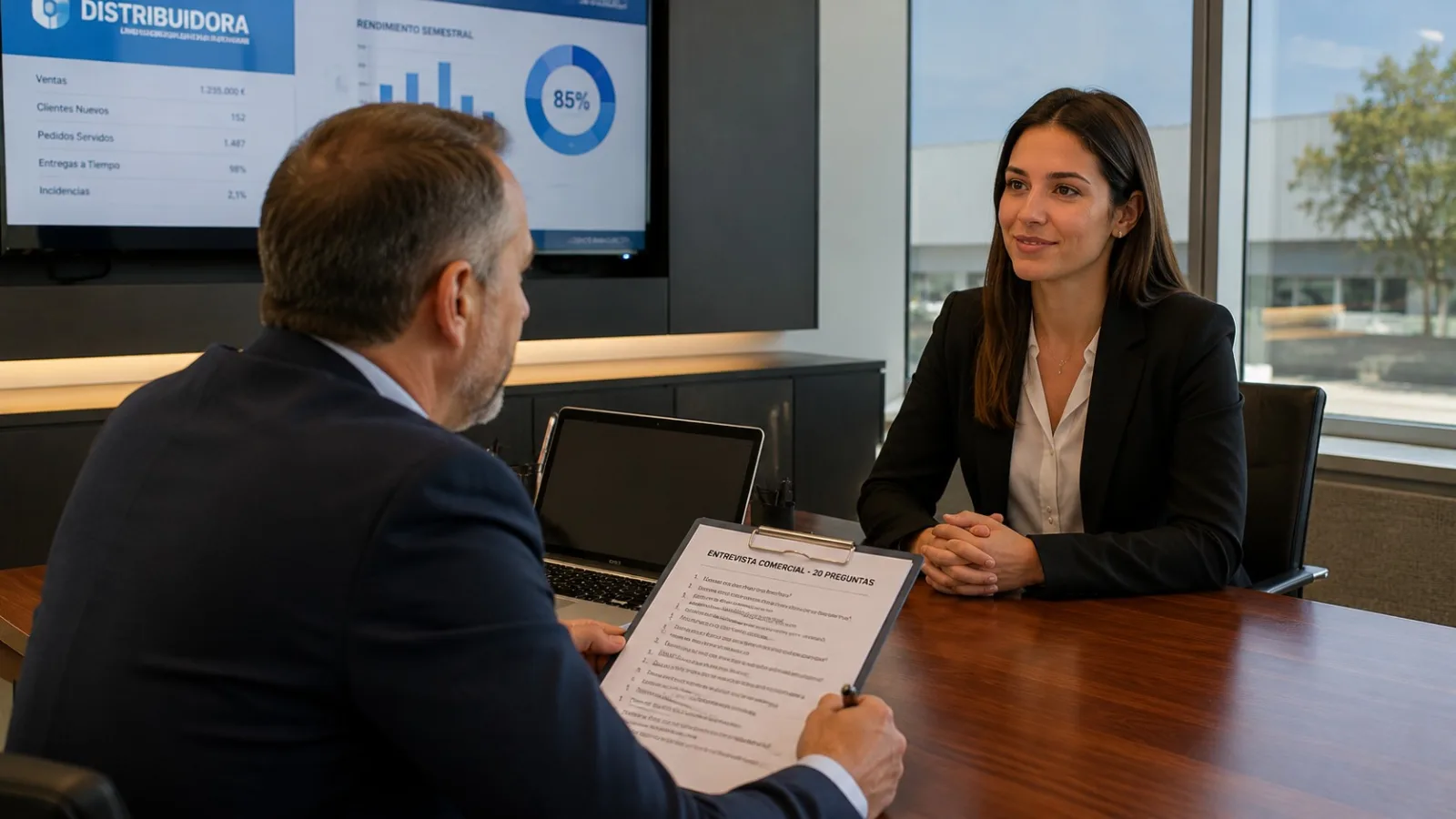
The salesperson's DNA: 20 key questions to sign the perfect sales rep for your distribution business
In distribution, how stock moves and how profitable the business is depend on one critical factor: the sales force. There's an old debate in the sales world: are good salespeople born or made? At Red Paralela we have no doubt. Technical knowledge of a product or a route can be taught in a few weeks; however, the psychological profile of a born salesperson is innate.
Resilience, empathy, hunger for success and tolerance of frustration aren't learnt from a company handbook. That's why, if you need to bring sales talent into your distribution company, you shouldn't look for whoever knows your current catalogue best, but for whoever has the right mindset to open up markets and close deals.
"Don't hire a sales rep for what they know about your product; hire them for how they react when a customer says no."
If you're looking to strengthen your sales network, these are the 20 psychological and behavioural questions you should ask in interviews to find out whether you're facing the ideal candidate.
Block 1: Resilience and handling rejection
Day-to-day life in distribution is full of "no"s and closed doors. You need to know how the candidate deals with frustration.
- 1. How do you handle a flat "no" after months of negotiating with an important account or outlet? (Look for emotional maturity and the ability to move on quickly.)
- 2. Tell me about the toughest sale you've lost in your career and what you learnt from it. (Assesses their capacity for self-criticism.)
- 3. What do you do to keep your motivation high when you go through a sales drought? (Measures their discipline and whether they depend only on peak seasons.)
- 4. How do you react to a customer who is openly hostile or angry? (Assesses their impulse control and assertiveness.)
- 5. What drives you to keep making cold calls or cold visits on a Monday morning? (Explores their inner engine: money, self-improvement, recognition?)
Block 2: Empathy and customer psychology
Selling in distribution isn't delivering a monologue; it's listening and understanding the pain points of the customer's business.
- 6. If you had to explain our distribution model to a 10-year-old, how would you do it? (Measures their ability to simplify complex pitches and arguments.)
- 7. How do you identify the real needs of a customer who doesn't even know what they want? (Assesses their skill at asking strategic diagnostic questions.)
- 8. In a first meeting with a prospect, what percentage of the time do you talk and how much do you let the other person talk? (The ideal answer should favour active listening, at least 60/40.)
- 9. Tell me about a time you had to win the trust of a customer who was wary of suppliers. (Look for techniques for building long-term relationships.)
- 10. How do you handle price objections without immediately offering a discount or cutting the margin? (Measures whether they know how to defend the value of the service.)
Block 3: Method, organisation and proactivity
Talent without order isn't sustainable in distribution. A good sales rep must be methodical with their routes and their portfolio.
- 11. How do you qualify a prospect to know whether it's worth investing time in visiting them? (Stops them wasting time on unprofitable accounts.)
- 12. Describe your process for preparing a meeting with a key account or major buyer. (Assesses whether they improvise or research the market thoroughly beforehand.)
- 13. Which technology tools or CRM do you consider essential for managing your customer portfolio? (A modern salesperson must rely on data and follow-up.)
- 14. How do you prioritise your diary when you have pending routes, incidents and new contacts to make? (Measures their time management under pressure.)
- 15. If you joined our team, what would you do in your first 30 days to start generating opportunities? (Look for proactivity, initiative and autonomy.)
Block 4: Ambition and results orientation
Distribution needs people who want to compete, beat quotas and keep growing their assigned territory.
- 16. What percentage of your monthly targets do you personally consider a "success"? (If they settle for 100%, they lack ambition. The best always aim for 120%.)
- 17. Would you prefer a high base salary with low commission, or a modest base with unlimited commission? (A salesperson confident in their ability will always choose the second option.)
- 18. What has been the biggest sales achievement of your career so far, and how did you achieve it? (Look for passion and pride when recalling the success.)
- 19. When do you decide it's time to give up on a prospect and stop pushing? (Measures their efficiency; knowing when to walk away so as not to waste time is also a virtue.)
- 20. Why should we choose you over candidates who do have direct experience in our distribution niche? (The acid test: if they can't sell themselves with this question, they'll hardly sell your products.)
Conclusion: the catalogue can be learnt, the profile has to be spotted
As a distributor, when you use this set of questions in your selection processes, don't focus only on the content of the answers. Pay special attention to the candidate's tone, body confidence and energy.
A sales rep with the right psychological profile will answer the hard questions honestly, won't try to dress up past failures and will show, from the very first minute, that they are in control of the conversation. After all, the job interview is their first big sale; if they can convince you, they'll be able to convince your customers.