
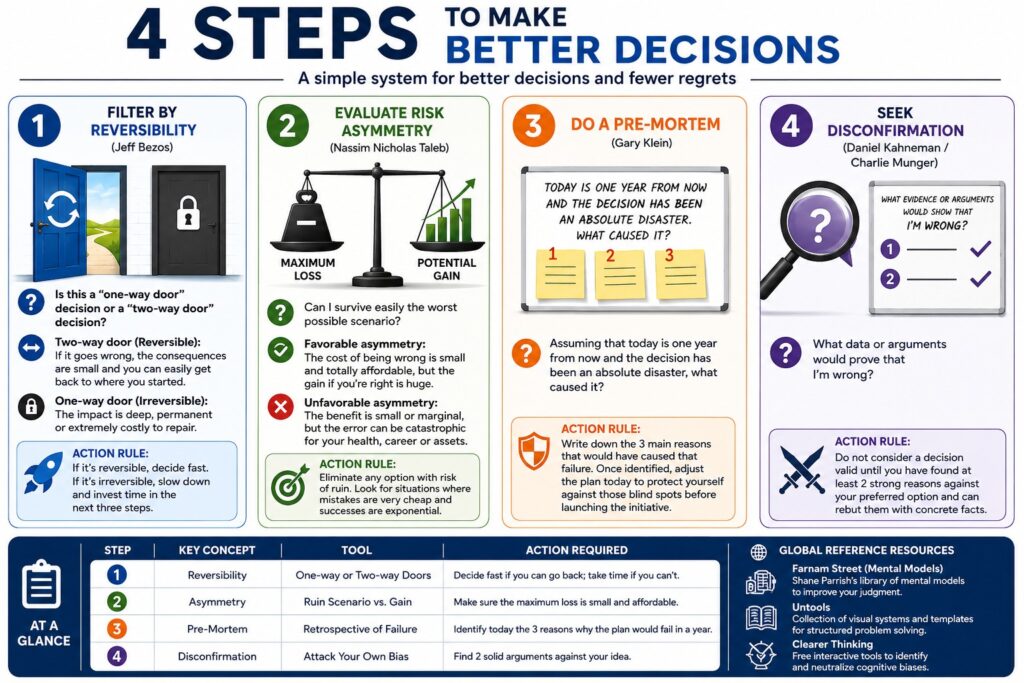
4 Steps to Making Good Decisions
Making the right choice on important decisions rarely depends on intuition or luck. People who make fewer mistakes aren’t smarter; they simply use a filtering system to eliminate emotional noise and self-deception before taking action.
This 4-step protocol synthesizes risk management methodologies and cognitive psychology developed by key figures such as Nassim Taleb, Jeff Bezos, Gary Klein, and the brothers Chip and Dan Heath (authors of the WRAP framework).
If you are about to make a complex decision, you can try running it through this sequence before taking the plunge.
Step 1: Filter by Reversibility (Jeff Bezos)
The question: Is it a “one-way door” or a “two-way door” decision?
-
-
- Two-way decision (Reversible): If it goes wrong, the consequences are minor and you can quickly return to the starting point.
- One-way decision (Irreversible): The impact is profound, permanent, or extremely costly to fix.
-
Rule of action: If the decision is reversible, decide quickly. Getting paralyzed analyzing data on correctable decisions is a waste of time. If it is irreversible, slow down and invest resources in the next three steps.
Step 2: Evaluate Risk Asymmetry (Nassim Nicholas Taleb)
The question: Can I easily survive the worst-case scenario?
Analyze only the relationship between your maximum loss (if things go wrong) and your potential gain (if things go right).
-
-
- Favorable asymmetry: The cost of being wrong is bounded and completely manageable (e.g., losing a limited budget or 20 hours of work), but the benefit if you succeed is huge.
- Unfavorable asymmetry: The benefit is small or marginal, but an error could prove catastrophic for your health, career, or cash flow.
-
Rule of action: Immediately discard any option with a risk of ruin. Look for situations where mistakes are very cheap and successes pay off exponentially.
Step 3: Perform a Pre-Mortem (Gary Klein)
The question: Assuming today is one year from now and the decision has been an absolute disaster, what caused it?
The human brain tends toward overconfidence bias when it wants something to succeed. A Pre-Mortem turns the analysis around by forcing you to conduct a retrospective from future failure.
Rule of action: Write down on a sheet of paper the top 3 reasons that caused that hypothetical failure. Once identified, adjust your plan today to shield yourself against those blind spots before launching the initiative.
Step 4: Seek Disconfirmation (Daniel Kahneman / Charlie Munger)
The question: What data or arguments would prove that I am wrong?
Confirmation bias makes you look only for information that validates the option you instinctively prefer. To make objective decisions, you must force yourself to do the opposite work.
Rule of action: Do not consider a decision valid until you have found at least two solid reasons against your preferred option and have been able to refute them with concrete facts.
Quick Execution Summary
| Step | Key Concept | Tool | Required Action |
| 1 | Reversibility | 1 or 2-way doors | Decide fast if you can go back; take your time if you can’t. |
| 2 | Asymmetry | Ruin scenario vs. Gain | Ensure the maximum loss is small and manageable. |
| 3 | Pre-Mortem | Failure retrospective | Identify today the 3 reasons why the plan would fail in a year. |
| 4 | Disconfirmation | Challenging your own bias | Find 2 solid arguments against your idea. |
Global Reference Resources for Further Reading
-
-
- Farnam Street (Mental Models): Shane Parrish’s mental model library to improve judgment.
- Untools: Collection of visual systems and templates for structured problem-solving.
- Clearer Thinking: Free interactive tools to identify and neutralize cognitive biases.
-