What will HORECA distribution look like in 20 years?

¿Cómo será la distribución HORECA dentro de 20 años?

What will HORECA distribution look like in 20 years?

A hypothesis: perhaps the distributor will no longer be necessary.

We have been directly linked to distribution for almost 40 years.
We have seen changes in products, brands, purchasing habits, management systems, and ways of interacting with hospitality establishments.
Today Red Paralela is no longer a traditional HORECA distributor. But precisely because of this, we can look at the sector from a different position and ask ourselves a question:

What will HORECA distribution look like in 20 years?

What we are going to propose below is not a prediction.
It is just a hypothesis.
But a hypothesis that, seeing how artificial intelligence, automation, and the ability to connect information in real-time are advancing, we believe is worth imagining.

And if we take this evolution to its ultimate consequences, a quite radical scenario emerges:

What if, in 20 years, the distributor as we know it today had practically disappeared?

No one would place orders anymore

Today, a restaurant needs to place orders.
Someone checks the warehouse, calculates what is needed, talks to a sales rep, logs into a platform, sends a message, or makes a call.
Then the distributor prepares the order, organizes a route, and delivers it.
It is a process we have built over decades.

But imagine another scenario.
The restaurant’s management system is directly connected to its daily activity.
It knows what it sells.
It knows what is left.
It knows the reservations.
It detects consumption rates.
It can foresee what it will need in the coming days.
And, thanks to artificial intelligence, it can anticipate needs that today still require human intervention.

When the system detects that a certain product is needed, it does not generate an alert for someone to place an order. It generates it directly.

The hospitality owner sets the rules. The system does the rest.

This does not mean the restaurant loses control. On the contrary.

The owner could perfectly decide how they want their supply chain to work:

  • For this product, I always want this brand.
  • For this other one, I accept any equivalent product.
  • In this case, I want to work with a specific manufacturer.
  • Here, I want the best price.
  • For this product, I do not want substitutions.
  • And for those that are not critical, you can automatically choose the best available option.

The hospitality owner establishes the rules.
The system takes care of executing them.

And this is where everything changes. Because that system would no longer need to be connected to a distributor. It could be connected directly to manufacturers and producers.

The manufacturer would no longer need to go through the distributor

Imagine that a manufacturer knows, thanks to these platforms, that in the coming days, certain products will have a specific demand in a particular area.

They could send merchandise directly to large logistics centers.
Not necessarily because someone has placed a specific order.
But because the available information makes it possible to anticipate demand.

These centers could receive merchandise from thousands of different manufacturers and producers.
Store it. Sort it. Preserve it when necessary. Prepare it. And group it to make deliveries as efficiently as possible.

The merchandise would be much closer to the demand even before the establishment formally made the purchase. And when the restaurant’s system needed that product, it could locate it automatically and trigger the whole process.

Manufacturer / producer ➔ Logistics center ➔ Restaurant
(Without the need for a distributor between them)

The logistics center becomes a fundamental piece

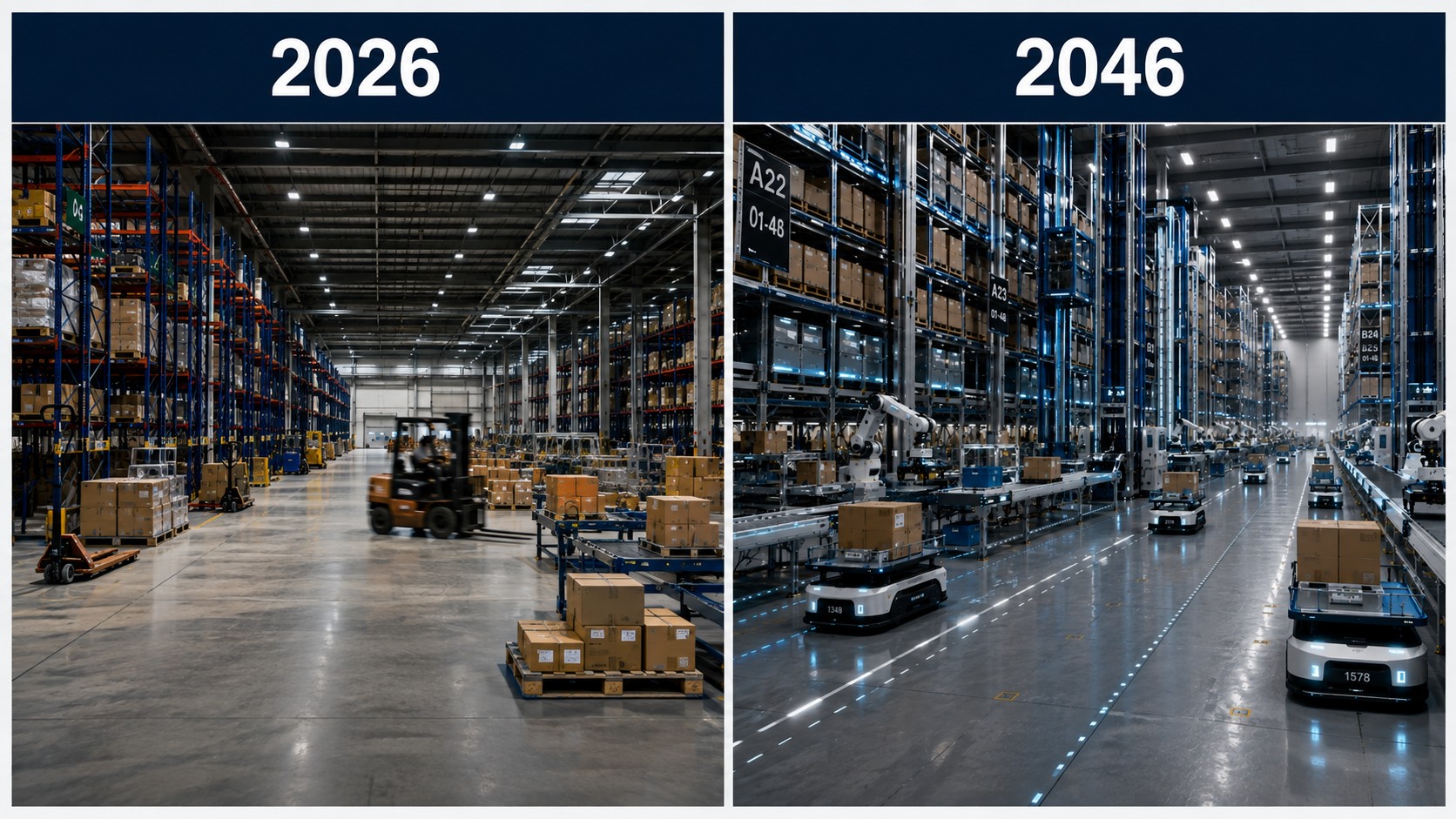
This would probably be impossible without a massive transformation in logistics.
We could imagine large, highly automated platforms capable of managing goods from thousands of suppliers and manufacturers.
Practically robotic warehouses.
Systems capable of knowing in real-time what is stored, whose it is, where it is, and what demand exists for each product.
And, above all, capable of grouping products from many different manufacturers into a single delivery.

That would be one of the great advantages of the model.
Today, a distributor needs to buy, store, and manage a huge number of references to offer a sufficiently wide assortment to its clients.
In this scenario, that function disappears.
The restaurant can access a huge catalog without a single company having to own all that stock.

And billing could also disappear from the manual process

If the system knows what has been ordered, what has been delivered, at what price, and under what conditions, billing can be integrated into the same process.

The product leaves the logistics center.
It arrives at the restaurant.
The system registers the delivery.
The invoice is generated.
It is accounted for.
The payment is made.

Everything connected.
No calls. No emails. No manual data entry. Without multiple companies having to exchange information over and over again.
The operation could be automated from start to finish.

So, what happens to the distributor?

Here is the most important part of our hypothesis.
If this system were to work really well, the traditional distributor could cease to be necessary for a large part of the products it sells today.

Not because someone decided to eliminate them.
Simply because their intermediation role would no longer add enough value.

If a manufacturer can reach the hospitality owner directly.
If the product can be stored in a large logistics center.
If that center can prepare and group the goods of thousands of suppliers.
If artificial intelligence can anticipate demand.
If the system can automatically generate orders.
And if billing is also connected…

What need would there be for a distributor to buy, store, and resell that product?

This is probably the most uncomfortable question in the entire article.

But perhaps not all distributors will disappear

Even in this scenario, it is hard to imagine that absolutely all products could work in the same way.

Specialized distributors could survive.
Companies working with very specific brands.
Limited production products.
Products requiring special conservation or handling.
Products requiring highly technical knowledge.
Small brands that do not have the capacity to enter large networks.
Unique products whose sale depends heavily on advice, prescription, or personal relationships.

In those cases, the distributor could still make sense.
But they would be a very different distributor.
They would not compete to have the largest warehouse or the most trucks.
They would compete based on their knowledge, their brands, their specialization, and their ability to provide something that the large platform cannot automate.

What if this were truly the future?

We insist: this is only a hypothesis.
We do not know if it will happen. We do not know when. We do not know what barriers will appear. We do not even know if technology will ever integrate so completely.

But many of the pieces of this scenario already exist separately:

  • Artificial intelligence can analyze and anticipate demand.
  • Systems can communicate with each other.
  • Logistics is moving towards increasing automation.
  • Warehouses are becoming smarter.
  • Manufacturers have more and more information about consumption.
  • And establishments generate massive amounts of data about what they sell and what they need.

The interesting question is what will happen when all these pieces are connected.

Perhaps the big shift won’t be technological

Perhaps it will be business-related.

For decades, we have built distribution around a central figure: the distributor.
The distributor buys. Stores. Finances. Maintains stock. Sells. Prepares. Transports. Invoices.

But if technology allows direct connection between demand and supply and the use of large shared logistics infrastructures, some of those functions might no longer need an intermediary company.

And then the model could shift from:

Manufacturer ➔ Distributor ➔ Restaurant

to something much more like:

Manufacturer / producer ➔ Logistics center ➔ Restaurant

With a massive technological layer connecting everything.
And perhaps the real protagonist will no longer be the distributor.
It will be the information about demand.

A hypothesis worth starting to think about today

We do not know if in 20 years we will see exactly this scenario. Probably not.
The future always ends up being different from how we imagine it.

But we believe it is worth raising because it forces us to ask a question that could be important long before 2046:

If one day technology manages to directly connect manufacturers and producers with HORECA establishments, anticipate their needs, manage stock, organize logistics, and automate billing… what role will be left for the distributor?

Perhaps they will disappear.
Perhaps they will transform.
Perhaps they will survive only where the product, the brand, or the knowledge still requires a person in the middle.

We do not know.

But if this hypothesis makes any sense, the future of HORECA distribution will not be about doing what we do today, better.
It will be about asking ourselves what part of what we do today will be necessary tomorrow.

And perhaps that is a question we shouldn’t wait twenty years to answer.
AI in HORECA Distribution: Transforming Customer Service

Atención al cliente con inteligencia artificial en distribución horeca

AI in HORECA distribution: Why a wholesaler’s phone can no longer afford to “communicate”

In the fast-paced day-to-day of the HORECA channel, time is the most expensive ingredient. For a wholesale distributor, managing calls during “peak hours” is often a bottleneck: last-minute orders, queries about lost invoices, or the eternal question “where is my truck?”.

Digitalization has advanced significantly with e-commerce platforms, but the landline phone remains the trusted channel for many customers. The good news is that, thanks to Artificial Intelligence, this traditional channel has become a high-efficiency tool.

The Voice Agent: Your new “employee” that never rests

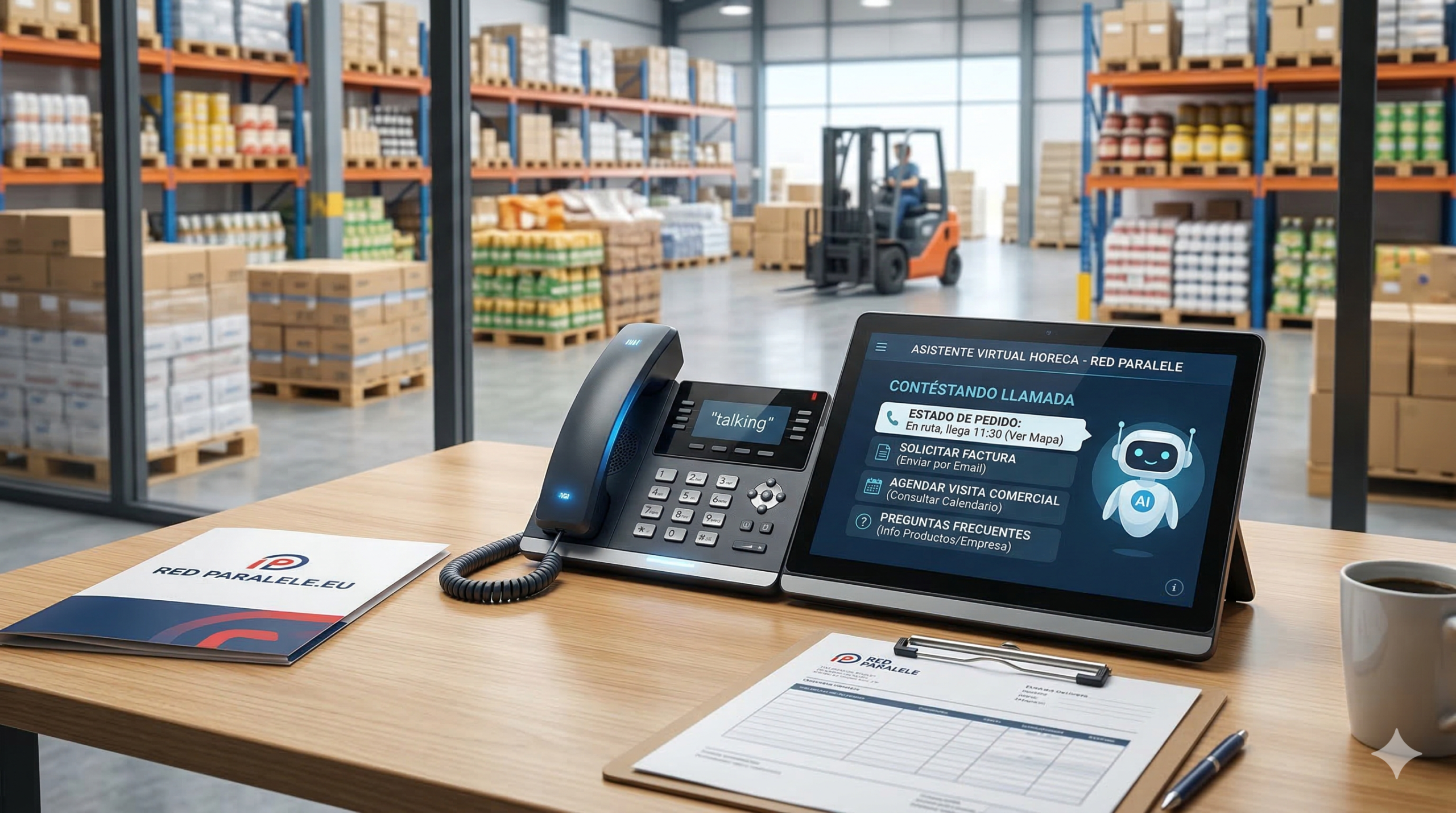
Unlike old “press 1 for sales” switchboards, today’s AI voice agents hold natural conversations. They understand context, don’t get tired and, most importantly, are integrated with company data.

What can this technology actually do for a HORECA wholesaler?

1. Intelligent Reception and Routing

The agent answers the call on the first ring. It identifies whether the customer needs to speak with accounting, their assigned sales representative, or the warehouse.

  • The benefit: No more hold music and endless call transfers. The customer reaches the right person immediately.

2. On-the-fly Document Management

It’s common for a restaurant owner to call asking for an invoice for their accountant or a quote for a special event.

  • The solution: The AI accesses the ERP, locates the document and sends it via email or WhatsApp in seconds, while continuing the conversation with the customer. No human intervention.

3. Real-time Order Status

“What time will my order arrive today?” This is the most frequently asked question.

  • The solution: Being connected to logistics, the AI informs about the expected delivery window or any incidents on the route, reducing stress for both the customer and the customer service team.

4. Answering Questions and FAQs

From checking allergens of a specific product to knowing the minimum order for a particular area, the AI acts as a living company manual, accurately answering any technical question about the catalog.

5. Automated Sales Scheduling

If a customer identifies a need that requires personal attention, the AI doesn’t just take note: it can check the sales representative’s schedule for that area and book a visit directly. This ensures no business opportunity is lost due to administrative oversight.

Reflection: Implementing AI is not about replacing human interaction, but freeing it from repetitive tasks so it can focus on what truly adds value: personal relationships and strategic advice.

Towards smarter distribution

At Red Paralela, we believe that operational efficiency is the key for the HORECA sector to keep growing. This forward-looking vision and continuous technological evolution are made possible thanks to our innovation ecosystem, where we rely on the technical support of grau.ad (a group company), who help us integrate these cutting-edge solutions into the day-to-day of distribution.

The future of wholesale distribution is not just about moving boxes; it’s about moving information quickly, accurately and humanly. Is your phone ready for the next level?


Beverage Distribution in Spain: How to Survive the Administrative Stranglehold in 2026

Un camión de reparto en la plaza de una ciudad aplastado por un mazo gigantesco

Administrative suffocation in wholesale beverage distribution: Comply with laws or sell product?

The wholesale beverage distribution sector in Spain is going through a critical phase. What was traditionally a business based on logistical efficiency and commercial relationships is becoming a race through bureaucratic obstacles. The convergence of new environmental regulations, digitized fiscal controls and market regulations is forcing qualified staff to spend more time filling out forms than optimizing routes or visiting clients.

In this article we analyze the regulations that, although with commendable objectives, are reducing the competitiveness of our companies by imposing tasks that add no real value for the customer.

1. The environmental maze: From RD 1055/2022 to the new European Regulation (PPWR)

Packaging management has become a massive statistical task for distributors. Royal Decree 1055/2022 already requires a detailed breakdown of weights and materials for every product reference placed on the market. But the challenge does not end there.

Starting on August 12, 2026, the new European Packaging Regulation (PPWR) will come into effect. This regulation introduces even stricter obligations:

      • Space minimization: Empty space inside grouping and transport boxes may not exceed 50%.

      • Supplier auditing: Wholesalers must request and archive certificates of conformity from each manufacturer to ensure packaging complies with the new recyclability standards.

      • ERP data registration: Management systems must be adapted to record the exact composition and recyclability class of each package.

Obligation Administrative Task Impact on Staff
Producer Registration Annual reporting of units, weights and materials. Very High (Months of data collection).
PPWR Certification Audit and archiving of supplier certificates. High (Technical and documentation workload).
Empty Space Control Physical and documentary verification of packaging. Medium (New warehouse protocols).

2. The Plastic Tax: A persistent “operational chaos”

Since its implementation, the tax of €0.45/kg on non-reusable plastic has been described by associations such as ANAIP as a source of legal uncertainty. The problem is not only the cost, but also traceability:

      • Impossible certifications: Getting international suppliers to provide the Spanish standard UNE-EN 15343:2008 is a titanic task that often ends with the company assuming the full tax cost due to lack of documentation.

      • Refund management: The procedure before the AEAT to recover the tax on exports is so complex that many SMEs give up, losing commercial margin.

3. Food Chain Law and the RECA Register

The reform of Law 12/2013 sought to balance the chain, but it has introduced contractual rigidity that clashes with the day-to-day dynamism of the sector.

      • RECA registration: Requires each contract and its modifications to be registered in the AICA digital registry before delivery takes place.

      • Destruction of agility: In a sector where offers change daily and volumes fluctuate, this constant “data entry” prevents quick deals and forces sales staff to act as data administrators.

4. Total fiscal surveillance: SILICIE, EMCS and VeriFactu

For those distributing alcohol, the digital tax burden is permanent. In addition to the already known SILICIE system (immediate reporting of special tax accounting books) and the EMCS system for the circulation of goods , new requirements are now being added:

      • VeriFactu (January/July 2026): All companies and self-employed professionals must implement systems for the immediate transmission of invoicing records to the AEAT.

      • Fiscal Stamps: Starting January 1, 2026, the commercialization of spirits with old fiscal stamps will be prohibited, requiring rigorous physical and documentary stock control to avoid serious penalties.

System Function Administrative Burden
SILICIE Real-time electronic accounting of alcohol. Very High (Reporting for every movement).
VeriFactu Immediate transmission of invoices to the tax authority. High (Investment in software and processes).
EMCS Control of the movement of excise goods. High (ARC code management).

5. The challenge of Urban Logistics (DUM-H)

Not all bureaucracy is in offices. Municipal regulations on Urban Goods Distribution (DUM-H) are suffocating delivery drivers:

      • Low Emission Zones (LEZ): Require specific authorizations for each vehicle in each municipality, with platforms that do not communicate with each other.

      • Insufficient loading times: The standard 30 minutes are unfeasible for reverse beverage logistics (collection of empty containers and kegs), generating an avalanche of fines that administrative staff must contest daily.

Conclusion: Toward a digitalization that frees rather than chains

The sum of these tasks —environmental, fiscal, contractual and logistical— consumes more than 1,500 hours per year in bureaucratic procedures for companies in our sector. That is time not spent finding new clients or improving our catalog.

What is the solution?

      1. Automation: Integrating the ERP with public systems (RECA, SILICIE, VeriFactu) is now a survival requirement, not an option.

      2. Administrative unification: Authorities must urgently apply the “only once” principle so companies do not have to report the same data to different ministries.

At RED PARALELA, we believe the value of a wholesaler lies in its service capacity and its knowledge of the market, not in its ability to fill out forms. We also believe it is time to rationalize the legislative ecosystem so those who truly move the economy can focus on their work.

Automating order management for HORECA distributors

automatización de pedidos del distribuidor horeca

Automate or Die: The Future of Order Reception in the Horeca Channel

The Horeca distribution sector is living a paradox: while gastronomy innovates at a breakneck pace, many distributors are still managing their orders as they did twenty years ago.

If your operations still depend on a sales rep listening to WhatsApp voice notes at midnight or an administrator transcribing paper notes into the ERP, you have a leak problem.

  • Leaks of time,
  • of money and,
  • most seriously, of customers.

In a market with tight margins, efficiency is no longer an extra; it is your life insurance.

The Era of Zero Error: Technologies that Dictate Who Stays Behind

Automation is not about “buying software,” it’s about eliminating the bottlenecks that kill your profitability. These are the tools that are separating the leaders from those about to disappear:

1. B2B Portals: Your Store Open While You Sleep

Waiting for a sales rep to visit the premises is a thing of the past. A dedicated B2B e-commerce portal allows hospitality professionals to place their orders at their moment of greatest need (when closing the books or taking inventory).

  • The impact: You reduce the cost per order to almost zero and prevent the customer from calling the competition if your sales rep doesn’t arrive on time.

2. AI and OCR: Digitalizing Customer Chaos

You cannot force all your customers to be tech-savvy, but you can be. Artificial Intelligence with OCR solutions allow you to receive a photo of a crumpled delivery note or a voice message and automatically convert them into a structured order in your system.

  • The advantage: You maintain customer convenience while eliminating human error in data entry.

3. EDI (Electronic Data Interchange): The Language of the Giants

If you aspire to serve large restaurant chains or organized groups, EDI is your “identity document.” It remains the gold standard for systems to talk to each other without human intervention, ensuring that the order, delivery note, and invoice match to the penny.

4. Self-Sales and Pre-Sales Apps (SFA)

Giving your sales reps total mobility. The order is closed at the customer’s table and printed in the warehouse in real time. If your sales rep is still taking notes in a notebook to record them when they get back to the office, you are losing critical logistics hours.

Why Resistance to Change is Your Company’s Biggest Cost

Many distributors fear that technology will “cool down” the relationship with the customer. The reality is quite the opposite:

      • Fewer incidents = Happier customers: A misdelivered order due to a transcription error damages the relationship more than any machine ever could.
      • Sales reps, not data entry clerks: Your sales team should be advising, introducing new references, and improving margins, not typing data into a screen.
      • Precision logistics: Receiving automated orders allows for delivery route optimization even before the warehouse opens.

Conclusion: The Clock is Ticking

Technology has stopped being an economic barrier and has become a mental one. Distributors who remain anchored in “the way we’ve always done it” will see their operating costs devour their profits, while digitalized competitors gain market share with leaner and faster structures.

Impact of automation and digital transformation: how to measure efficiency and cost reduction

Automation and digital transformation are no longer futuristic concepts: they are the foundation of today’s competitiveness. For HORECA distributors and many SMEs, adopting technologies and automated processes means working with fewer frictions, reducing costs, and gaining agility.

But the big question is: how can their impact really be measured?

1. Operational efficiency: key indicators

Efficiency is not a perception; it is measured with data. Some useful KPIs are:

  • Process time → how many minutes are reduced in repetitive tasks (orders, invoicing, route management…).
  • Operational errors → incidents before and after automation.
  • Fulfillment rate → percentage of orders delivered on time and in full.
  • Productivity per employee → number of operations each person manages after digitalization.

2. Cost reduction: where to look for savings

The most direct impact is usually found in:

  • Labor costs: fewer hours dedicated to manual tasks.
  • Logistics costs: more efficient routes, lower fuel consumption.
  • Inventory costs: fewer stockouts or excess merchandise.
  • Administrative costs: electronic invoicing, automatic reconciliation.

3. Return on investment (ROI)

The initial cost of implementing technology is only part of the equation. What really matters is:

  • Payback period: time needed to recover the investment thanks to the savings generated.
  • Estimated annual savings: comparison of costs before and after.
  • Indirect benefit: customer satisfaction, loyalty, and new business opportunities.

4. Measurement tools

  • Real-time dashboards integrating sales, logistics, and finance.
  • Internal benchmarking: comparing quarters before and after each implementation.
  • Satisfaction surveys for employees and customers to measure perception of agility and quality.

In conclusion, automation is not just a trend but a real lever for savings and efficiency. The key is to accompany each initiative with clear metrics that allow its impact on the bottom line to be verified. Sometimes it is enough to start measuring to realize how much room for improvement still lies ahead.