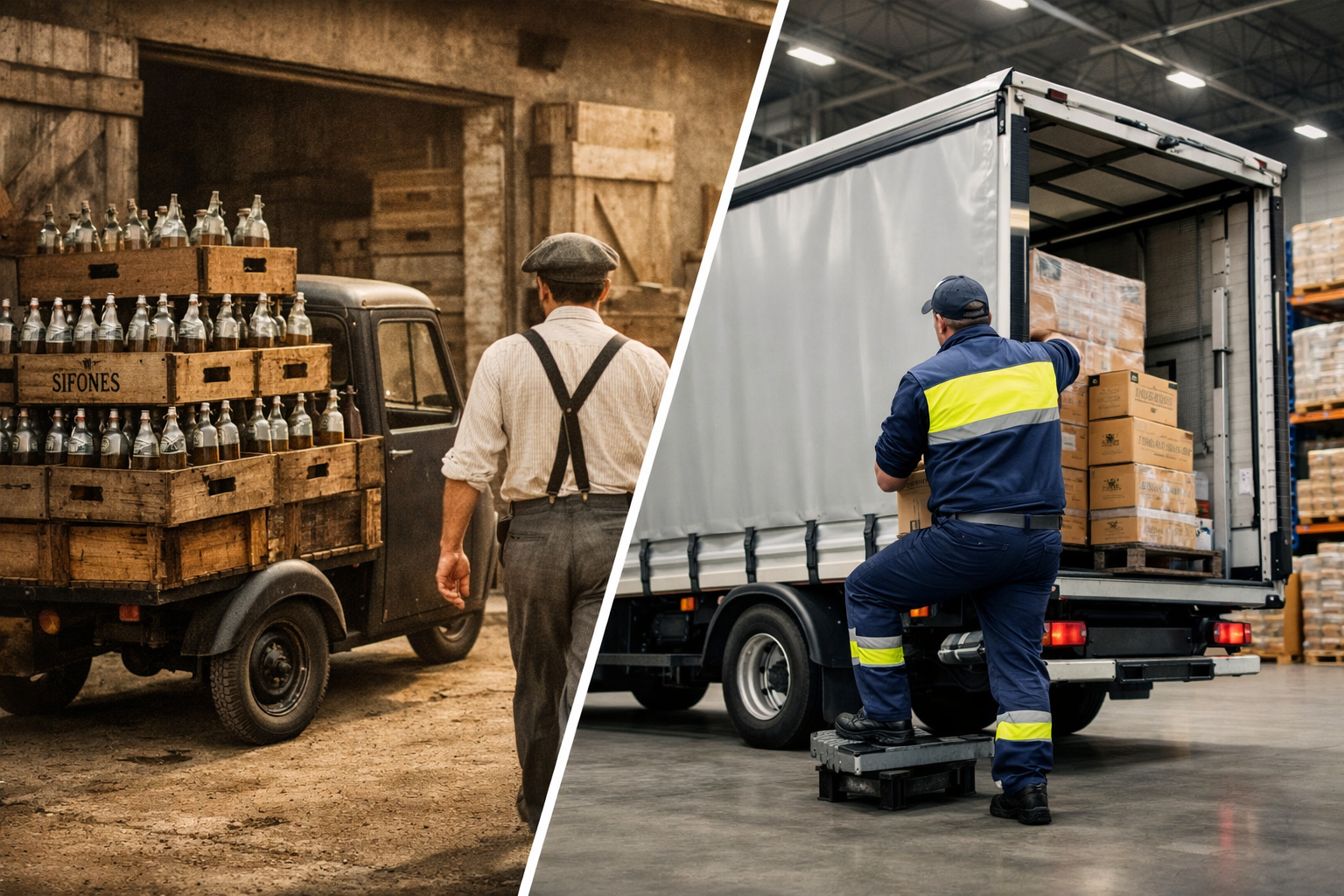
The intergenerational shift in HoReCa distribution: when growth is no longer about accumulation

De la distribución artesanal al modelo logístico actual: una evolución que invita a reflexionar.

Where We Come From — and Why the Model Is Starting to Weigh Us Down.

Many beverage and soft drink distribution companies did not start out as distributors. They began as small local producers of soda water, siphon bottles, or soft drinks. Family businesses, closely tied to their territory, that grew by solving a simple problem: supplying drinks to the bars in their area.

Carbòniques Montaner is a clear example of that journey. It went from manufacturing siphon bottles in the 1930s to distributing water, then beer, and later soft drinks. The next step was a logical one: together with other distributors in the region, it created a buying group to better manage that growth, add more product lines, and gain autonomy and independence from manufacturers who put pressure on our company, fully aware of the leverage they held over it. Over time, it continued expanding the catalogue until it was distributing around 1,000 SKUs.

That model worked. And it worked well for many years. Until, gradually, we became Red Paralela, leaving behind the capillary, local delivery model that had accompanied us for so many decades.

Technology followed that evolution too: from the fax machine to the first IT systems, and from there to what Red Paralela is today—an extranet designed to organise and manage distributors’ parallel operations.

Three generations along this path.

Today, many distributors still build their business around one or two official brands that are the true backbone of their revenue. In many cases, more than 50% of the business depends on them. Around that core, there is a very broad range of brands and product families that “tag along”, but are not strategic.

And that “tag-along” range comes at a cost:

      • A growing labour cost: more sick leave and lower productivity than ever.
      • An ever-increasing financial cost.
        A logistics cost that is hard to justify.
      • And a management cost that never stops rising.
      • While the core brand sustains the business, everything else starts to weigh it down. More SKUs, more stock, more breakages, more errors, and more resources spent on products that do not create real value

On top of that, the current context is especially challenging. Labour costs rising out of control. A suffocating regulatory environment. New laws, procedures, and obligations piling up—and instead of helping, they make day-to-day operations harder and reduce the ability to be efficient.

      • More rules every day.
      • Less margin every day.

And that is where uncomfortable questions begin to appear:

      • Does it make sense to maintain structures designed for massive catalogues when the real business rests on three or four key manufacturers?
      • Wouldn’t it be more sensible to simplify, focus efforts, and be extremely efficient by representing only those manufacturers that truly support the distributor (now and in the future) and that the distributor can genuinely defend?
      • Could it be time to stop and rethink the model before the structural weight makes it unviable?

Rethinking the model is not always comfortable, but it is almost always necessary.

The Escalating Costs in HORECA Distribution: Data, Trends, Legislation, and Accounting Control

In recent years, distributors in the HORECA channel (Hotels, Restaurants, and Catering) have faced a growing challenge: the sustained increase in operating costs. Transportation, energy, labor, and environmental regulations are some of the factors putting pressure on margins and reducing competitiveness.

In this article, we analyze the most relevant data, the trends for the coming years, the legislation affecting the sector, and how to design a control system based on accounting data to help you anticipate and maintain profitability.

1. How Much Have Costs Risen in Recent Years?

Transportation and Fuel

Transportation costs have risen significantly, driven by fuel prices, tolls, and the shortage of drivers. Since 2020, the cumulative increase is around 25–30%, with peaks in 2022 due to the energy crisis.

Energy

The cost of electricity and gas for industrial use nearly doubled between 2021 and 2022, significantly increasing expenses for refrigeration, storage, and preservation. Although prices have stabilized, they remain well above pre-pandemic levels.

Labor

Spain’s Minimum Wage (SMI) has risen by more than 50% since 2018. This translates into higher labor costs and social contributions for distribution companies. The impact has been especially significant for warehouse staff and delivery drivers, while more qualified positions (office staff, sales representatives) have experienced smaller increases, although proportionate to updated agreements.

2. Trends for 2025 and Beyond

  • Mandatory Digitalization: Real-time control of inventory, sales, and margins using ERP (Enterprise Resource Planning) and BI (Business Intelligence) tools.
  • Logistics Optimization: Route planning and predictive data to reduce mileage and fuel consumption.
  • Supplier Consolidation: Fewer, more reliable suppliers with long-term agreements to ensure stability.
  • Dynamic Pricing Policies: More frequent price adjustments to adapt to changes in variable costs.

3. Legislation Driving Up Costs

The regulatory framework continues to add pressure:

  • Waste and Soil Contamination Law: Requires packaging management and compliance with recycling objectives.
  • Minimum Wage Increases: Directly impact payroll costs.
  • European Emission Regulations: Will affect vehicle fleets and logistics, requiring medium-term adaptations.

4. The Hidden Cost: More Taxes, More Paperwork, Less Productivity

In addition to direct increases in raw materials, transportation, and energy, there is a silent cost that grows every year: the administrative burden. Each new regulation means:

  • Extra office hours to prepare reports and filings.
  • Implementation or upgrading of ERP systems to comply with reporting requirements.
  • Continuous training for administrative staff.
  • Adaptation to more frequent inspections.
    These tasks do not add direct value to the customer, but they are mandatory. The result: more work, more resources, and higher fixed costs, reducing the distributor’s agility.

5. How to Design a Control System Based on Accounting Data

An accounting control system allows you to move from reaction to anticipation. Here are the key steps:

Step 1. Classify Costs by Responsibility Centers

Group expenses by area: transportation, warehouse, purchasing, sales, personnel, and administration. This will show where cost increases are concentrated.

Step 2. Define Key Performance Indicators (KPIs)

  • Margin by product line.
  • Average delivery cost.
  • Logistics ratio: (Transport + warehouse costs) divided by revenue.
  • Administrative hours per processed order.

Step 3. Automate Data Capture

Integrate invoice, logistics, and sales data into an ERP or BI system that generates automatic reports.

Step 4. Analyze Trends and Set Alerts

Compare key indicators month by month. Set alerts when delivery costs rise more than 10% compared to the previous quarter.

Step 5. Simulate Scenarios

What happens if fuel prices rise by 10%? What if a key customer is lost? Simulation helps you prepare action plans and avoid surprises.

Conclusion

The escalation of costs in HORECA distribution will not stop in the short term. However, a distributor who works with accurate data can anticipate changes, negotiate better with suppliers, and maintain profitability. The key is not just saving, but making informed decisions.

How Can We Help You?

Our mission at RED PARALELA is to be your trusted partner: offering competitive prices and impeccable service all year round, without legal complications or risks from mismanagement that could further increase your indirect costs.