How to Optimize Inbound Transportation Costs

bolsas de transporte

How to Optimize Transport Costs in Wholesale Purchases (Domestic and TIR)

For any wholesaler, the profit margin begins to be decided at the time of purchase. Bringing in stock from suppliers’ factories, whether domestically or through international transit (TIR), involves managing a variable logistics cost that directly impacts the purchase price of the product.

Rate volatility, the lack of vehicle availability during high-demand seasons, and the need to efficiently coordinate both full loads and partial loads require agile tools to ensure procurement transport does not eat into profitability before the goods are even stored. In this scenario, online freight exchanges are the key tool to adjust costs and secure supply.

Cost Optimization in Stock Procurement

Instead of relying on fixed rates or the limited portfolio of traditional agencies, freight exchanges allow mitigating market fluctuations on purchasing routes thanks to two operational pillars:

      • Securing guaranteed return trips: By publishing a pickup requirement in the supplier’s area, the load is exposed to carriers who have made a delivery near that point and need to return to their base. To avoid running empty, they offer highly competitive rates that drastically lower the wholesaler’s acquisition cost.

      • Efficient consolidation of fractional purchases: When a purchase does not require a full truck, these platforms make it possible to locate carriers en route with available space in their trailers. By sharing the journey with other cargo, you pay exclusively for the space occupied by your pallets, optimizing the unit logistics cost of the acquired stock.

The Reference Tools for the Open Market

When purchasing transport is managed through agencies in the spot market, the capacity offer is concentrated in three main environments:

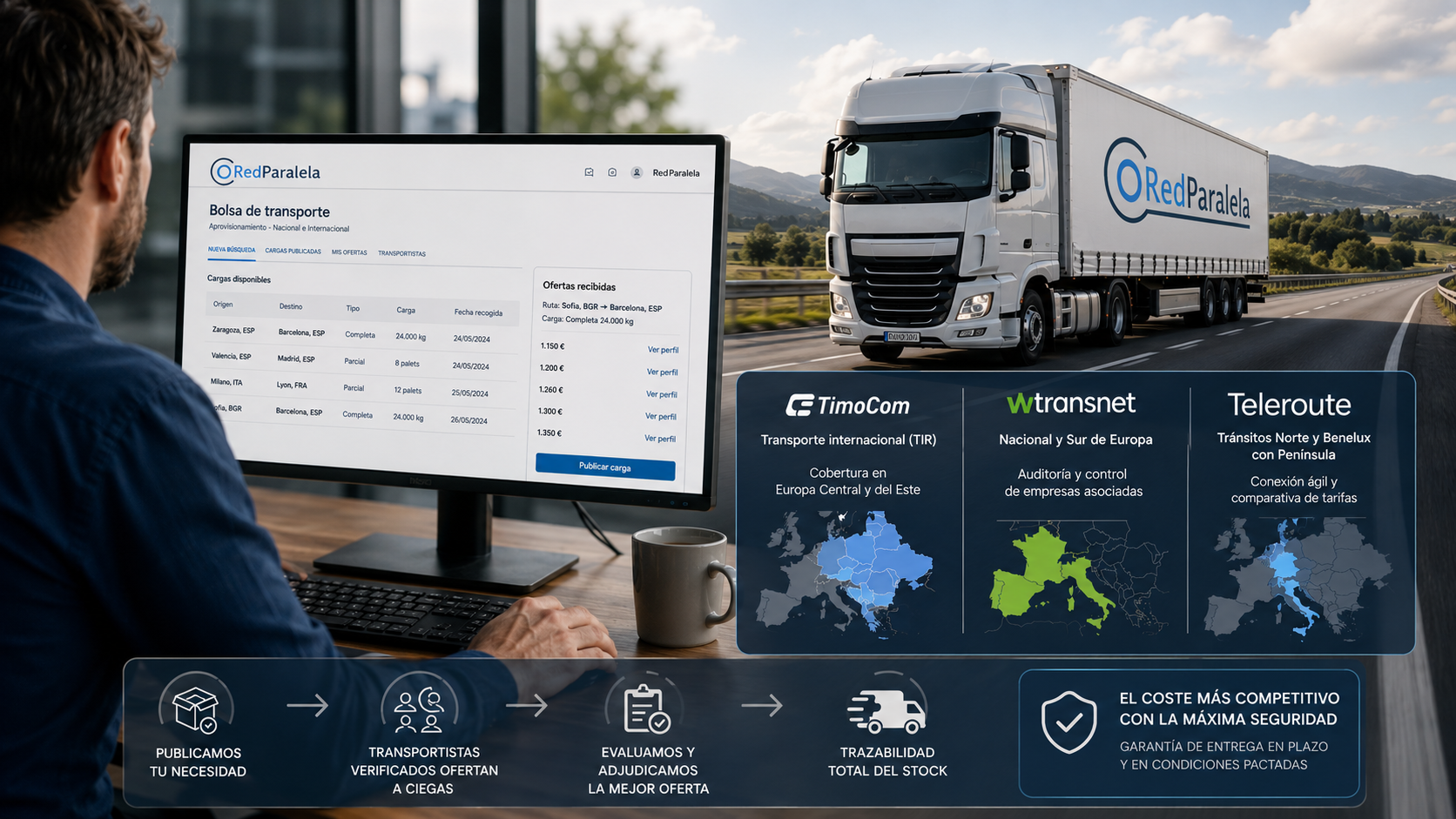
1. TimoCom

It is the indispensable platform for international transport (TIR). Its huge volume of users in Central and Eastern Europe makes it the primary option to secure the transport of imported goods at competitive return rates.

2. Wtransnet

The leading exchange for domestic traffic and Southern Europe (France, Italy, and Portugal). It stands out for the auditing and control of its associated companies, which drastically reduces operational risk when collecting already paid goods from domestic suppliers.

3. Teleroute

Highly consolidated in transits connecting the north of the continent and the Benelux area with the Iberian Peninsula. It is an agile alternative to compare rates and capture carriers looking for return loads to our market.

The Red Paralela Solution

At Red Paralela, thanks to our high volume of operations, we decided years ago to create our own freight exchange.

Our private platform operates under very strict parameters to guarantee maximum security and efficiency in procurement:

      • Verified carriers: We only operate with professionals approved by us who use their own trucks and are prohibited from subcontracting loads.

      • Blind-bid allocation: Carriers bid blindly for each domestic or international collection service we publish, and we decide which of them to award each load to after evaluating the proposals.

This model allows us to have total control over stock traceability from the supplier’s warehouse, guaranteeing the most competitive market price on each route and the absolute security that the goods will reach their destination under the agreed conditions.

PPE in Beverage Distribution

epis almacén de bebidas

PPE in Beverage Distribution: Between the “Absurd”, the Mandatory, and Shielding Your Company Legally

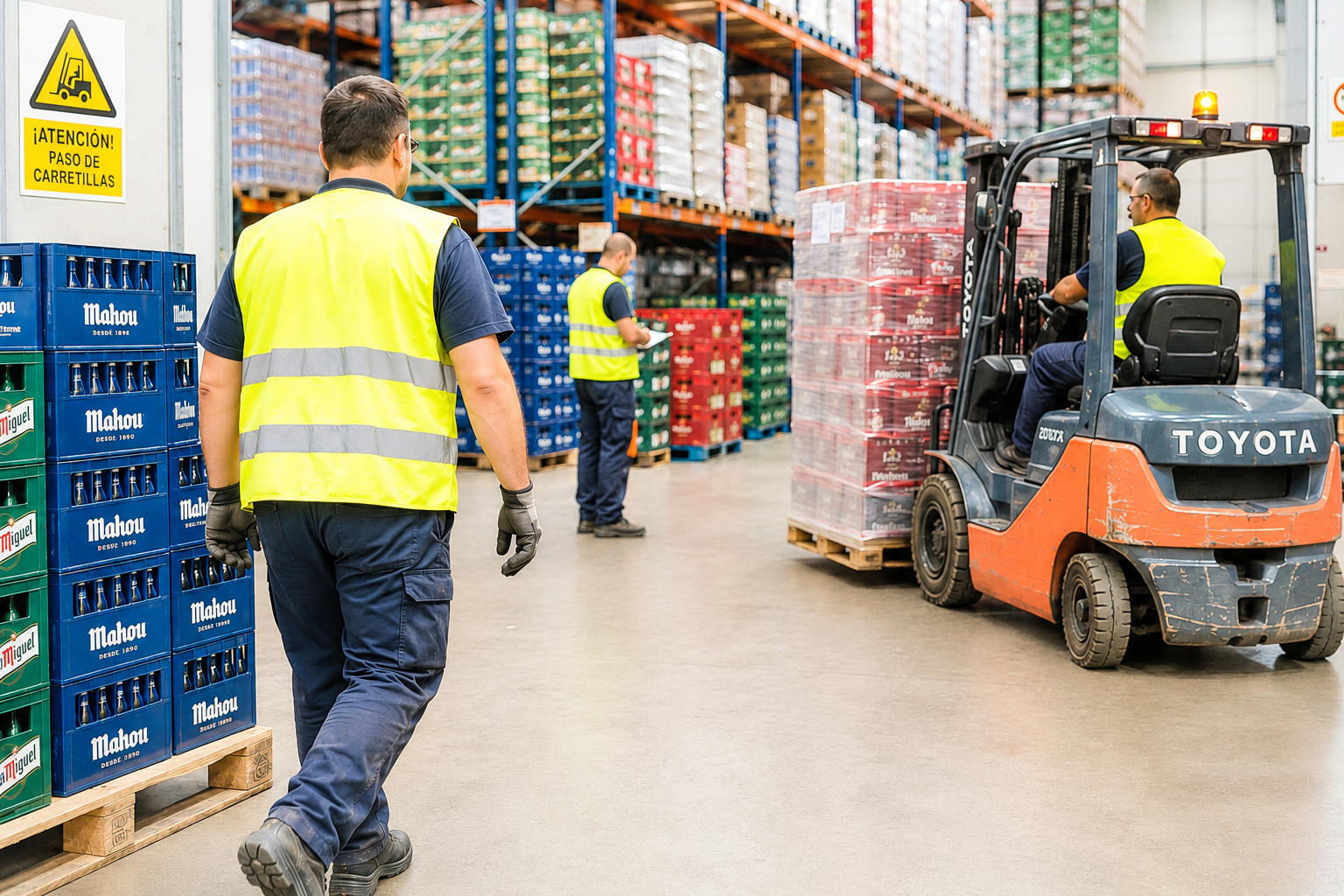
The day-to-day operations in a beverage distribution warehouse are a high-intensity ecosystem: forklifts speeding through aisles, beer pallets weighing hundreds of kilos moving high above, thousands of clinking glass bottles, and, occasionally, the inevitable wet floor from a breakage.

In this environment, Personal Protective Equipment (PPE) is the thin line separating a productive day from a tragedy. However, any warehouse manager has heard something like: “Boss, these boots are just too heavy for summer” or “The reflective vest makes me absurdly hot, besides, we all know each other here.”

Today we analyze that dangerous boundary between what workers consider “uncomfortable” and what the law mandates as strictly mandatory, and how you must act to prevent an employee’s recklessness from ruining your company legally.

1. Is it Really Necessary? Between Comfort and Real Risk

What might seem like an exaggerated rule to a worker is pure survival logic for physics and the Occupational Risk Prevention Act (LPRL). In the beverage distribution sector, the risks are highly specific and severe:

    • Safety Footwear: A 50 kg beer keg slipping during loading or unloading can crush an unprotected foot.

    • High-Visibility Vest: In a warehouse with constant machinery movement, failing to be seen by a forklift operator in a blind spot poses a critical risk of being run over.

    • Protective Gloves and Safety Glasses: A glass bottle bursting under pressure or handling broken boxes causes hundreds of severe cuts and serious eye injuries every year.

The use of PPE is not a goodwill suggestion; it is a legal mandate that leaves no room for negotiation.

2. The Rebellious Worker and the Collective Agreement Labyrinth

When a worker repeatedly refuses to use PPE, looking the other way is never an option. As an employer, you have a duty to protect them, but also the power to sanction them. Now, how is this punished legally?

In Spain, there is no single “Beverage Collective Agreement.” Depending on your province and how your business is classified, your warehouse might be regulated by the Wholesale Food Trade, Logistics, or even Hospitality collective bargaining agreements.

Despite this geographic mix, all collective agreements align on the fundamentals. The regulations are categorical: a repeated refusal to use PPE or creating a serious risk to oneself or coworkers is almost always classified as Very Serious Misconduct.

If you detect this attitude, you must apply a relentless and gradual disciplinary protocol:

    1. Verbal Warning: First notice and educational awareness.

    2. Written Warning: If they repeat it, a formal letter is delivered detailing the day, time, and missing PPE. The employee must sign the acknowledgment of receipt.

    3. Suspension from Work and Pay: Activating whatever your collective agreement dictates for very serious misconduct, which typically ranges between 16 and 60 days of penalty.

    4. Justified Disciplinary Dismissal: If the rebellion is chronic, the Workers’ Statute protects the dismissal without the right to a single euro of severance pay.

Golden Rule for Protection: Do not issue generic or undocumented warnings. Review the collective agreement code on your company’s payrolls, look up the exact article for Very Serious Misconduct, and copy its wording verbatim into the sanction letter. If you use the wrong agreement, a judge will void the measure due to a procedural defect.

3. The Nightmare: What Happens if There Is an Accident Due to Not Using PPE?

There is a widespread myth that “if workers get injured through their own fault by not wearing their boots, the company washes its hands of it.” This is a grave mistake. If the Labor Inspectorate arrives after a serious accident and finds that the employee was not wearing the mandatory equipment, the company faces a nightmarish scenario:

    • Financial Penalties: Administrative fines that can reach astronomical figures depending on the severity of the case.

    • The Dreaded Benefit Surcharge: The company can be ordered to pay out of pocket a surcharge of between 30% and 50% on all financial benefits the worker receives (sick leave, disability, etc.) for life. No insurance covers this.

    • Criminal Liability: The company’s administrator or the warehouse manager could face prison sentences if it is proven that there was “passive tolerance” or a lack of supervision.

For the company to be cleared of blame before a judge, it is not enough to show that the worker “didn’t want” to wear the PPE; you must prove that the company did everything legally and humanamente possible to force them to use it.

4. How to Legally Shield Your Company (Action Plan)

To prevent a third party’s recklessness from becoming your ruin, you must build a shield of indisputable documentary evidence:

Key Action How to Implement It Effectively?
Delivery Record Every time you hand over PPE, the worker must sign a document stating the date, model, and their explicit commitment to its use and care.
Documented Training Giving out the equipment is not enough. You must conduct specific talks on beverage warehouse risks and record the attendance signature of the entire workforce.
Active Supervision Perform regular visual inspections. If you see someone non-compliant, order them to gear up immediately and keep an internal record of the warning.
Disciplinary Regime If a worker persists in their stance, issue written sanctions. The lack of prior penalties is employment lawyers’ favorite argument to blame the company for tolerating the risk.

Maintaining safety in a beverage distribution warehouse requires firmness. PPE might feel uncomfortable in the summer heat, but the cost of not using it is infinitely higher for the worker’s health and completely unsustainable for your business’s viability. Leading by example, raising awareness, and, when necessary, disciplining with the collective agreement in hand, is the only valid strategy.

How much does it cost to digitalize your delivery trucks?

iot para flotas de reparto

 3 IoT solutions with names, prices, and links

In urban and regional distribution, profit margins are won or lost on every corner. Talking about “telemetry” or “internet of things (IoT)” sounds great on paper, but if you manage delivery trucks, you need pragmatism: what device to buy, what brand sells it, and how much the bill will cost you.

Today we set theory aside. We analyze three real commercial solutions you can install in your rigid trucks or vans to optimize delivery routes, reduce fuel consumption in the city, and prevent theft during unloading.

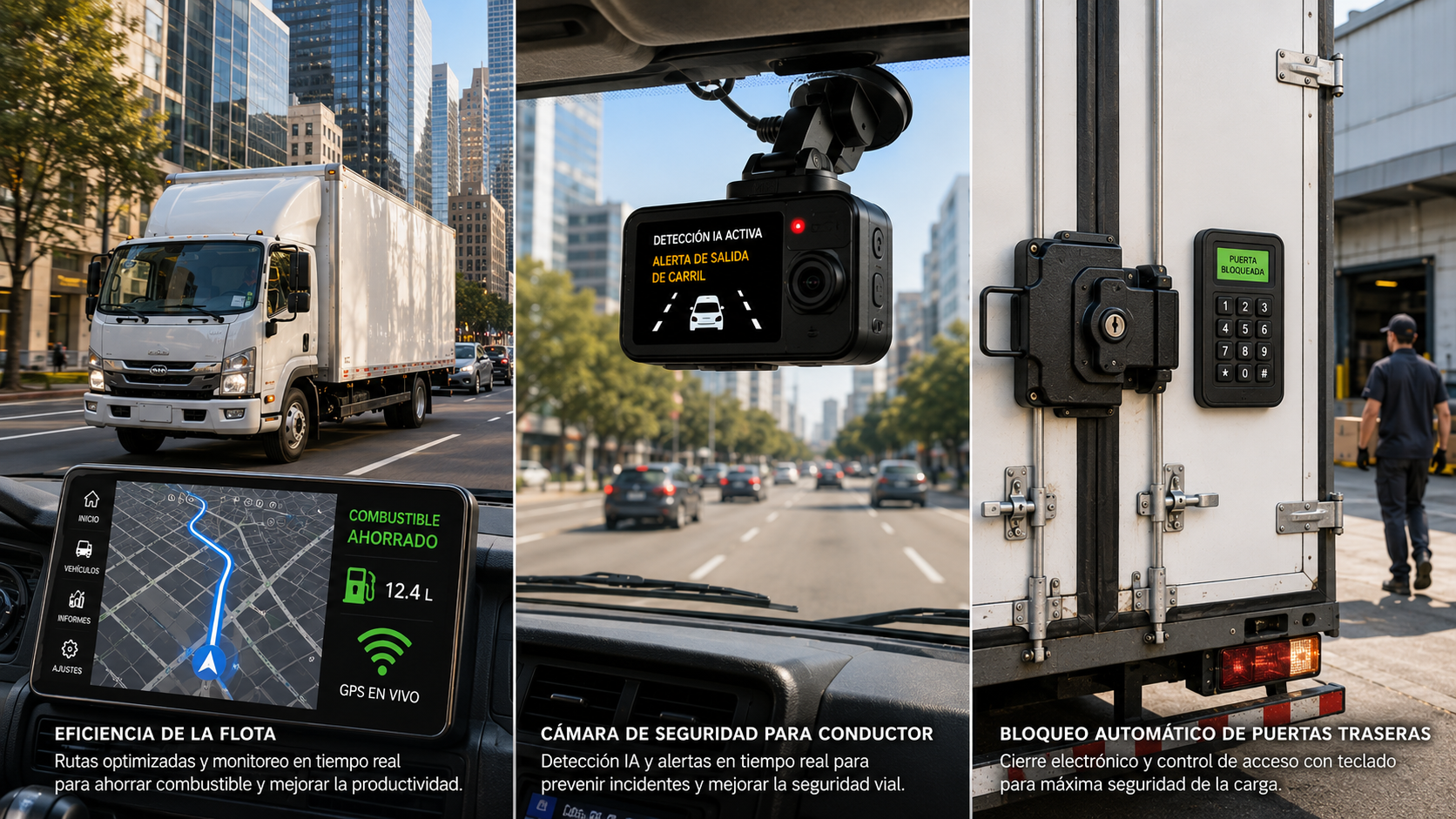
1. Route control and fuel savings in the city: Webfleet (by Bridgestone)

In local delivery, traffic jams and closed streets skyrocket fuel consumption. This is the leading platform in Spain to monitor what happens with your trucks street by street.

  • The hardware: The LINK 740 series device is installed hidden, connected directly to the vehicle’s OBD port or CAN bus.
  • What it does in practice: It gives you the exact GPS location second by second, plans optimal delivery routes with urban traffic in real time, and analyzes the driver’s driving style (such as leaving the engine running while unloading, which wastes money, or unnecessary acceleration between traffic lights).
  • Approximate cost: The physical device costs around 100 € – 150 € (one-time or financed payment) and the monthly software subscription ranges between 15 € and 30 € per truck.
  • Where to buy: You can request a direct quote on the official website of Webfleet España.

2. Safety with cameras and AI against bumps and fines: Samsara

Urban delivery is prone to minor accidents, scrapes in loading zones, and false third-party claims. Smart camera technology is the most mature solution to protect both the driver and the truck.

  • The hardware: A front-facing and cabin dashboard camera (Samsara CM31 or similar) connected to the dash.
  • What it does in practice: It is not a standard camera. Its artificial intelligence detects if the driver gets distracted at the wheel (preventing rear-end collisions) and, most importantly, if the truck is hit while parked during unloading, it instantly records the footage to the cloud so you have irrefutable proof for the insurance company.
  • Approximate cost: It operates under a subscription model that unifies hardware and software, with costs usually starting from 25 € – 40 € monthly per vehicle depending on your fleet volume.
  • Where to buy: You can request a demo and a quote on the page of Samsara España.

3. Automatic electromechanical locks (anti-theft on the go): SBS Locks (distributed by Cargotrack)

In urban delivery, the biggest danger is “opportunistic theft”: having your rear tailgate or side door opened while you are inside a business delivering an order 50 meters away from the truck, having had to park far away due to lack of space.

  • The hardware: Surface-mounted or integrated security locks on the cargo doors (such as the SBS lock range).
  • How does it connect to IoT? Although the base system is local electromechanical, it can be integrated with the fleet’s GPS trackers. This allows the lock to send real-time data to the central management station every time the door opens or closes, logging the event on the map.
  • What it does in practice: It features an automatic slam-lock system. As soon as the courier unloads the goods and closes the door, it locks mechanically instantly. To reopen it, the driver uses a coded remote or a digital keypad (avoiding reliance on whether the GPS has coverage between tall buildings), but control managers receive an instant alert if the door remains open longer than it should.
  • Approximate cost: The physical device ranges between 180 € and 350 € per door (one-time payment). If you want to connect it to the telemetry platform to monitor openings in real time, a small monthly fee of about 5 €/month is added.
  • Where to buy: You can check the specific security catalog and request a quote on the website of Cargotrack España – Cierres SBS.

Investment summary for a delivery fleet

Let’s do some quick numbers for a distribution company with a modest fleet of 5 urban delivery trucks:

Concept Initial investment (devices) Total monthly fleet cost (5 trucks)
Route control and efficiency (Webfleet) ~600 € ~100 € / month
Safety with AI cameras (Samsara) Integrated into leasing/renting ~150 € – 200 € / month
Automatic anti-theft locks (Cargotrack) ~1,200 € (one-time payment) 0 € / month (it is pure technology)

The real balance: A single theft avoided in an industrial estate thanks to the automatic lock, an insurance dispute won due to an urban bump, or an 8% reduction in fuel consumption thanks to better routes, completely pay off the cost of this technology within the first few months of use.

In this article, we have gathered three specific examples of companies providing these services, although fortunately the technology market is wide and more alternatives exist. Our intention has been to show real, mature cases with baseline figures on the table to help evaluate the feasibility of making the digital leap in freight distribution.

The tricky fleet dilemma

camion de reparto vs furgoneta

How to Choose the Right Beverage Delivery Truck in the Era of LEZs?

Delivering beverages in urban centers has always been a top-tier logistical challenge. Moving tons of liquid and glass through narrow streets, dodging traffic, and searching for free loading and unloading zones requires almost superpowers.

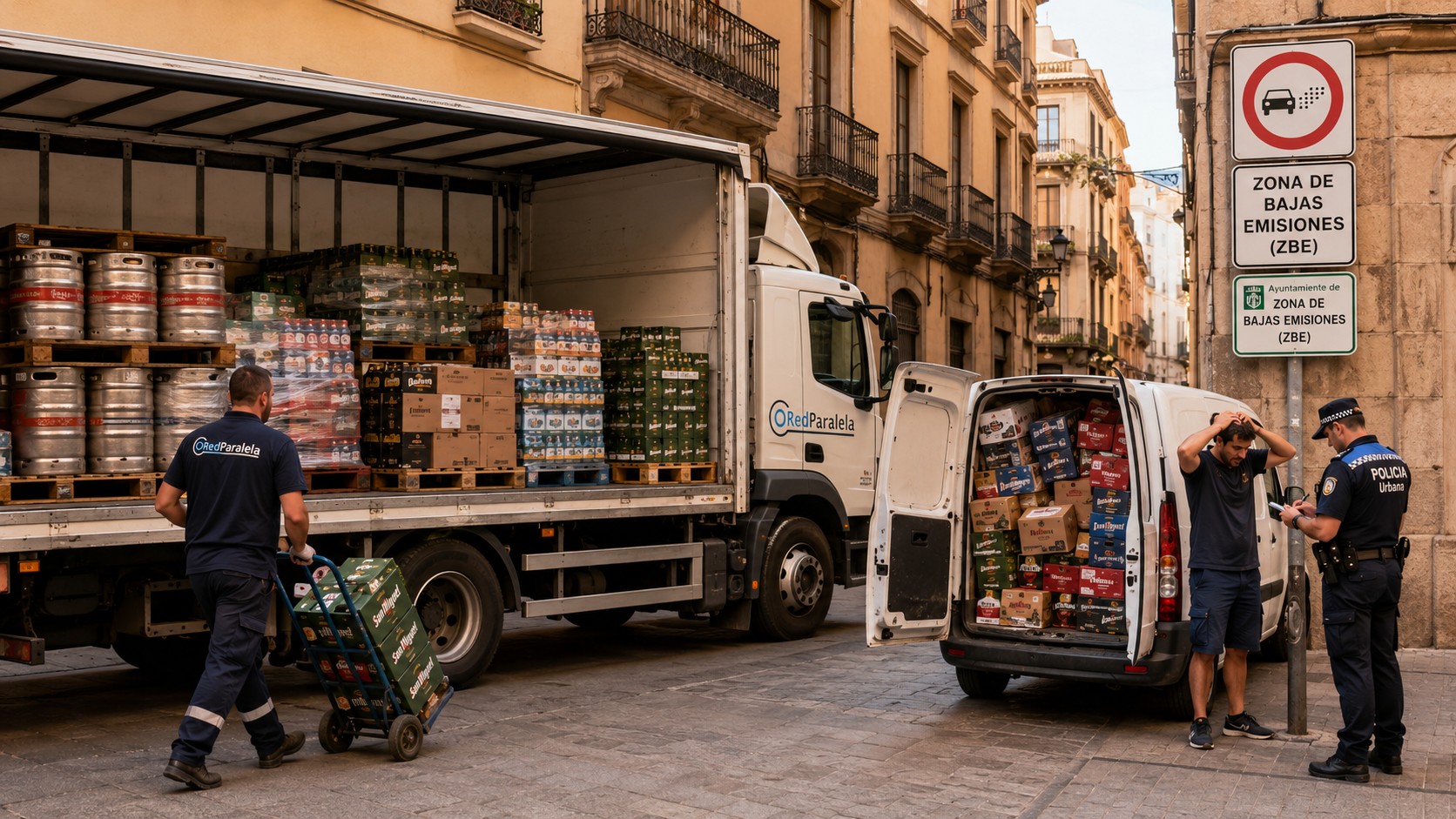
However, the rules of the game have completely changed. With Low Emission Zones (LEZs) fully active, beverage distributors find themselves trapped in a true strategic dead-end. It is what we call “the tricky fleet dilemma”: whichever option you choose to renew your vehicles, it seems you always fall into an economic or operational trap.

How to get out of this labyrinth without harming your business’s profitability? Let’s lay the cards on the table.

The 3 Traps of Modern Urban Delivery

When a distributor considers how to adapt their fleet to continue entering city centers to serve the HORECA channel, they usually evaluate three paths. The problem is that all three come with “fine print”:

🛑 Trap No. 1: “The Van Refuge” (For fear of the truck license)

  • The temptation: Since professional drivers are scarce in the market, the logical temptation is to buy large 3,500 kg vans. After all, anyone with a car driving license (B) can drive them, and you can forget about the tachograph.

  • The real trap: The weight of the goods. An empty van already weighs around 2,300 kg, leaving you with barely 1,200 kg of payload. In our sector, that amounts to little more than a pallet and a half of stock. To deliver the same amount that a single truck carries, you have to put three vans on the street. What you save on the driver’s license, you pay threefold in salaries, insurance, fuel, and, very likely, overweight fines.

🛑 Trap No. 2: “The Pure Electric Mirage” (Green posturing)

  • The temptation: Buying a 100% electric heavy truck with a 0 Label to have full and guaranteed access to any LEZ for the next fifteen years.

  • The real trap: The company’s cash flow. The purchase price of an electric truck today remains astronomical for a distributor SME. Unless you are a large multinational with financial muscle and your own ultra-fast charging infrastructure in your warehouse, this investment can decapitalize your business before you have amortized the first kilometer.

🛑 Trap No. 3: “Diesel Inaction” (Waiting for the storm to pass)

  • The temptation: Do nothing. Maintain current Euro VI diesel trucks (C Label) and rely on the temporary exemptions that city councils grant to commercial freight transport.

  • The real trap: Exemptions have an expiration date. The day time or access restrictions tighten in your city, you will be locked out. If your truck cannot enter to unload at the exact time the hospitality business needs the stock, that client will call another distributor who can. Inaction is a direct commercial risk.

The “Anti-Trap” Solution: The 7,200 to 7,500 kg Truck with ECO Technology

To break this vicious cycle, urban beverage logistics has found its ideal sweet spot in a very specific category: the truck between 7,200 kg and 7,500 kg of Maximum Authorised Mass (MAM) with an ECO powertrain (hybrids or powered by Compressed Natural Gas/CNG).

Why is this the smartest investment from a purely economic standpoint?

  • Real payload capacity: Compared to the one thousand kilos of a van, a 7,200 kg truck (like the Iveco Daily chassis) or a 7,500 kg one (like the Fuso Canter) offers a net payload of between 3,500 and 4,000 kg. It allows you to move between 4 and 5 heavy pallets completely legally in a single trip. Route optimization in its purest form.

  • Maneuverability without penalties: These are compact, narrow, or cab-over trucks designed specifically for city stop-and-go driving. They turn in tight spaces and do not gridlock traffic.

  • The ECO Label shield: Hybrid or gas versions bypass LEZ restrictions without the need for the prohibitive upfront cost of a pure electric vehicle. Their acquisition cost (CAPEX) is perfectly manageable for an SME, and the cost per kilometer (OPEX) in urban cycles is highly competitive.

Professionalizing the Fleet Is Not an Expense, It Is an Investment in the Future

It is true that making the leap to a 7.5-ton truck legally requires your delivery drivers to hold a C1 or C driving license and the CAP (Certificate of Professional Competence), in addition to managing driving times with a tachograph.

But if we look at the numbers coldly, professionalization is the only profitable path. A qualified driver at the wheel of an efficient vehicle with the proper payload capacity performs three times better than three overloaded vans dodging traffic police controls.

In modern beverage distribution, efficiency is no longer measured just by how many crates you can move, but by how much it costs you to get each kilo of product into the city center. The 7,500 kg ECO truck is not a future option; it is the necessary tool to protect your business margins today.

The Real Value of Tyres

cómo elegir neumáticos

What a driver taught me about the “real value” of tires

Sometimes, after so many years in this sector, you think you already know everything about logistics. But suddenly, a new lesson appears when you least expect it.

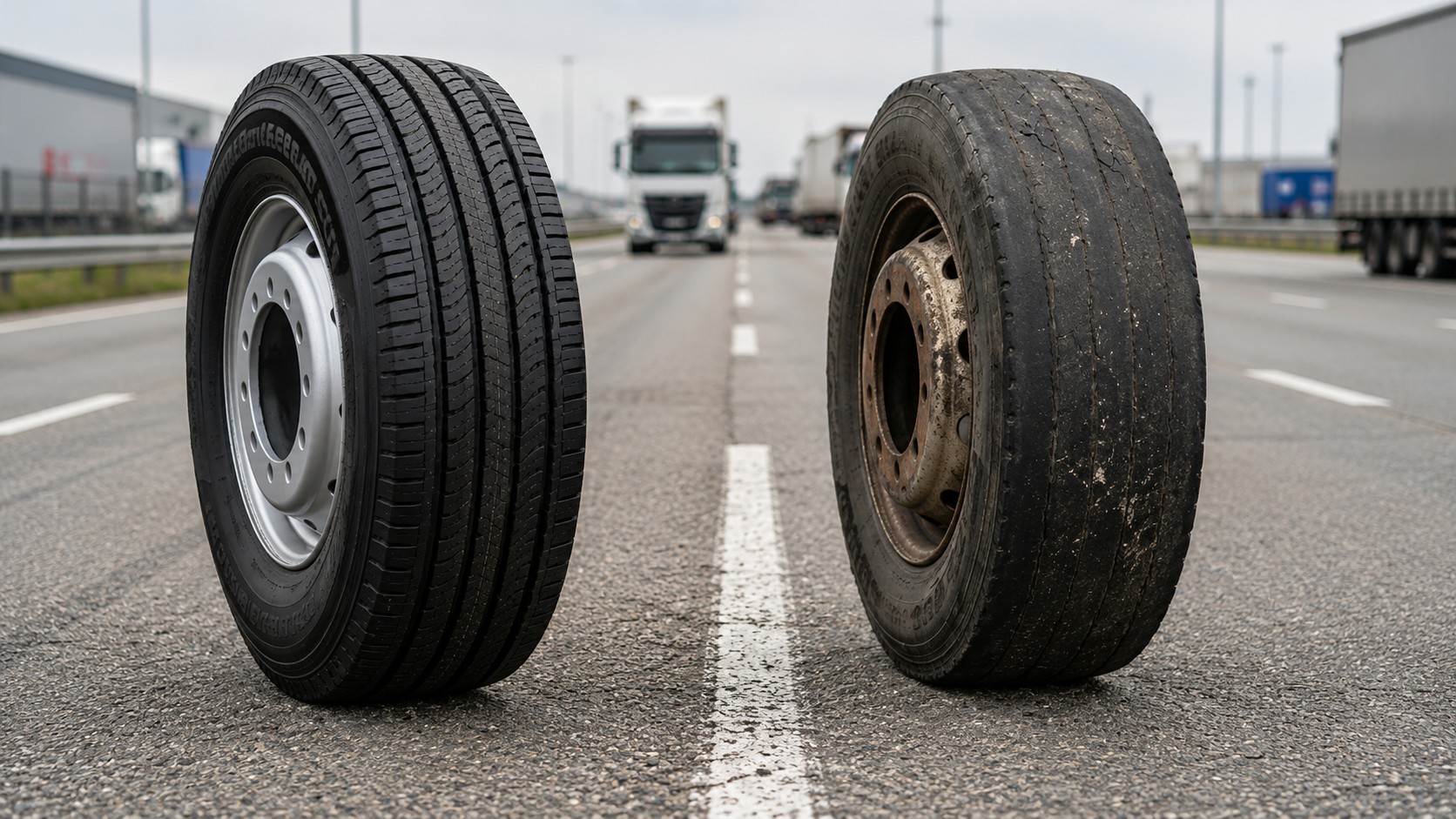
The other day, while chatting with a driver about the condition of his wheels, he revealed a world I didn’t know about tires. He started with a phrase that might sound cliché, but the interesting part was the reasoning that followed: “The cheapest tire is usually the one that costs you the most at the end of the month”. And look how right he was:

  • Mileage performance: a premium tire may cost 30% more, but if its compound allows it to run 50% more miles, the cost per mile (the data that really matters) is much lower.
  • Fuel consumption: rolling resistance is key. A low-quality tire can trigger fuel consumption enough to pay the difference for a top-brand tire in just a few months. With diesel prices as they are today, this data is especially important.
  • Manufacturing date (DOT Code): vital data to avoid deception. Tires have what we could call “technical obsolescence”: even if the tread looks new, the rubber crystallizes over time and loses its grip. To find out when it was actually made, look for the DOT code on the sidewall (four digits): the first two indicate the week and the last two the year.

Example: if you read 1226, it means that the tire came off the assembly line in week 12 of the year 2026. Beware of trickery! Sometimes there are tempting offers for “brand new” tires that have been sitting in a warehouse for 5 years. If the rubber has lost its elasticity, you are buying a risk, not a solution.

  • Safety and peak response: this is where “trickery” becomes most expensive. A quality tire reduces braking distance in the wet and handles high temperatures and maximum loads much better, minimizing the risk of a blowout. A single scare or a breakdown stop invalidates any previous savings on the purchase price.
  • Casing value: quality casings allow for guaranteed retreading processes —something that low-cost brands rarely offer— which means savings of up to 50% in cost and a firm commitment to sustainability by reducing oil consumption and waste generation by 70%.

In such a competitive market, trickery is the order of the day. The real value of a tire is not what you pay at the workshop, but the sum of its durability, its reliability, and, above all, the peace of mind of knowing that the truck will respond when the road gets tough.

At Red Paralela, we no longer have our own vehicles. Our transition towards an effective freight exchange based on efficiency has allowed us to reduce our costs by taking advantage of trucks that have reached a destination and have no return load.

But that doesn’t mean this isn’t our world, and we feel motivated to share this small discovery. In the end, in this sector, information is the best fuel.

The end of delivery as we know it

Un almacén logístico con todo tipo de mercancías y dos operarios trabajando

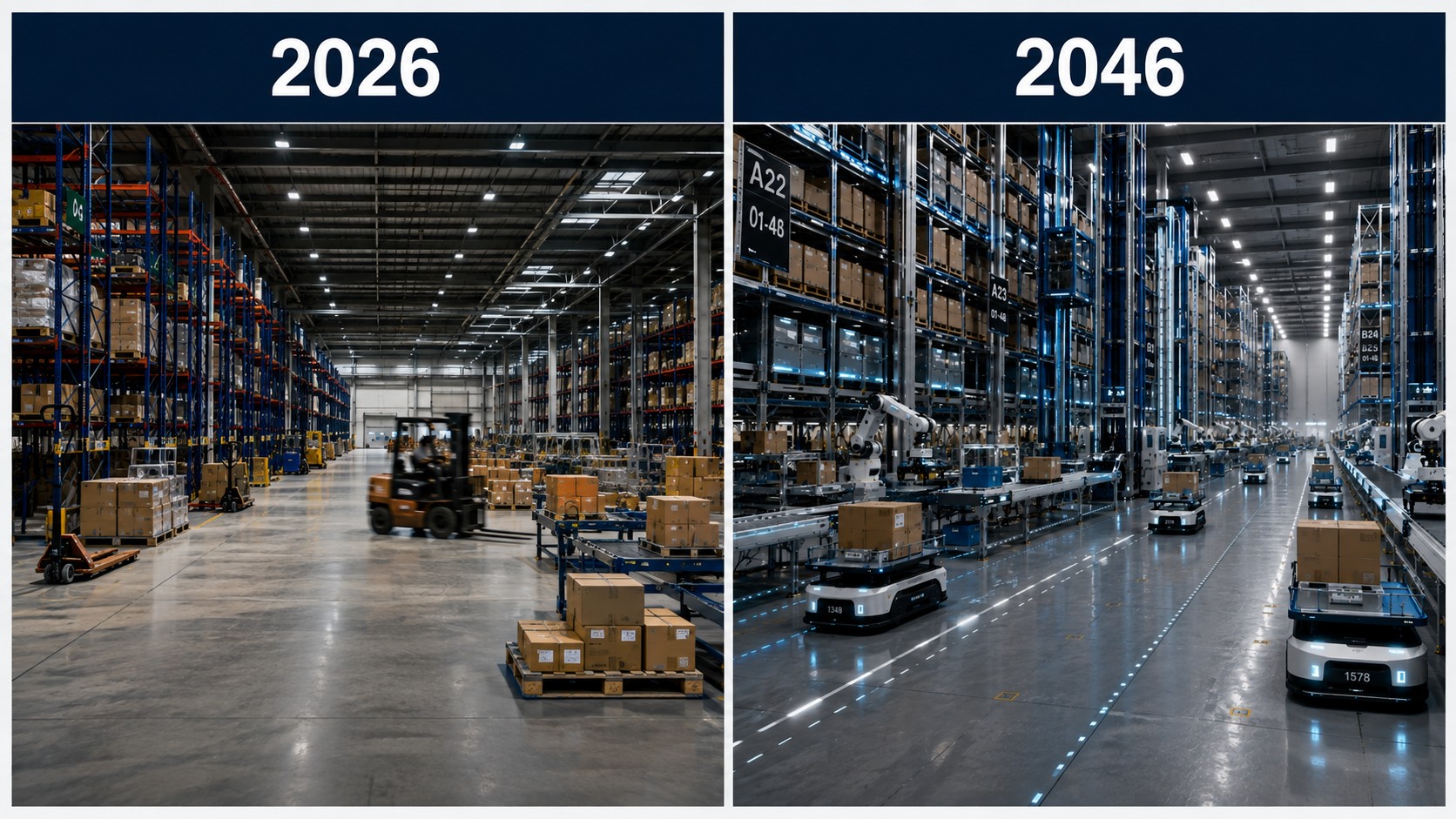
Towards the “Single Operator”? A Hypothesis on the End of Goods Distribution as We Know It

If you step out onto any busy street in a major city at ten in the morning, you’ll witness a scene that would be almost comical if it weren’t so inefficient: five vans from five different companies, double-parked, delivering five orders to the same building.

In other sectors, the trend has been clear: consolidate or perish. Yet last-mile logistics has remained a stronghold of individualism… until now. The question we raise today at Red Paralela is not whether the model will change, but how much time the current model has left before it collapses.

The Wall Ahead: The Triple Threat

Traditional delivery is colliding with three realities that can no longer be avoided:

  1. Runaway cost escalation: Fuel, fleet maintenance and, above all, labour costs are making the margin per delivery increasingly negligible.

  2. Legislative pressure and Low Emission Zones (LEZ): Municipal regulations are no longer suggestions; they are physical barriers. Entering city centres is (and will be) an expensive and restricted privilege.

  3. Customer expectations: We want everything “yesterday”, but we don’t want to see vans blocking our streets or breathe their fumes.

Logistics Integration: Utopia or Necessity?

The idea we put forward is ambitious: a unified distribution network. Imagine that, instead of each distributor maintaining its own infrastructure as today, there are shared facilities where goods are consolidated before entering the urban environment.

What would we gain from this “shared logistics” model?

  • Real load optimisation: vans and trucks with fewer, fuller loads.

  • Drastic reduction in emissions: fewer vehicles on the road means cleaner cities and companies that finally meet their sustainability targets without going bankrupt.

  • Savings on operating costs: by sharing infrastructure and transport, fixed costs are spread. There is strength in unity, but in logistics, there is also profitability.

From Competition to “Coopetition”

We know what you’re thinking: “How am I supposed to hand my goods over to a competitor or an integrated third party?”. This is where the shift in mindset comes in.

In a globalised world, competitive advantage should no longer be about who has the fastest van, but about who manages information and customer service better. Logistics must move from being a war of physical assets to a pursuit of excellence in data management.

The future of distribution does not lie in having more vehicles on the street, but in having fewer, better utilised and fully integrated into a common ecosystem.

Are We Ready?

At Red Paralela we believe that integration is not merely a possibility — it is the only viable path forward. The current model is exhausting its last reserves of efficiency. The transition towards shared urban hubs and integrated fleets will be painful for those who resist, but a golden opportunity for those who choose to lead it.

What do you think? Do you see a future where you and your competitors share the same delivery vehicle to protect your margins?