
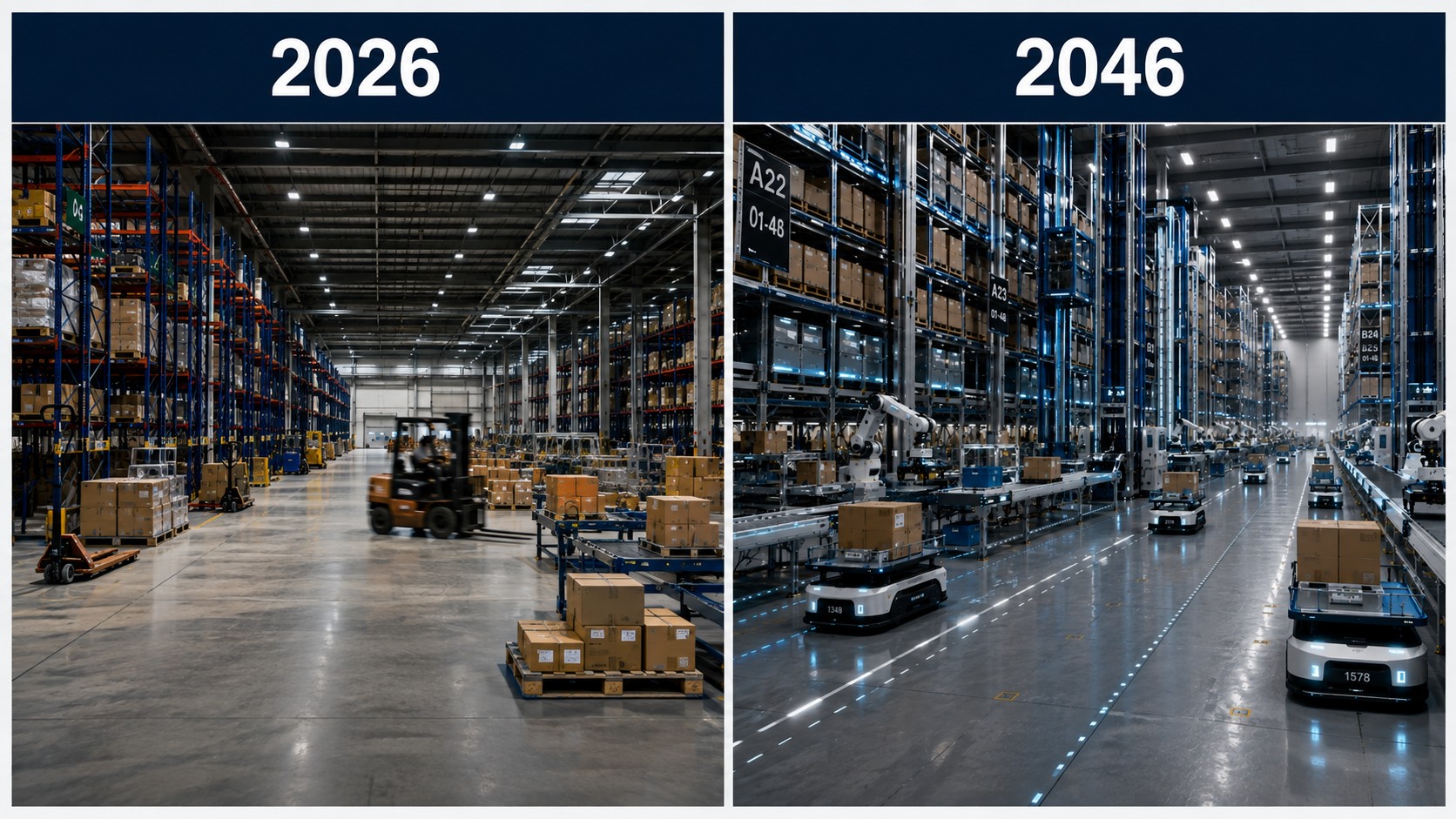
What will HORECA distribution look like in 20 years?
A hypothesis: perhaps the distributor will no longer be necessary.
We have been directly linked to distribution for almost 40 years.
We have seen changes in products, brands, purchasing habits, management systems, and ways of interacting with hospitality establishments.
Today Red Paralela is no longer a traditional HORECA distributor. But precisely because of this, we can look at the sector from a different position and ask ourselves a question:
What will HORECA distribution look like in 20 years?
What we are going to propose below is not a prediction.
It is just a hypothesis.
But a hypothesis that, seeing how artificial intelligence, automation, and the ability to connect information in real-time are advancing, we believe is worth imagining.
And if we take this evolution to its ultimate consequences, a quite radical scenario emerges:
What if, in 20 years, the distributor as we know it today had practically disappeared?
No one would place orders anymore
Today, a restaurant needs to place orders.
Someone checks the warehouse, calculates what is needed, talks to a sales rep, logs into a platform, sends a message, or makes a call.
Then the distributor prepares the order, organizes a route, and delivers it.
It is a process we have built over decades.
But imagine another scenario.
The restaurant’s management system is directly connected to its daily activity.
It knows what it sells.
It knows what is left.
It knows the reservations.
It detects consumption rates.
It can foresee what it will need in the coming days.
And, thanks to artificial intelligence, it can anticipate needs that today still require human intervention.
When the system detects that a certain product is needed, it does not generate an alert for someone to place an order. It generates it directly.
The hospitality owner sets the rules. The system does the rest.
This does not mean the restaurant loses control. On the contrary.
The owner could perfectly decide how they want their supply chain to work:
- ✓ For this product, I always want this brand.
- ✓ For this other one, I accept any equivalent product.
- ✓ In this case, I want to work with a specific manufacturer.
- ✓ Here, I want the best price.
- ✓ For this product, I do not want substitutions.
- ✓ And for those that are not critical, you can automatically choose the best available option.
The hospitality owner establishes the rules.
The system takes care of executing them.
And this is where everything changes. Because that system would no longer need to be connected to a distributor. It could be connected directly to manufacturers and producers.
The manufacturer would no longer need to go through the distributor
Imagine that a manufacturer knows, thanks to these platforms, that in the coming days, certain products will have a specific demand in a particular area.
They could send merchandise directly to large logistics centers.
Not necessarily because someone has placed a specific order.
But because the available information makes it possible to anticipate demand.
These centers could receive merchandise from thousands of different manufacturers and producers.
Store it. Sort it. Preserve it when necessary. Prepare it. And group it to make deliveries as efficiently as possible.
The merchandise would be much closer to the demand even before the establishment formally made the purchase. And when the restaurant’s system needed that product, it could locate it automatically and trigger the whole process.
(Without the need for a distributor between them)
The logistics center becomes a fundamental piece
This would probably be impossible without a massive transformation in logistics.
We could imagine large, highly automated platforms capable of managing goods from thousands of suppliers and manufacturers.
Practically robotic warehouses.
Systems capable of knowing in real-time what is stored, whose it is, where it is, and what demand exists for each product.
And, above all, capable of grouping products from many different manufacturers into a single delivery.
That would be one of the great advantages of the model.
Today, a distributor needs to buy, store, and manage a huge number of references to offer a sufficiently wide assortment to its clients.
In this scenario, that function disappears.
The restaurant can access a huge catalog without a single company having to own all that stock.
And billing could also disappear from the manual process
If the system knows what has been ordered, what has been delivered, at what price, and under what conditions, billing can be integrated into the same process.
The product leaves the logistics center.
It arrives at the restaurant.
The system registers the delivery.
The invoice is generated.
It is accounted for.
The payment is made.
Everything connected.
No calls. No emails. No manual data entry. Without multiple companies having to exchange information over and over again.
The operation could be automated from start to finish.
So, what happens to the distributor?
Here is the most important part of our hypothesis.
If this system were to work really well, the traditional distributor could cease to be necessary for a large part of the products it sells today.
Not because someone decided to eliminate them.
Simply because their intermediation role would no longer add enough value.
If a manufacturer can reach the hospitality owner directly.
If the product can be stored in a large logistics center.
If that center can prepare and group the goods of thousands of suppliers.
If artificial intelligence can anticipate demand.
If the system can automatically generate orders.
And if billing is also connected…
What need would there be for a distributor to buy, store, and resell that product?
This is probably the most uncomfortable question in the entire article.
But perhaps not all distributors will disappear
Even in this scenario, it is hard to imagine that absolutely all products could work in the same way.
Specialized distributors could survive.
Companies working with very specific brands.
Limited production products.
Products requiring special conservation or handling.
Products requiring highly technical knowledge.
Small brands that do not have the capacity to enter large networks.
Unique products whose sale depends heavily on advice, prescription, or personal relationships.
In those cases, the distributor could still make sense.
But they would be a very different distributor.
They would not compete to have the largest warehouse or the most trucks.
They would compete based on their knowledge, their brands, their specialization, and their ability to provide something that the large platform cannot automate.
What if this were truly the future?
We insist: this is only a hypothesis.
We do not know if it will happen. We do not know when. We do not know what barriers will appear. We do not even know if technology will ever integrate so completely.
But many of the pieces of this scenario already exist separately:
- Artificial intelligence can analyze and anticipate demand.
- Systems can communicate with each other.
- Logistics is moving towards increasing automation.
- Warehouses are becoming smarter.
- Manufacturers have more and more information about consumption.
- And establishments generate massive amounts of data about what they sell and what they need.
The interesting question is what will happen when all these pieces are connected.
Perhaps the big shift won’t be technological
Perhaps it will be business-related.
For decades, we have built distribution around a central figure: the distributor.
The distributor buys. Stores. Finances. Maintains stock. Sells. Prepares. Transports. Invoices.
But if technology allows direct connection between demand and supply and the use of large shared logistics infrastructures, some of those functions might no longer need an intermediary company.
And then the model could shift from:
Manufacturer ➔ Distributor ➔ Restaurant
to something much more like:
Manufacturer / producer ➔ Logistics center ➔ Restaurant
With a massive technological layer connecting everything.
And perhaps the real protagonist will no longer be the distributor.
It will be the information about demand.
A hypothesis worth starting to think about today
We do not know if in 20 years we will see exactly this scenario. Probably not.
The future always ends up being different from how we imagine it.
But we believe it is worth raising because it forces us to ask a question that could be important long before 2046:
If one day technology manages to directly connect manufacturers and producers with HORECA establishments, anticipate their needs, manage stock, organize logistics, and automate billing… what role will be left for the distributor?
Perhaps they will disappear.
Perhaps they will transform.
Perhaps they will survive only where the product, the brand, or the knowledge still requires a person in the middle.
We do not know.
But if this hypothesis makes any sense, the future of HORECA distribution will not be about doing what we do today, better.
It will be about asking ourselves what part of what we do today will be necessary tomorrow.
And perhaps that is a question we shouldn’t wait twenty years to answer.