
FMCG Parallel Market: How to Buy Safely and Protect Your Margins

Mercado paralelo FMCG: cómo comprar con seguridad y margen

From the Perfect Deal to the Perfect Disaster: Why Buying Well Starts Long Before Negotiating the Price

Some deals seem impossible to turn down.

A distributor finds a fast-moving consumer goods (FMCG) stocklot at an exceptional price. The numbers make sense. The margin is excellent. The supplier appears trustworthy, and everything suggests this will be one of those purchases that makes weeks of searching worthwhile.

The deal is closed.

A few days later, the phone starts ringing.

The payment is put on hold because concerns arise about the seller’s company. When the goods finally arrive, the labeling does not comply with the destination country’s regulations, and distribution comes to a standstill.

Suddenly, what looked like the perfect bargain doesn’t seem like such a great deal anymore.

And the worst part is that this story is far from unusual.

Problems Rarely Appear During the Negotiation

The FMCG parallel market offers opportunities with margins that are difficult to achieve through traditional channels.

But it is also an environment where risks are rarely obvious.

Most of them appear only after the money has changed hands or the goods are already in transit.

Over the years, we have seen the same patterns repeat themselves time and again:

      • Companies whose financial reliability was not what it seemed.
      • Documentation issues that delay payments or deliveries.
      • Labeling problems that force an operation to stop at the last minute.
      • Tax authority inquiries resulting from unknowingly trading with companies involved in VAT fraud.

None of these situations starts out as a major problem.

They all begin as a small detail that nobody noticed in time.

The Cost That Almost Nobody Calculates

When people talk about the cost of a transaction, they usually think about the purchase price, transport costs or the expected margin.

However, there is another cost that is far less visible: the cost of a deal that goes wrong.

Hours spent resolving unexpected issues.

Payments frozen.

Customers waiting for goods that never arrive.

Difficult conversations.

Documentation that has to be reviewed months later.

And above all, opportunities that are never pursued again because nobody wants to repeat the same experience.

That is why many distributors prefer to walk away from an attractive opportunity rather than take on uncertainty they cannot control.

And that is a perfectly rational decision.

The Value of Good Intermediation

When a transaction involves tens or even hundreds of thousands of euros, the real question is not how much professional intermediation costs.

The real question is how much it can cost to do without it.

Good intermediation does not exist simply to introduce buyers and sellers.

It exists to reduce uncertainty.

To identify risks before they become losses.

To make sure that a deal which looked profitable at the beginning still looks profitable after the truck has unloaded the goods and the payment has safely reached its destination.

Most of this work goes unnoticed.

Precisely because, when it is done properly, problems never have the chance to appear.

Our Way of Understanding Red Paralela

At Red Paralela, we do not want to become just another marketplace where companies meet.

We want to be the partner that brings confidence and peace of mind to every transaction.

We act as an intermediary because we believe trust is an essential part of doing business.

We support every transaction because we know that real value lies not only in finding the right opportunity, but in making sure it reaches a successful conclusion.

It may sound like a subtle difference.

For anyone who has experienced a defaulted payment, a documentation issue or a blocked transaction, it is anything but.

Because the best deals are not the ones that promise the highest margins.

They are the ones that, weeks later, are still remembered as successful ones.
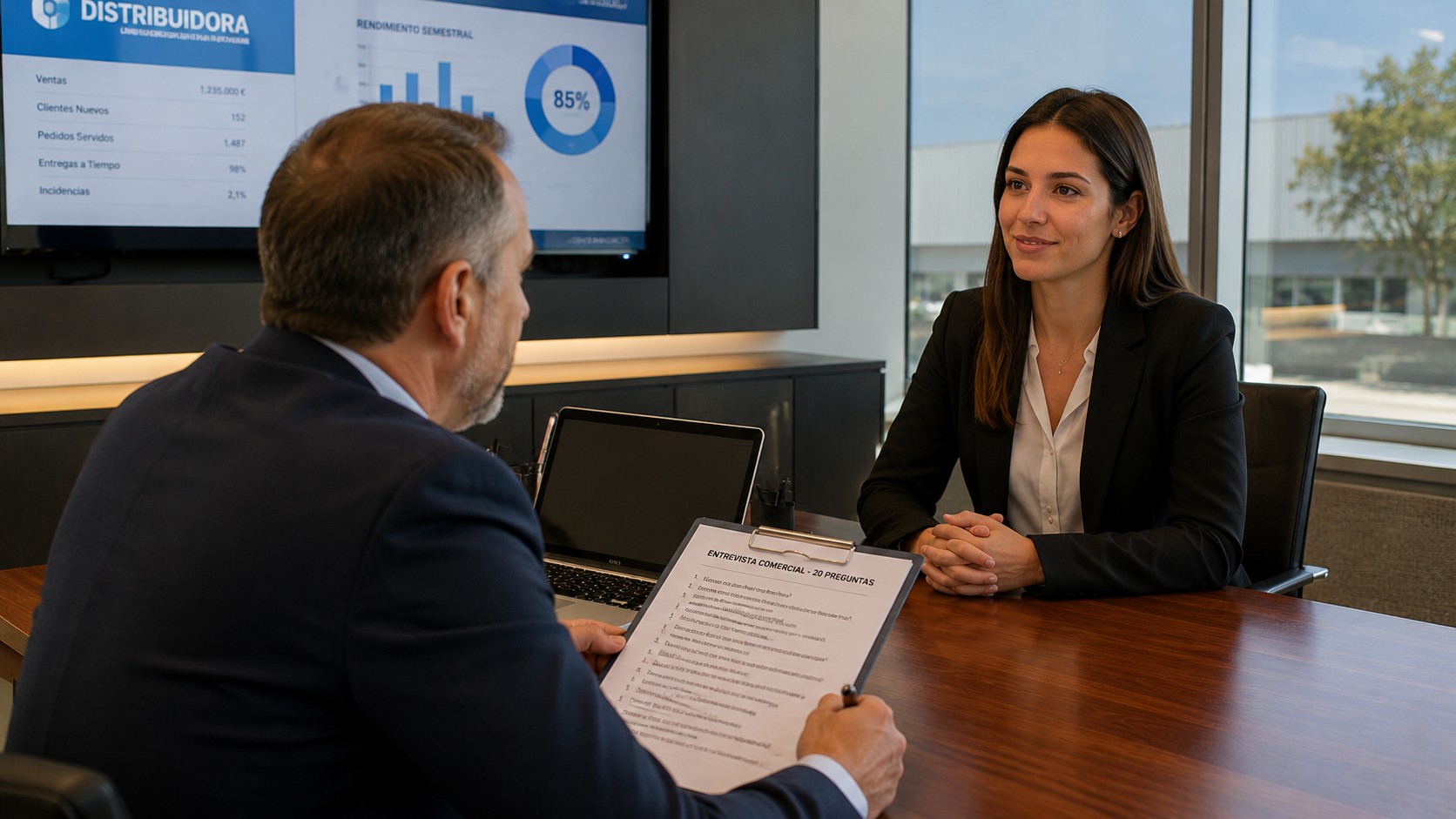
The Salesperson’s DNA: 20 Questions to Hire a Sales Rep

“`html

entrevistando a una comercial

The Salesperson’s DNA: 20 Key Questions to Hire the Perfect Sales Rep for Your Distribution Business

In the distribution sector, inventory turnover and business profitability depend on a critical factor: the sales force. There is an old debate in the commercial world: are good salespeople born or made? At Red Paralela, we have a clear stance. The technical knowledge of a product or a route can be taught in a few weeks; however, the psychological profile of a natural-born salesperson is innate.

Resilience, empathy, a hunger for success, and frustration tolerance are not learned in a corporate manual. That is why, if you need to add sales talent to your distribution company, you shouldn’t look for someone who knows your current catalog best, but rather for someone who has the right mental framework to open markets and close deals.

“Don’t hire a sales rep for what they know about your product; hire them for how they react when a client says no.”

If you are looking to boost your sales network, these are the 20 psychological and behavioral questions you should ask during interviews to find out if you are facing the ideal candidate.

Block 1: Resilience and rejection management

The day-to-day of distribution is full of “noes” and closed doors. You need to know how the candidate processes frustration.

    • 1. How do you handle a flat ‘no’ after months of negotiating with a major account or point of sale? (Look for emotional maturity and the ability to move on quickly).

    • 2. Tell me about the most difficult sale you’ve lost in your career and what you learned from it. (Evaluates their capacity for self-criticism).

    • 3. What do you do when you go through a sales dry spell to keep your motivation high? (Measures their discipline and whether they only rely on peak seasons).

    • 4. How do you react to a client who is openly hostile or angry? (Evaluates impulse control and assertiveness).

    • 5. What motivates you to keep making cold calls or doing door-to-door visits on a Monday morning? (Probes into their internal drive: money, self-improvement, recognition?).

Block 2: Empathy and client psychology

Selling in distribution isn’t about delivering a monologue; it’s about listening and understanding the pain points of the client’s business.

    • 6. If you had to explain our distribution model to a 10-year-old, how would you do it? (Measures their ability to simplify complex pitches and arguments).

    • 7. How do you identify the real needs of a client who doesn’t even know what they want? (Evaluates their ability to ask strategic diagnostic questions).

    • 8. In a first meeting with a potential client, what percentage of the time do you speak versus letting the other person speak? (The ideal answer should favor active listening, at least 60/40).

    • 9. Tell me about a time when you had to win the trust of a client who was suspicious of suppliers. (Looks for long-term relationship-building techniques).

    • 10. How do you handle price objections without immediately resorting to offering a discount or lowering the margin? (Measures if they know how to defend the value of the service).

Block 3: Methodology, organization, and proactivity

Talent without order in distribution is not sustainable. A good sales rep must be methodical with their routes and portfolio.

    • 11. How do you qualify a potential client to know if it’s worth investing time in visiting them? (Prevents them from wasting time on unprofitable accounts).

    • 12. Describe your process for preparing a meeting with a major account or a key buyer. (Evaluates whether they improvise or thoroughly research the market beforehand).

    • 13. What technological tools or CRM do you consider essential for managing your client portfolio? (A modern salesperson must rely on data and follow-ups).

    • 14. How do you prioritize your schedule when you have pending routes, incidents, and new contacts to make? (Measures time management under pressure).

    • 15. If you join our team, what would you do during your first 30 days to start generating opportunities? (Looks for proactivity, initiative, and autonomy).

Block 4: Ambition and results orientation

The distribution sector needs profiles that want to compete, exceed quotas, and seek constant growth in their assigned territory.

  • 16. What percentage of your monthly targets do you consider a personal ‘success’? (If they settle for 100%, they lack ambition. The best always aim for 120%).

  • 17. Do you prefer a high base salary with low commissions, or an adjusted base with unlimited commissions? (A salesperson confident in their ability will always choose the second option).

  • 18. What has been the biggest sales achievement of your career to date and how did you attain it? (Look for passion and pride when recalling success).

  • 19. When do you decide it’s time to walk away from a potential client and stop insisting? (Measures efficiency; knowing when to retreat to avoid wasting time is also a virtue).

  • 20. Why should we choose you over candidates who do have direct experience in our distribution niche? (The litmus test: if they can’t sell themselves on this question, they will hardly sell your products).

Conclusion: The catalog can be learned, the profile must be detected

As a distributor, when you use this battery of questions in your hiring processes, don’t just focus on the content of the answers. Pay special attention to the candidate’s tone, body language, and energy.

A sales rep with the right psychological profile will answer tough questions honestly, won’t try to sugarcoat past failures, and will demonstrate, from the very first minute, that they are in control of the conversation. After all, the job interview is their first big sale; if they can convince you, they will be able to convince your clients.

“`