How to Choose the Right Beverage Delivery Truck in the Era of LEZs?
Delivering beverages in urban centers has always been a top-tier logistical challenge. Moving tons of liquid and glass through narrow streets, dodging traffic, and searching for free loading and unloading zones requires almost superpowers.
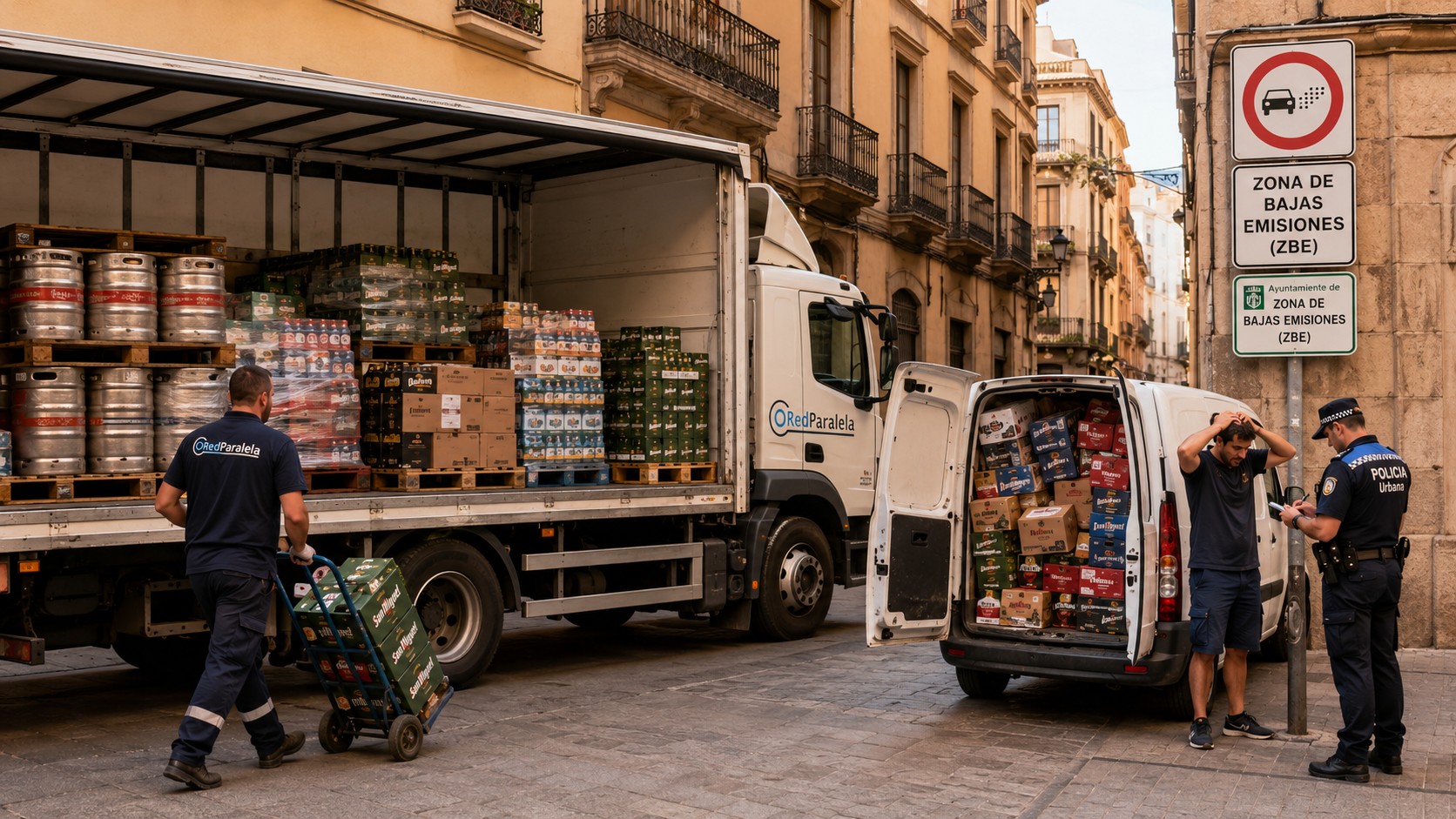
However, the rules of the game have completely changed. With Low Emission Zones (LEZs) fully active, beverage distributors find themselves trapped in a true strategic dead-end. It is what we call “the tricky fleet dilemma”: whichever option you choose to renew your vehicles, it seems you always fall into an economic or operational trap.
How to get out of this labyrinth without harming your business’s profitability? Let’s lay the cards on the table.
The 3 Traps of Modern Urban Delivery
When a distributor considers how to adapt their fleet to continue entering city centers to serve the HORECA channel, they usually evaluate three paths. The problem is that all three come with “fine print”:
🛑 Trap No. 1: “The Van Refuge” (For fear of the truck license)
-
The temptation: Since professional drivers are scarce in the market, the logical temptation is to buy large 3,500 kg vans. After all, anyone with a car driving license (B) can drive them, and you can forget about the tachograph.
-
The real trap: The weight of the goods. An empty van already weighs around 2,300 kg, leaving you with barely 1,200 kg of payload. In our sector, that amounts to little more than a pallet and a half of stock. To deliver the same amount that a single truck carries, you have to put three vans on the street. What you save on the driver’s license, you pay threefold in salaries, insurance, fuel, and, very likely, overweight fines.
🛑 Trap No. 2: “The Pure Electric Mirage” (Green posturing)
-
The temptation: Buying a 100% electric heavy truck with a 0 Label to have full and guaranteed access to any LEZ for the next fifteen years.
-
The real trap: The company’s cash flow. The purchase price of an electric truck today remains astronomical for a distributor SME. Unless you are a large multinational with financial muscle and your own ultra-fast charging infrastructure in your warehouse, this investment can decapitalize your business before you have amortized the first kilometer.
🛑 Trap No. 3: “Diesel Inaction” (Waiting for the storm to pass)
-
The temptation: Do nothing. Maintain current Euro VI diesel trucks (C Label) and rely on the temporary exemptions that city councils grant to commercial freight transport.
-
The real trap: Exemptions have an expiration date. The day time or access restrictions tighten in your city, you will be locked out. If your truck cannot enter to unload at the exact time the hospitality business needs the stock, that client will call another distributor who can. Inaction is a direct commercial risk.
The “Anti-Trap” Solution: The 7,200 to 7,500 kg Truck with ECO Technology
To break this vicious cycle, urban beverage logistics has found its ideal sweet spot in a very specific category: the truck between 7,200 kg and 7,500 kg of Maximum Authorised Mass (MAM) with an ECO powertrain (hybrids or powered by Compressed Natural Gas/CNG).
Why is this the smartest investment from a purely economic standpoint?
-
Real payload capacity: Compared to the one thousand kilos of a van, a 7,200 kg truck (like the Iveco Daily chassis) or a 7,500 kg one (like the Fuso Canter) offers a net payload of between 3,500 and 4,000 kg. It allows you to move between 4 and 5 heavy pallets completely legally in a single trip. Route optimization in its purest form.
-
Maneuverability without penalties: These are compact, narrow, or cab-over trucks designed specifically for city stop-and-go driving. They turn in tight spaces and do not gridlock traffic.
-
The ECO Label shield: Hybrid or gas versions bypass LEZ restrictions without the need for the prohibitive upfront cost of a pure electric vehicle. Their acquisition cost (CAPEX) is perfectly manageable for an SME, and the cost per kilometer (OPEX) in urban cycles is highly competitive.
Professionalizing the Fleet Is Not an Expense, It Is an Investment in the Future
It is true that making the leap to a 7.5-ton truck legally requires your delivery drivers to hold a C1 or C driving license and the CAP (Certificate of Professional Competence), in addition to managing driving times with a tachograph.
But if we look at the numbers coldly, professionalization is the only profitable path. A qualified driver at the wheel of an efficient vehicle with the proper payload capacity performs three times better than three overloaded vans dodging traffic police controls.
In modern beverage distribution, efficiency is no longer measured just by how many crates you can move, but by how much it costs you to get each kilo of product into the city center. The 7,500 kg ECO truck is not a future option; it is the necessary tool to protect your business margins today.