How to Optimize Transport Costs in Wholesale Purchases (Domestic and TIR)
For any wholesaler, the profit margin begins to be decided at the time of purchase. Bringing in stock from suppliers’ factories, whether domestically or through international transit (TIR), involves managing a variable logistics cost that directly impacts the purchase price of the product.
Rate volatility, the lack of vehicle availability during high-demand seasons, and the need to efficiently coordinate both full loads and partial loads require agile tools to ensure procurement transport does not eat into profitability before the goods are even stored. In this scenario, online freight exchanges are the key tool to adjust costs and secure supply.
Cost Optimization in Stock Procurement
Instead of relying on fixed rates or the limited portfolio of traditional agencies, freight exchanges allow mitigating market fluctuations on purchasing routes thanks to two operational pillars:
-
-
-
Securing guaranteed return trips: By publishing a pickup requirement in the supplier’s area, the load is exposed to carriers who have made a delivery near that point and need to return to their base. To avoid running empty, they offer highly competitive rates that drastically lower the wholesaler’s acquisition cost.
-
Efficient consolidation of fractional purchases: When a purchase does not require a full truck, these platforms make it possible to locate carriers en route with available space in their trailers. By sharing the journey with other cargo, you pay exclusively for the space occupied by your pallets, optimizing the unit logistics cost of the acquired stock.
-
-
The Reference Tools for the Open Market
When purchasing transport is managed through agencies in the spot market, the capacity offer is concentrated in three main environments:
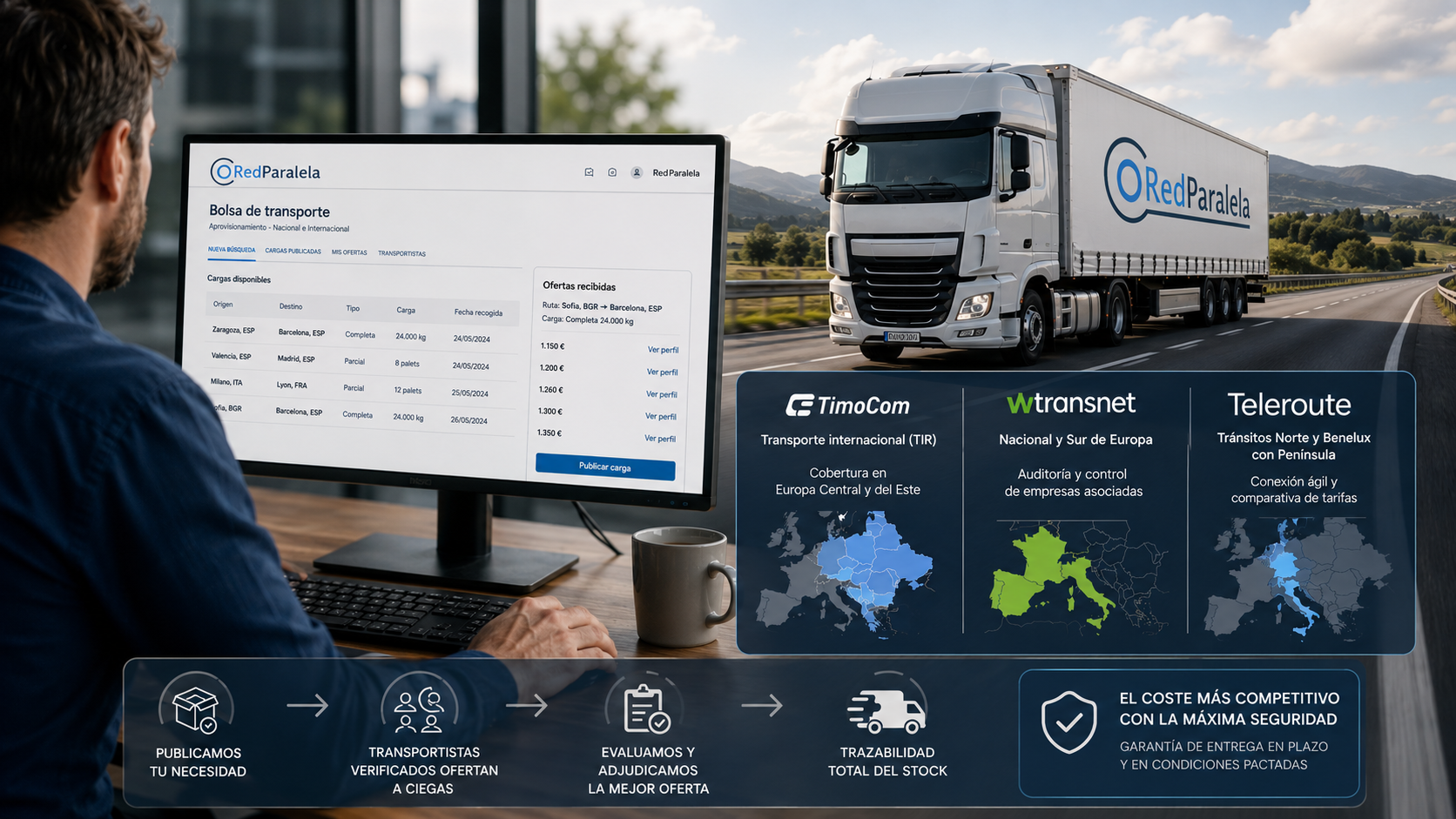
1. TimoCom
It is the indispensable platform for international transport (TIR). Its huge volume of users in Central and Eastern Europe makes it the primary option to secure the transport of imported goods at competitive return rates.
2. Wtransnet
The leading exchange for domestic traffic and Southern Europe (France, Italy, and Portugal). It stands out for the auditing and control of its associated companies, which drastically reduces operational risk when collecting already paid goods from domestic suppliers.
3. Teleroute
Highly consolidated in transits connecting the north of the continent and the Benelux area with the Iberian Peninsula. It is an agile alternative to compare rates and capture carriers looking for return loads to our market.
The Red Paralela Solution
At Red Paralela, thanks to our high volume of operations, we decided years ago to create our own freight exchange.
Our private platform operates under very strict parameters to guarantee maximum security and efficiency in procurement:
-
-
-
Verified carriers: We only operate with professionals approved by us who use their own trucks and are prohibited from subcontracting loads.
-
Blind-bid allocation: Carriers bid blindly for each domestic or international collection service we publish, and we decide which of them to award each load to after evaluating the proposals.
-
-
This model allows us to have total control over stock traceability from the supplier’s warehouse, guaranteeing the most competitive market price on each route and the absolute security that the goods will reach their destination under the agreed conditions.