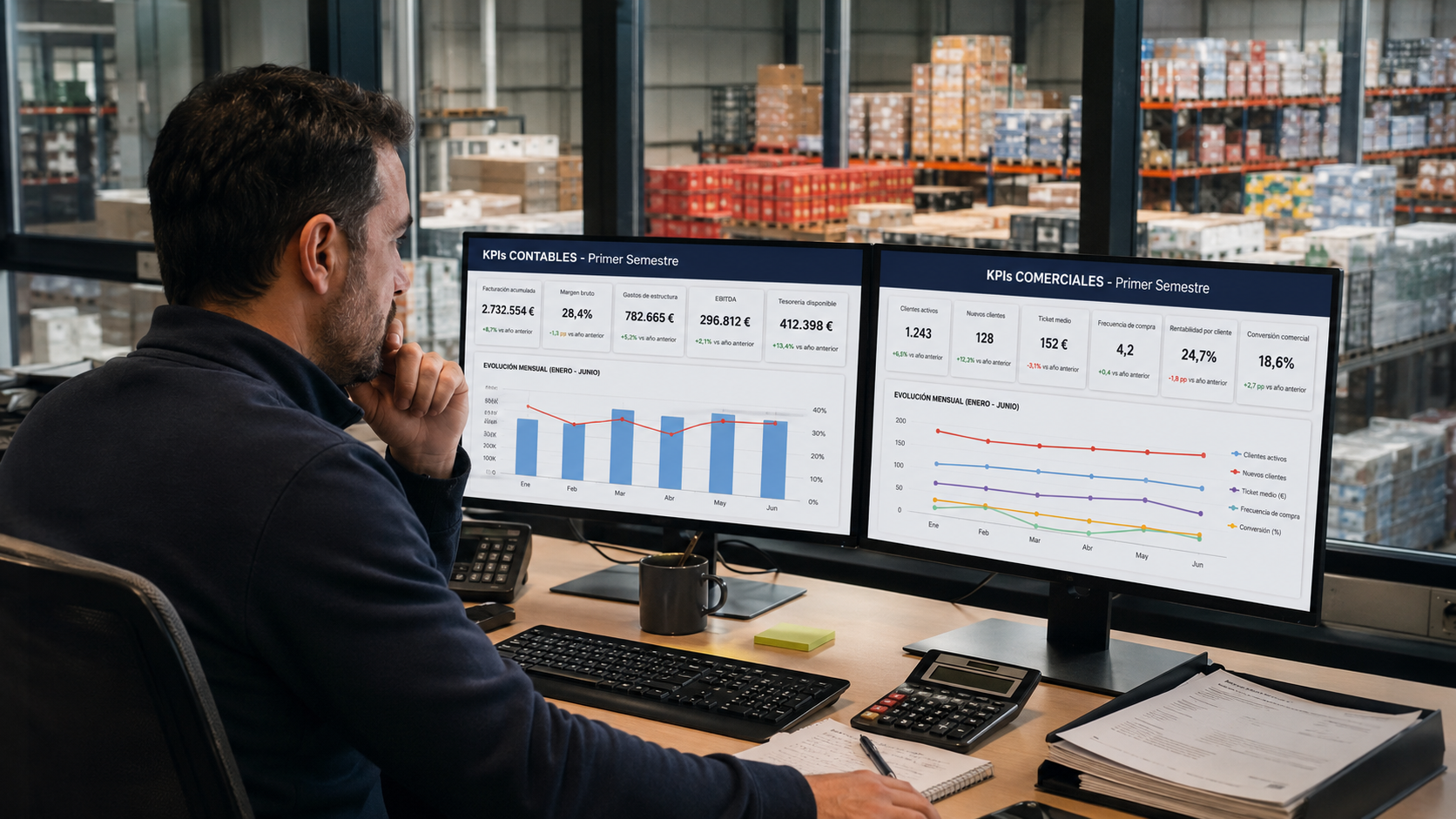
The Essential Financial and Sales KPIs to Review at Mid-Year

Los KPI imprescindibles para medir la rentabilidad de tu empresa al finalizar el primer semestre

Six Months Are Enough to Predict How Your Year Will End (If You Know What to Measure)

Introduction

Many companies wait until December to assess whether the year has been successful. That is a mistake.

By the halfway point of the financial year, there is already enough information to determine whether the business is on track to achieve its objectives or whether significant adjustments are needed. Whether your company concentrates most of its sales in just a few months or generates steady revenue throughout the year, six months provide a sufficiently representative sample to make informed decisions.

The difference between companies that react in time and those that simply wait usually lies in the indicators they monitor.

The Essential Financial KPIs

1. Revenue Growth

Comparing sales with the previous year is not enough. You should also analyse:

      • Cumulative revenue.
      • Real growth after adjusting for inflation or price increases.
      • Progress against the annual budget.

2. Gross Margin

Higher sales do not always mean higher profits.

Gross margin shows whether increased sales are actually generating profit or simply creating more work with lower profitability.

3. Operating Expenses

Comparing fixed costs against the planned budget helps identify deviations before they become a serious problem.

Pay particular attention to:

      • Staff costs.
      • Vehicles.
      • Energy.
      • Rent.
      • Outsourced services.

4. Operating Profit (EBITDA or Operating Income)

This is probably the indicator that best reflects the overall health of the business.

If, after six months, operating profit is well below the annual target, immediate action is required.

5. Cash Flow

Even profitable businesses can experience cash flow problems.

Monitor:

      • Available cash.
      • Outstanding receivables.
      • Upcoming payments.
      • Financing requirements.

The Commercial KPIs That Really Matter

1. Active Customers

How many customers have actually purchased during the past six months?

Many companies discover that they are becoming increasingly dependent on fewer customers.

2. New Customer Acquisition

It is not only about how much you sell.

It also matters how many new customers you acquire each month.

3. Average Order Value

If the number of orders remains stable but the average order value decreases, there is likely a positioning or competitive pricing issue.

4. Purchase Frequency

Especially important in the distribution industry.

Are your customers buying as often as they did a year ago?

5. Customer Profitability

Not all customers contribute the same level of profit.

Looking only at revenue can hide unprofitable customers due to discounts, incidents or logistics costs.

6. Sales Conversion Rate

For companies with a sales team, it is essential to measure:

      • Sales visits completed.
      • Quotations submitted.
      • Closing rate.
      • Average sales cycle.

What If Your Business Is Seasonal?

For seasonal businesses, a mid-year review is even more valuable.

If your peak season has already passed, you can probably estimate your annual results with a high degree of accuracy.

If your busiest period is still ahead, the first half of the year helps determine whether the business is prepared with sufficient liquidity, inventory, staffing and commercial capacity.

The Key Is Not Measuring More, but Measuring Better

One of the most common mistakes is producing dozens of reports that nobody actually uses.

A carefully selected set of well-interpreted indicators allows for much better decisions than a dashboard full of irrelevant data.

Because the purpose of a KPI is not to describe the past, but to help shape the future.

The halfway point of the year is not a pause in the calendar. It is the best time to decide how you want to reach December. If your numbers are on track, you can accelerate. If they are not, you still have six months to correct your course. Waiting until year-end to discover problems is almost always the most expensive decision.

The KPIs every HORECA distributor should track (and how to improve them)

In a business like HORECA distribution, what you don’t measure, you can’t improve. And what you measure poorly can lead to the wrong decisions.

What are KPIs?
KPIs (Key Performance Indicators) are key metrics that help you understand how your business is evolving and allow you to make decisions based on facts — not just intuition.

📊 1. Stock turnover

What it measures: the speed at which you sell your inventory.
Why it matters: the faster your stock moves, the less capital is tied up, and the lower the risk of expiry or deterioration. But be careful: if you discount too aggressively, you might lose more margin than the liquidity you gain.

What matters more? It depends on the product and your financial situation. Holding onto slow-moving stock comes with hidden costs: space, expiry risk, devaluation, and lost opportunities to sell faster-moving items. In most cases, sacrificing some margin is better than letting stock become unsellable.

How to improve it:

  • Set up automated alerts to detect slow-moving items.
  • Anticipate packaging or format changes and cut purchases early to avoid getting stuck with obsolete stock.
  • Run targeted or cross-promotions to clear slow stock before it’s too late.

💶 2. Gross margin per customer

What it measures: the actual profit you make from each customer, after product and service-related costs.
Why it matters: some customers buy a lot but barely leave you any profit.

But be careful: some low-margin customers can bring volume and visibility — especially if they’re key accounts in your area. It’s worth considering their strategic value, not just their numbers. If they help you consolidate routes or attract other clients, they might still be worth it.

How to improve it:

  • Calculate margin per order, not just per product.
  • Factor in discounts, rush orders, returns, and logistics costs.
  • Adjust service conditions or delivery frequency if a customer isn’t profitable — unless their strategic value justifies it.

🚚 3. Logistics cost per delivery and per route

What it measures: the real cost of delivering an order and the overall performance of each delivery route.
Why it matters: an individual delivery may seem profitable, but the entire route could be losing money.

How to improve cost per delivery:

  • Group deliveries by zones and days.
  • Raise the minimum order size for low-margin drops.
  • Use route optimization tools to minimize distance and time.

How to improve cost per route:

  • Treat each route as a unit: total cost, total margin, and order density.
  • Identify consistently unprofitable routes.
  • Increase sales efforts in low-density areas to gain volume.
  • Adjust delivery frequencies or combine routes with insufficient volume.

📞 4. Customer satisfaction (automated and actionable)

What it measures: the customer’s experience right after delivery, focusing on key service moments.
Why it matters: if you don’t catch dissatisfaction early, you risk losing the customer without knowing why.

How to improve it:

  • Send a short survey after each delivery, with just 3 questions:
    1. How do you rate the order handling?
    2. How do you rate the delivery?
    3. Any comments or suggestions?
  • Integrate responses into your CRM for proper follow-up.
  • Act within 24 hours if a customer gives negative feedback.
  • Use positive comments to build loyalty or strengthen relationships.

📆 5. Customer order frequency

What it measures: changes in how regularly a customer places orders within a profitable ticket size.
Why it matters: tracking whether frequency is increasing or decreasing helps you anticipate churn or double down on loyalty-building efforts.

How to improve it:

  • Define a “healthy” frequency range based on customer type and order size.
  • Set alerts for significant changes in buying patterns.
  • Reach out proactively if a customer is ordering less — ideally with a special offer or better terms. If they’re ordering more, reward their loyalty with exclusive perks.

⚠️ BONUS: Don’t track everything

More data doesn’t always mean more insight. What really matters is tracking KPIs that help you make decisions. If a KPI doesn’t lead to action, drop it.

💡 What now?

Ask yourself:

  1. Am I tracking what really matters?
  2. Am I making decisions based on these KPIs?
  3. Is my follow-up automated, or am I relying on Excel and luck?

If you have any questions about what we’ve explained, email us at info@redparalela.eu — we’ll be happy to help.