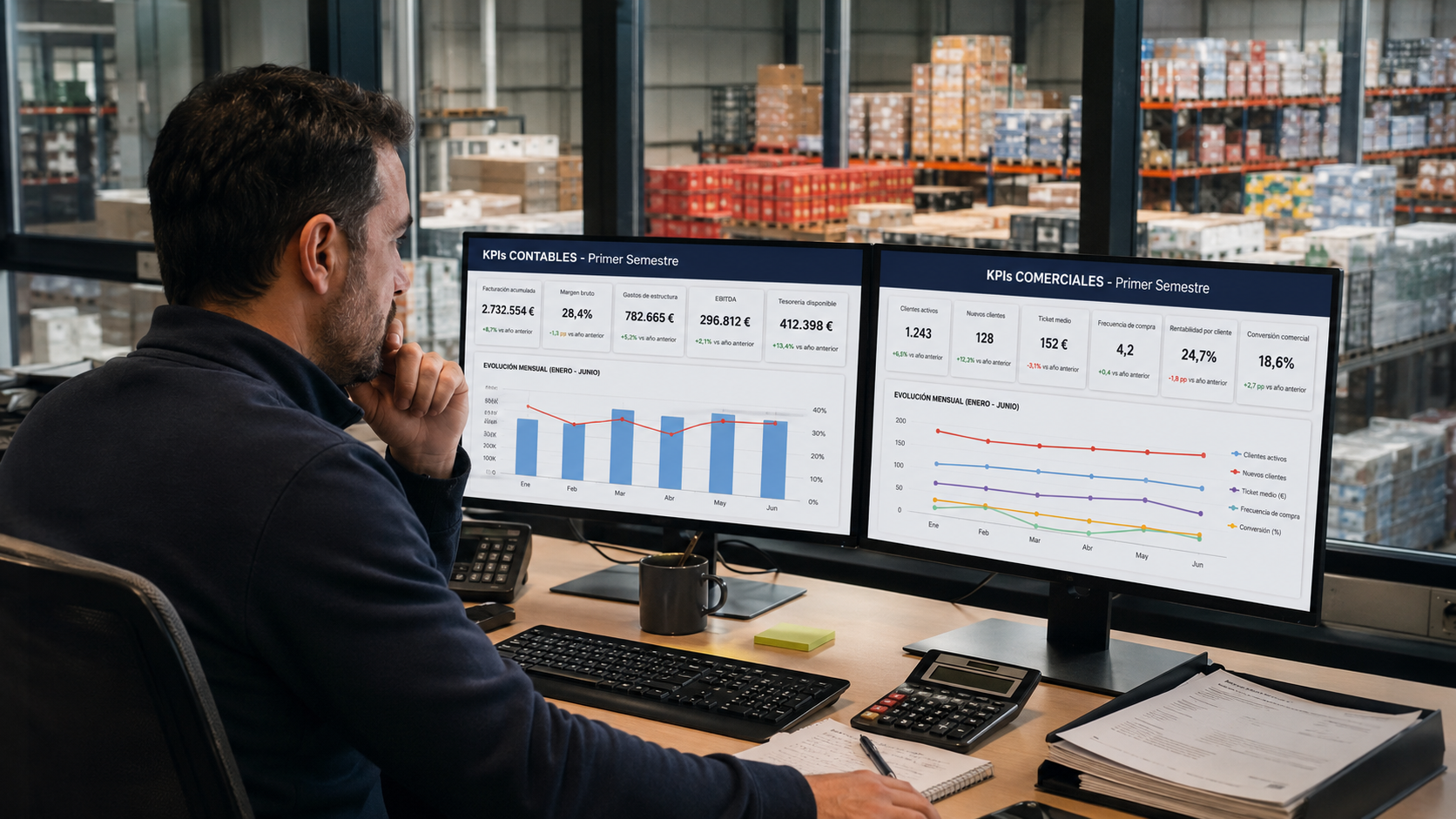
The Essential Financial and Sales KPIs to Review at Mid-Year

Los KPI imprescindibles para medir la rentabilidad de tu empresa al finalizar el primer semestre

Six Months Are Enough to Predict How Your Year Will End (If You Know What to Measure)

Introduction

Many companies wait until December to assess whether the year has been successful. That is a mistake.

By the halfway point of the financial year, there is already enough information to determine whether the business is on track to achieve its objectives or whether significant adjustments are needed. Whether your company concentrates most of its sales in just a few months or generates steady revenue throughout the year, six months provide a sufficiently representative sample to make informed decisions.

The difference between companies that react in time and those that simply wait usually lies in the indicators they monitor.

The Essential Financial KPIs

1. Revenue Growth

Comparing sales with the previous year is not enough. You should also analyse:

      • Cumulative revenue.
      • Real growth after adjusting for inflation or price increases.
      • Progress against the annual budget.

2. Gross Margin

Higher sales do not always mean higher profits.

Gross margin shows whether increased sales are actually generating profit or simply creating more work with lower profitability.

3. Operating Expenses

Comparing fixed costs against the planned budget helps identify deviations before they become a serious problem.

Pay particular attention to:

      • Staff costs.
      • Vehicles.
      • Energy.
      • Rent.
      • Outsourced services.

4. Operating Profit (EBITDA or Operating Income)

This is probably the indicator that best reflects the overall health of the business.

If, after six months, operating profit is well below the annual target, immediate action is required.

5. Cash Flow

Even profitable businesses can experience cash flow problems.

Monitor:

      • Available cash.
      • Outstanding receivables.
      • Upcoming payments.
      • Financing requirements.

The Commercial KPIs That Really Matter

1. Active Customers

How many customers have actually purchased during the past six months?

Many companies discover that they are becoming increasingly dependent on fewer customers.

2. New Customer Acquisition

It is not only about how much you sell.

It also matters how many new customers you acquire each month.

3. Average Order Value

If the number of orders remains stable but the average order value decreases, there is likely a positioning or competitive pricing issue.

4. Purchase Frequency

Especially important in the distribution industry.

Are your customers buying as often as they did a year ago?

5. Customer Profitability

Not all customers contribute the same level of profit.

Looking only at revenue can hide unprofitable customers due to discounts, incidents or logistics costs.

6. Sales Conversion Rate

For companies with a sales team, it is essential to measure:

      • Sales visits completed.
      • Quotations submitted.
      • Closing rate.
      • Average sales cycle.

What If Your Business Is Seasonal?

For seasonal businesses, a mid-year review is even more valuable.

If your peak season has already passed, you can probably estimate your annual results with a high degree of accuracy.

If your busiest period is still ahead, the first half of the year helps determine whether the business is prepared with sufficient liquidity, inventory, staffing and commercial capacity.

The Key Is Not Measuring More, but Measuring Better

One of the most common mistakes is producing dozens of reports that nobody actually uses.

A carefully selected set of well-interpreted indicators allows for much better decisions than a dashboard full of irrelevant data.

Because the purpose of a KPI is not to describe the past, but to help shape the future.

The halfway point of the year is not a pause in the calendar. It is the best time to decide how you want to reach December. If your numbers are on track, you can accelerate. If they are not, you still have six months to correct your course. Waiting until year-end to discover problems is almost always the most expensive decision.


Profitability of delivery routes in HORECA distribution

Camión en una ruta de reparto que pierde dinero

The route that invoices the most can make you lose money (and you don’t even know it)

There’s a question that almost no HORECA wholesaler asks themselves honestly:

Do I really know how much money each of my routes makes or loses?

Most answer quickly: “Yes, of course. That route sells a lot”.
But selling a lot doesn’t mean making money.

And this is where the problem starts.

In many distributors, routes are analysed by turnover. As if volume were a guarantee of profitability. It isn’t. Especially in coastal areas, where seasonality masks reality for several months a year.

The only serious way to measure a route is to calculate its real net margin. Every month.

What is a route’s profitability, really?

It’s not the commercial margin.
It’s not growth.
It’s not the number of customers.

The formula is this:

Real net invoicing
– real cost of goods
– direct route costs
– allocated indirect costs
= real net margin

If this calculation doesn’t exist, the business is making decisions blind.

the first common mistake: using gross invoicing

Profitability is calculated using real net invoicing minus:

– discounts
– rebates
– credit notes
– returns

the second mistake: forgetting what it costs to serve

A route doesn’t only cost fuel.

It costs:

– driver’s salary
– social security contributions
– maintenance
– vehicle lease or depreciation
– insurance
– tolls
– per diems

And it also consumes overhead:

– warehouse
– picking
– traffic / warehouse manager
– administration
– sales organisation
– inventory financing cost
– shrinkage

If these costs aren’t allocated, profitability is accounting fiction.

Seasonality distorts everything

For coastal distributors (very typical in Spain), it’s even more critical.

In summer:

      • invoicing spikes
      • frequency increases
      • urgent orders multiply
      • fuel consumption rises

In winter:

      • density drops
      • many kilometres remain the same
      • average ticket falls
      • cost per order spikes

A route can look excellent in August and be loss-making for six months a year. That’s why it’s not enough to analyse a good month. You have to look at:

      • monthly profitability
      • annual average
      • the difference between high and low season

The indicators that separate those who make money from those who merely survive

If a wholesaler wants to control real profitability, they should start measuring:

      • euros invoiced per kilometre
      • euros invoiced per stop
      • average gross margin per order
      • logistics cost per order
      • number of orders per customer per month

When the average gross margin per order is lower than the logistics cost per order, every delivery destroys value.

And this happens more often than it seems.

The real levers to make a route profitable

It’s not just about selling more. It’s about selling better.

    1. Increase density
      More invoicing per kilometre.
      More customers concentrated.
      Eliminate scattered customers that consume time and overhead.

    2. Increase the average ticket
      Set minimum order values.
      Reduce micro-orders.
      Bundle purchases.

    3. Adjust frequencies
      Many distributors deliver too often.
      Cutting one delivery per week can change the profitability of the entire route.

    4. Segment conditions
      Not all customers can have the same frequency or the same terms.

    5. Adapt structure to seasonality
      On the coast, you can’t have the same structure in January as you do in August.

Final reflection

In today’s HORECA environment, the wholesaler who invoices the most doesn’t win.
The winner is the one who knows exactly which routes generate net margin and which ones destroy it.

Because an unprofitable route isn’t fixed by selling more.
It’s fixed by measuring better and making uncomfortable decisions.

And that’s where the difference begins between surviving and building a solid business.

Calculating the commercial margin: how to successfully close the year after a weak summer

In HORECA distribution, summer is usually the decisive period. Hospitality consumption soars, and margins grow, partly because customers prioritize service over price. But what happens when the summer has been weaker than expected? The immediate question is: will the accumulated margin be enough to close the year positively?

How to Calculate the Commercial Margin Correctly

The gross margin (selling price minus purchase price) is insufficient for a distributor. The correct approach is to work with the net margin on sales, also deducting logistics, rebates, discounts, and operating costs. Only then do we obtain the real picture of what each euro sold actually contributes.

Seasonality as a Risk

Seasonality acts like a “cushion.” The gains made during the strong months — primarily summer in HORECA — should cover the drop in sales during autumn and winter. When summer has been weak, that cushion shrinks or disappears, forcing a cold analysis of the accumulated numbers up to September.

How to Know if We Will Close the Year Positively

The practical way is to compare the accumulated margin to date with the remaining annual fixed costs. If what has been achieved up to September, plus the forecast for the lower-consumption months, covers costs and leaves a profit, the year will be saved. If not, corrective action must be taken immediately.

Corrective Strategies (Short Term)

When summer does not leave enough extra margin, immediate measures should focus on:

  • Adjusting purchases and stock to free up cash and avoid immobilized capital.
  • Reviewing rebates and supplier conditions, negotiating better payment terms or early purchase discounts.
  • Optimizing logistics routes to reduce empty kilometers and improve efficiency.
  • Tightening credit control and reinforcing collection management.
  • Increasing commercial activity: more frequent client visits, upselling, and capturing new points of sale.

Seasonal Diversification (Medium and Long Term)

Beyond immediate reactions, the best way to soften the effects of seasonality is to diversify:

  • Incorporate channels less dependent on summer tourism: vending, catering, offices, gyms.
  • Introduce product categories with stable year-round demand: coffee, tea, dry products, bottled water.
  • Develop agreements with clients who maintain strong activity outside the summer season (hospitals, schools, catering companies).

The Role of Analytical Accounting

Looking only at the global margin is not enough. Analytical accounting by departments (purchasing, sales, logistics, promotions, administration) allows precise detection of where deviations occur:

  • Purchasing: Have volume rebates been lost? Was stock purchased too expensively compared to the market?
  • Sales: Were there excessive discounts or promotions that cut into margin?
  • Logistics: Have costs increased due to poorly optimized routes or returns?
  • Administration: Are fixed costs growing faster than revenue?

With this analytical view, distributors can make corrective decisions month by month instead of discovering the problem at year-end. Even after a weak summer, there is still time to adjust course and ensure the year ends positively.

Conclusion

The commercial margin is not measured in a month or a quarter. It is measured over the full year. When summer falls short of expectations, distributors must react quickly, review accumulated results, apply immediate corrective actions, and work on medium-term diversification. Only then can the final picture of the year be positive, beyond the ups and downs of seasonality.