
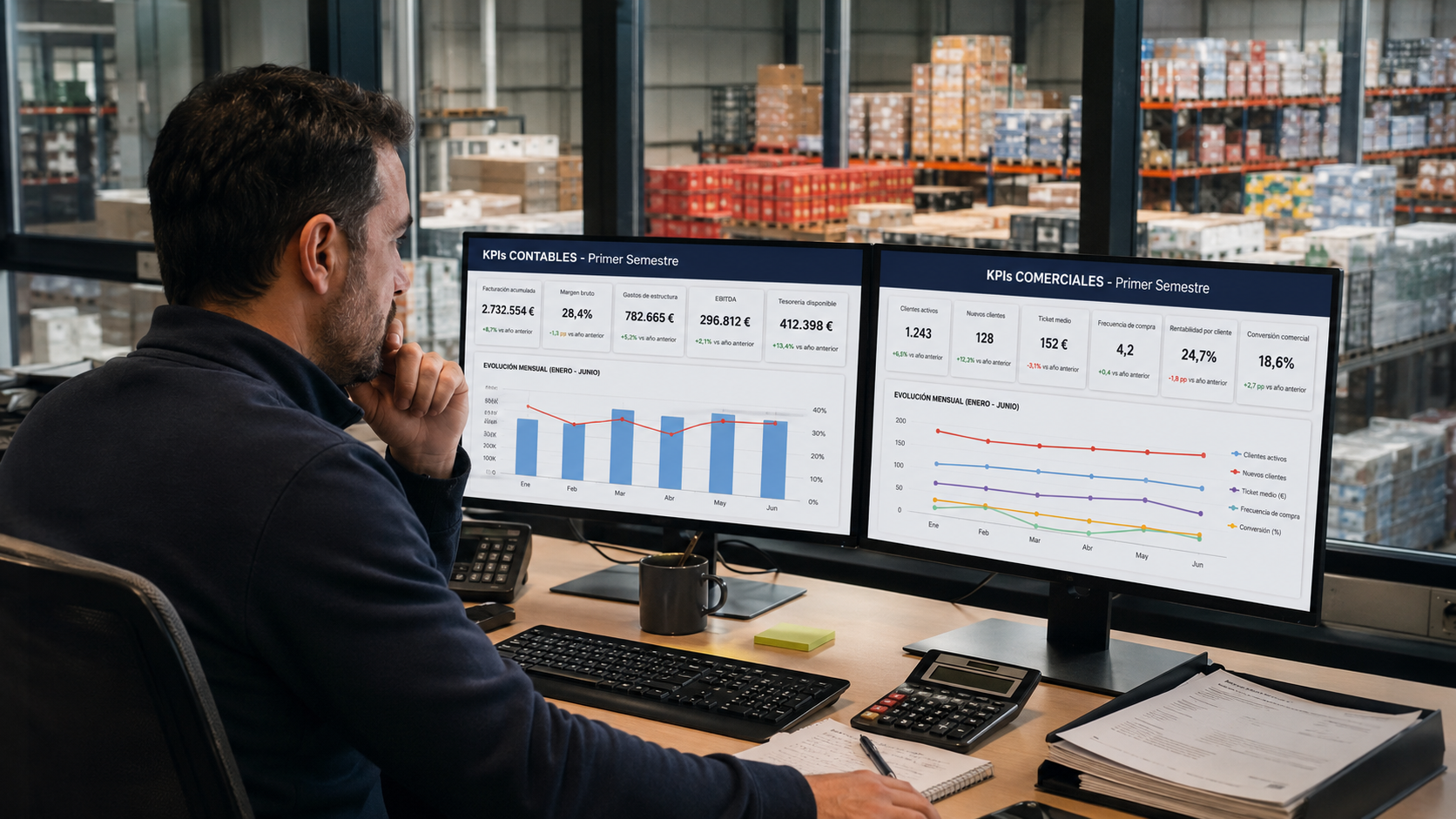
Six Months Are Enough to Predict How Your Year Will End (If You Know What to Measure)
Introduction
Many companies wait until December to assess whether the year has been successful. That is a mistake.
By the halfway point of the financial year, there is already enough information to determine whether the business is on track to achieve its objectives or whether significant adjustments are needed. Whether your company concentrates most of its sales in just a few months or generates steady revenue throughout the year, six months provide a sufficiently representative sample to make informed decisions.
The difference between companies that react in time and those that simply wait usually lies in the indicators they monitor.
The Essential Financial KPIs
1. Revenue Growth
Comparing sales with the previous year is not enough. You should also analyse:
-
-
- Cumulative revenue.
- Real growth after adjusting for inflation or price increases.
- Progress against the annual budget.
-
2. Gross Margin
Higher sales do not always mean higher profits.
Gross margin shows whether increased sales are actually generating profit or simply creating more work with lower profitability.
3. Operating Expenses
Comparing fixed costs against the planned budget helps identify deviations before they become a serious problem.
Pay particular attention to:
-
-
- Staff costs.
- Vehicles.
- Energy.
- Rent.
- Outsourced services.
-
4. Operating Profit (EBITDA or Operating Income)
This is probably the indicator that best reflects the overall health of the business.
If, after six months, operating profit is well below the annual target, immediate action is required.
5. Cash Flow
Even profitable businesses can experience cash flow problems.
Monitor:
-
-
- Available cash.
- Outstanding receivables.
- Upcoming payments.
- Financing requirements.
-
The Commercial KPIs That Really Matter
1. Active Customers
How many customers have actually purchased during the past six months?
Many companies discover that they are becoming increasingly dependent on fewer customers.
2. New Customer Acquisition
It is not only about how much you sell.
It also matters how many new customers you acquire each month.
3. Average Order Value
If the number of orders remains stable but the average order value decreases, there is likely a positioning or competitive pricing issue.
4. Purchase Frequency
Especially important in the distribution industry.
Are your customers buying as often as they did a year ago?
5. Customer Profitability
Not all customers contribute the same level of profit.
Looking only at revenue can hide unprofitable customers due to discounts, incidents or logistics costs.
6. Sales Conversion Rate
For companies with a sales team, it is essential to measure:
-
-
- Sales visits completed.
- Quotations submitted.
- Closing rate.
- Average sales cycle.
-
What If Your Business Is Seasonal?
For seasonal businesses, a mid-year review is even more valuable.
If your peak season has already passed, you can probably estimate your annual results with a high degree of accuracy.
If your busiest period is still ahead, the first half of the year helps determine whether the business is prepared with sufficient liquidity, inventory, staffing and commercial capacity.
The Key Is Not Measuring More, but Measuring Better
One of the most common mistakes is producing dozens of reports that nobody actually uses.
A carefully selected set of well-interpreted indicators allows for much better decisions than a dashboard full of irrelevant data.
Because the purpose of a KPI is not to describe the past, but to help shape the future.
The halfway point of the year is not a pause in the calendar. It is the best time to decide how you want to reach December. If your numbers are on track, you can accelerate. If they are not, you still have six months to correct your course. Waiting until year-end to discover problems is almost always the most expensive decision.