The Dangers of Imported Coca-Cola: What You Need to Know

Inspección sanitaria Coca-cola

The “bargain” that stayed at the port: Why words can save (or sink) your business

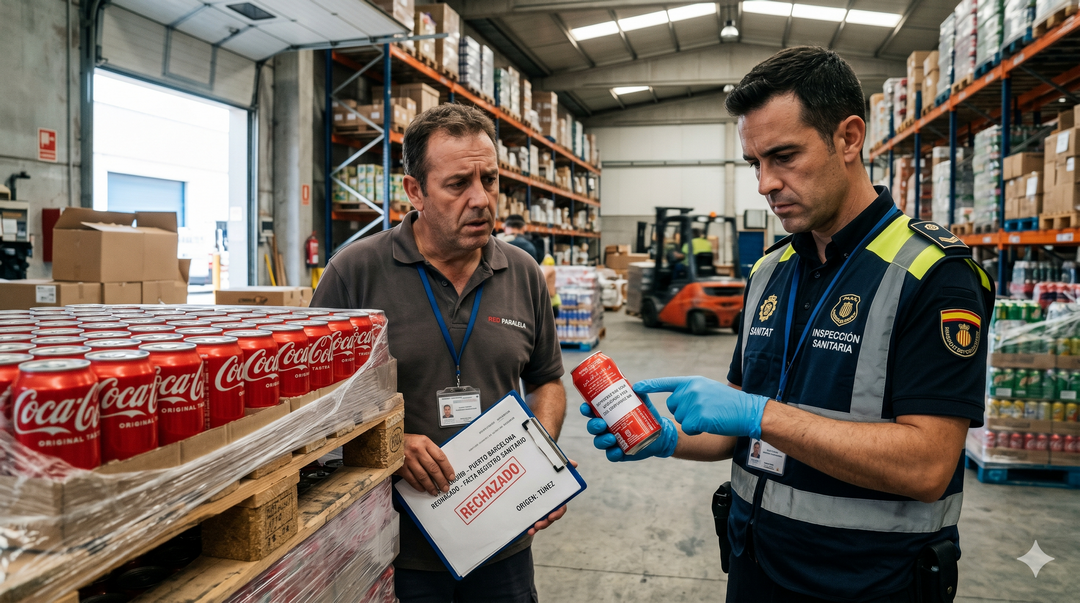
Imagine the scene: a distributor receives an offer that seems unbeatable. Trucks of Coca-Cola at a price that pulverizes the competition. The word “Import” is written on the invoice. The order is confirmed, paid for, and… suddenly, the merchandise is blocked at the Port of Barcelona. Or even worse: you receive an inspection visit at your warehouse and they ask for the importer’s health registry on the labeling.

What seemed like the deal of the year turns into a nightmare of lawyers, fines, and sealed pallets. At Red Paralela, we know this story well, because we have spent decades defending the difference between doing things right and playing with fire.

The myth of “foreign” Coca-Cola

Many speak of imported Coca-Cola as if it were an exotic product brought from far-off lands. But here is the first legal reality: If it comes from the European Union, it is not an import. It is, quite simply, the exercise of your right to buy within a single market.

Bringing products from France, Poland, or Germany is legal, safe, and transparent. At Red Paralela, we do not “import”; we operate within the intra-community space. The difference? The full weight of European law supports every move we make.

When cheap comes very, very expensive

True “importing” is that which comes from outside the EU (like that famous batch of Tunisian cans that ended up paralyzed at Barcelona customs). This is where the story takes a turn on two fronts:

  1. Blocking due to industrial property: Coca-Cola has ironclad contracts with its manufacturers outside Europe. If you try to bring product from Egypt or Tunisia into the EU without authorization, the brand has the legal right to stop you in your tracks. The product may be “original,” but its commercialization here is illegal, and the stock will end up destroyed or blocked.

  2. The health risk: The law requires the label to show the name and health registry number of the importer. Without this, in the event of any inspection or public health issue, you are the one legally responsible. Buying outside the EU without these guarantees is, literally, putting your company at risk.

A victory with a name and surname: Red Paralela

We are not speaking from hearsay. At Red Paralela, we have led the battle so that you can enjoy the benefits of the common market without fear.

After 10 years of litigation and enormous legal costs, we achieved a definitive judicial victory in the Supreme Court (September 2023). It wasn’t someone else’s victory; it was our own fight that set a legal precedent. The justice system agreed with us: once the brand puts the product on sale in Europe, it cannot prevent it from circulating freely.

We have invested a decade of resources to shield your right to free competition.

The moral of this story is clear:

Do not gamble with “bargains” that cross dangerous borders outside the EU. At Red Paralela, we offer you the efficiency of the European market with the peace of mind that every can complies with the law and is backed by a legal struggle that we already won for you.

Because a good operation is not the one that saves you a few cents today, but the one that allows you to sleep peacefully tomorrow.

CIPS vs. SWIFT: the new financial showdown that could redraw international trade

China is quietly advancing with a powerful alternative: the CIPS system

While much of global trade still revolves around the U.S. dollar and the SWIFT system, China is quietly advancing with a powerful alternative: the CIPS system. With near-instant transfer times, minimal fees, and a network that now connects almost 5,000 banks in 186 countries, CIPS is no longer a promise—it’s becoming a strategic reality.

And this isn’t about some distant future. In recent months, key countries have joined, a new version has been launched with digital yuan integration, and the signals are clear: if China decides to require its use for exports, many companies and governments will have to adapt—or be left out.

This article doesn’t aim to cause alarm, but to offer a clear view of what is unfolding. It’s not something that directly affects Red Paralela or most HORECA distributors, except for those who import from or export to Asia. But it is a shift that could redefine the ecosystem in which we all operate.

📊 Clear comparison: CIPS vs. SWIFT

Feature CIPS (China) SWIFT (Western consortium)
Year of creation 2015 1973
Main currency Chinese yuan (RMB) U.S. dollar (USD) and others
Transfer speed Near-instant (seconds to minutes) 1 to 3 business days
Costs Low or symbolic High, especially with intermediaries
Connected banks ≈ 4,900 in 186 countries ≈ 11,000 in over 200 countries
Messaging system ISO 20022 (from the start) ISO 20022 (transition in progress)
Intermediaries Few or none Several intermediaries
Geopolitical control People’s Bank of China West (U.S. and allies)
Digital currency integration Yes (digital yuan already tested) No (still under development)
Strategic goal Internationalize the yuan Maintain dollar dominance

🔮 What could happen if CIPS keeps gaining ground?

1. Changes in the way trade works
More international contracts in yuan, more pressure to work with Chinese or Asian banks.
👉 Especially relevant for companies importing from China.

2. Adjustment of international reserves
Central banks will start to diversify: fewer dollars, more yuan.
👉 This could affect the dollar’s value and stability.

3. Pressure on banks and payment platforms
Financial entities that don’t operate with CIPS could be excluded from some operations.
👉 Opportunity for fintechs, risk for slower traditional banks.

4. New economic alliances
CIPS opens the door to trade routes outside the dollar-SWIFT circuit.
👉 Sanctioned countries and China’s partners can boost their independence.

5. Possible Western countermeasures
The U.S. and EU could impose barriers on the use of CIPS or fast-track their own systems.
👉 A financial “cold war” may begin, with global implications.

⚠️ What does this mean for you as a distributor?

At this point, if you don’t work directly with China, there’s no immediate concern. This article is not an operational alert—it’s a global perspective on how the game board is shifting.

But it’s worth keeping on your radar. Because if the dollar loses dominance or trade routes change, the rules of the game may shift for you as well—even indirectly.

🧭 Conclusion

CIPS is not just a payment system. It’s a strategic move to redesign how money flows across the world.
And if it keeps expanding at this pace, we could soon see a fragmented global financial landscape, with two parallel circuits: the dollar-SWIFT system and the yuan-CIPS system.

At Red Paralela, we’ll keep a close eye on these developments. Because even if we don’t export to China, the global economy is a chessboard we all play on… whether we realize it or not.