

- Shipped
- Reading
- 3 min
Solutions for rising fuel costs
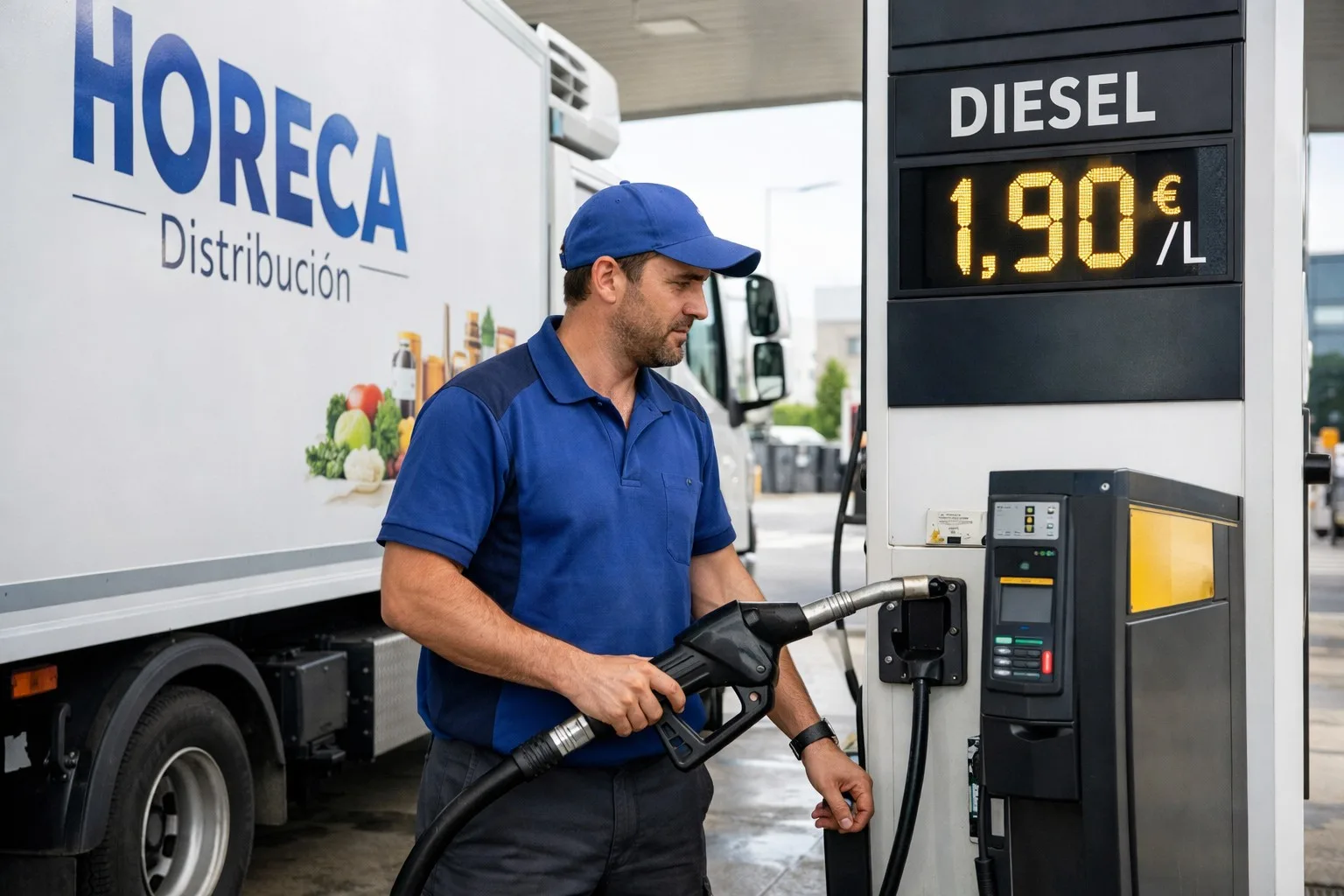
It is six in the morning. Your delivery driver starts the vehicle and the first thing he does is check the fuel gauge. Yesterday he filled up at 1,90 €/l (Source: Precios Medios Carburantes (Spanish average fuel prices), April 2026). That gesture, which used to be pure routine, is now the start of a countdown: every kilometre that vehicle travels through the city centre costs 20.4% more than it did just a year ago (Source: Índice de Variación de Costes del MITMA (cost variation index of Spain's Ministry of Transport)).
The problem is that while costs are taking the lift up, the profitability of HORECA distribution seems to be stuck in the basement. If you don't want your fleet's fuel tanks to swallow the whole year's profit, these are the cards you have on the table:
1. Getting out of the maze of urban inefficiencies
Urban delivery has always been complicated, but the new restrictions and Low Emission Zones have changed the rules. Your vehicles can no longer easily enter certain streets, they have to take detours and they lose an average of 20 minutes looking for a loading bay that is almost never free.
According to the DUM-H 2025 study by Fedis Horeca (the Spanish HORECA distributors' federation), commercial speed in urban centres has fallen by 15%. This means your driver makes fewer stops per hour, while the engine burns far more fuel stuck in traffic or idling. The first option is clear: replan routes not by proximity, but by energy-efficiency windows.
2. The Ley 15/2009 "taboo": your legal shield
Many distributors fear that passing on increases will drive away bar and restaurant owners, but the law is your best ally. Article 38 of Ley 15/2009 (Spain's Land Transport Contracts Act) requires the price of transport to be revised when diesel rises by more than 5%. It is not a suggestion; it is a legal right.
The distributors who will make it to 2027 are those who have stopped being afraid and have started itemising an energy surcharge transparently on every delivery note. They have understood that transport can no longer be a "gift" included in the price of the case.
3. The JBP: bringing the manufacturer to the table
If you have a partnership agreement with a major brand, you have a JBP (Joint Business Plan). Basically, it is the joint business plan in which you agree how to grow together. Traditionally, this agreement was used to set how many cases you were going to sell, but in 2026 the JBP has to be a pact for logistics survival.
You cannot keep providing the same level of service if the manufacturer does not share responsibility. The real options here are:
- Demand minimum orders: If a delivery is not profitable because of fuel costs, the order should not leave the warehouse.
- Compensation for capillarity: The manufacturer should provide financial support for delivery in critical areas or accept fewer visit days so that goods can be grouped together.
What is the sector actually doing?
The market has already split into three very distinct groups (Source: Barómetro de Distribución Horeca (HORECA Distribution Barometer) Q1-2026):
- The "Resilient" (60%): They are absorbing the blow by cutting back on trade offers. They have stopped running aggressive promotions in the hope that the extra margin will plug the diesel gap. It is a temporary measure that does not solve the underlying problem.
- The "Strategic" (25%): They have introduced service charges by zone. If the customer is in an old town centre or a highly restricted area, they pay a supplement for the logistical difficulty of the delivery.
- The "Efficient" (15%): They have connected their ERP to smart routing systems, cutting the kilometres travelled by 12%. They know exactly how much each stop costs them and, if a customer is loss-making because of their location, they renegotiate the terms immediately.
Conclusion
Diesel at €1.90/l has come to remind us that the "courtesy delivery" model is dead. Survival does not depend on selling more cases, but on delivering each one of them intelligently.